




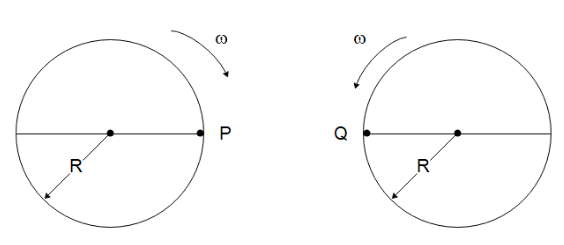
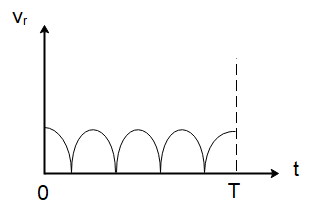
Two identical discs of the same radius $ R $ are rotating about their axes in opposite directions with the same constant angular speed $ \omega $ . The discs are in the same horizontal plane. At the time $ t = 0 $ , the points P and Q are facing each other as shown in the figure. The relative speed between the two points P and Q is $ {v_r} $ . In one time period $ \left( T \right) $ of rotation of the discs, $ {v_r} $ as a function of time is best represented by
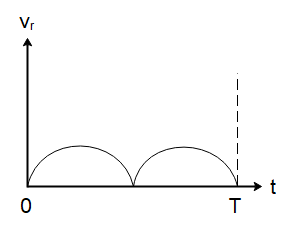
(A)
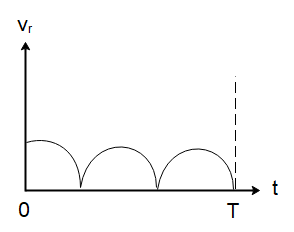
(B)
(C)
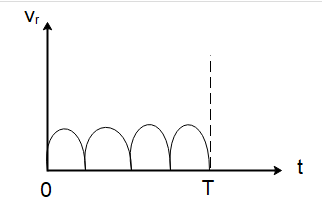
(D)
Answer
 Verified
626.4k+ views
Hint : In this solution, we will determine the relative positions of points P and Q and write the relative velocity in terms of a periodic function. We will then determine the relative time period of the relative velocity.
Complete step by step answer
In a point on a circle, its velocity will always be tangential to the circle in the direction in which it is rotating. In the scenario given to us, the two circles are rotating in opposite directions.
Since both the circles have opposite circular velocity, the relative velocity of points P and Q will be
$ {\omega _r} = 2\omega r $
Then the relative angle between the velocity vector of the two points will
$ \theta = {\omega _r}t $
Hence the relative velocity will be the resultant velocity vector as
$ \left| {{v_r}} \right| = \sqrt {{v^2} + {v^2} - 2vv\cos (2{\omega _r}t)} $
$ \Rightarrow \left| {{v_r}} \right| = \sqrt {2{v^2} \times (1 - 2\cos (2{\omega _r}t))} $
Which gives us
$ \left| {{v_r}} \right| = 2v\sin \omega r $
Hence the magnitude of the relative velocity will also have a time period of $ \omega $ . Now since the magnitude of the relative velocity will always be positive, the negative values will be converted to positive values and in one time period, the relative velocity will peak twice.
So, the correct choice will be the option (A).
Note
In such questions, we must be aware of the basic concepts of angular velocity and how periodic objects change relative positions with time. The important distinction in the options is that the relative velocity can only peak twice in one time period of rotation which is the case with option (A) only because other options attain a maximum peak value at more than 2 points in a time period.
Complete step by step answer
In a point on a circle, its velocity will always be tangential to the circle in the direction in which it is rotating. In the scenario given to us, the two circles are rotating in opposite directions.
Since both the circles have opposite circular velocity, the relative velocity of points P and Q will be
$ {\omega _r} = 2\omega r $
Then the relative angle between the velocity vector of the two points will
$ \theta = {\omega _r}t $
Hence the relative velocity will be the resultant velocity vector as
$ \left| {{v_r}} \right| = \sqrt {{v^2} + {v^2} - 2vv\cos (2{\omega _r}t)} $
$ \Rightarrow \left| {{v_r}} \right| = \sqrt {2{v^2} \times (1 - 2\cos (2{\omega _r}t))} $
Which gives us
$ \left| {{v_r}} \right| = 2v\sin \omega r $
Hence the magnitude of the relative velocity will also have a time period of $ \omega $ . Now since the magnitude of the relative velocity will always be positive, the negative values will be converted to positive values and in one time period, the relative velocity will peak twice.
So, the correct choice will be the option (A).
Note
In such questions, we must be aware of the basic concepts of angular velocity and how periodic objects change relative positions with time. The important distinction in the options is that the relative velocity can only peak twice in one time period of rotation which is the case with option (A) only because other options attain a maximum peak value at more than 2 points in a time period.
Recently Updated Pages
Which will be the least stable resonating structure class 11 chemistry CBSE

How many 5 digit telephone numbers can be construc-class-11-maths-CBSE
How do you find the angle of the resultant vector class 11 physics CBSE
Draw labelled diagram of the following i Gram seed class 11 biology CBSE
1 Quintal is equal to a 110 kg b 10 kg c 100kg d 1000 class 11 physics CBSE
What is the need and importance of classification class 11 biology CBSE
Trending doubts
One Metric ton is equal to kg A 10000 B 1000 C 100 class 11 physics CBSE
Find the value of the expression given below sin 30circ class 11 maths CBSE
Draw a diagram of nephron and explain its structur class 11 biology CBSE
10 examples of friction in our daily life
Proton was discovered by A Thomson B Rutherford C Chadwick class 11 chemistry CBSE
The teeth used for biting and cutting food are called class 11 biology CBSE