




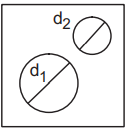
Two holes of unequal diameters ${d_1}$ and ${d_2}$ $({d_1} > {d_2})$ are cut in a metal sheet. If the sheet is heated:
(A) Both ${d_1}$ and ${d_2}$will decrease
(B) Both ${d_1}$ and ${d_2}$will increase
(C) ${d_1}$ will increase, ${d_2}$ will decrease
(D) ${d_1}$ will decrease, ${d_2}$ will increase
Answer
 Verified
492.6k+ views
Hint: This question is based on the concept of thermal expansion. Thermal expansion is defined as the expansion or contraction of the dimensions of any solid, liquid or gas when their temperature is changed to a higher value or to a lower value.
Complete answer:
There are three basic types of thermal expansion depending on the dimension of the body that undergoes change. These are:
(A) Linear expansion: Linear expansion is defined as the expansion which takes place in the length of the substance which is subjected to an increase in temperature.
(B) Areal expansion: Areal expansion is defined as the expansion of the surface area of the substance which is subjected to an increase in temperature.
(C) Volume expansion: Volumetric expansion is defined as the expansion in the volume of the substance which is subjected to an increase in temperature.
Now, since in this question the expansion takes place in an area, this question involves aerial expansion.
When the sheet is heated, then both the holes ${d_1}$ and ${d_2}$, increase in size because thermal expansion of an isotropic solid is very similar to a true photographic enlargement.
Thus, the correct answer is (B) Both ${d_1}$ and ${d_2}$ will increase.
Note: It is important to note that the coefficients of linear, areal and volume expansion are all related to each other. The relationship between them is $\gamma = 2\beta = 3\alpha $. If in a question, the coefficient of linear expansion is given and we are asked to calculate the change in volume, then we can use this relation.
Complete answer:
There are three basic types of thermal expansion depending on the dimension of the body that undergoes change. These are:
(A) Linear expansion: Linear expansion is defined as the expansion which takes place in the length of the substance which is subjected to an increase in temperature.
(B) Areal expansion: Areal expansion is defined as the expansion of the surface area of the substance which is subjected to an increase in temperature.
(C) Volume expansion: Volumetric expansion is defined as the expansion in the volume of the substance which is subjected to an increase in temperature.
Now, since in this question the expansion takes place in an area, this question involves aerial expansion.
When the sheet is heated, then both the holes ${d_1}$ and ${d_2}$, increase in size because thermal expansion of an isotropic solid is very similar to a true photographic enlargement.
Thus, the correct answer is (B) Both ${d_1}$ and ${d_2}$ will increase.
Note: It is important to note that the coefficients of linear, areal and volume expansion are all related to each other. The relationship between them is $\gamma = 2\beta = 3\alpha $. If in a question, the coefficient of linear expansion is given and we are asked to calculate the change in volume, then we can use this relation.
Recently Updated Pages
Master Class 11 Computer Science: Engaging Questions & Answers for Success

Master Class 11 Business Studies: Engaging Questions & Answers for Success
Master Class 11 Economics: Engaging Questions & Answers for Success
Master Class 11 English: Engaging Questions & Answers for Success
Master Class 11 Maths: Engaging Questions & Answers for Success
Master Class 11 Biology: Engaging Questions & Answers for Success
Trending doubts
One Metric ton is equal to kg A 10000 B 1000 C 100 class 11 physics CBSE
There are 720 permutations of the digits 1 2 3 4 5 class 11 maths CBSE
Discuss the various forms of bacteria class 11 biology CBSE
Draw a diagram of a plant cell and label at least eight class 11 biology CBSE
State the laws of reflection of light
Explain zero factorial class 11 maths CBSE