




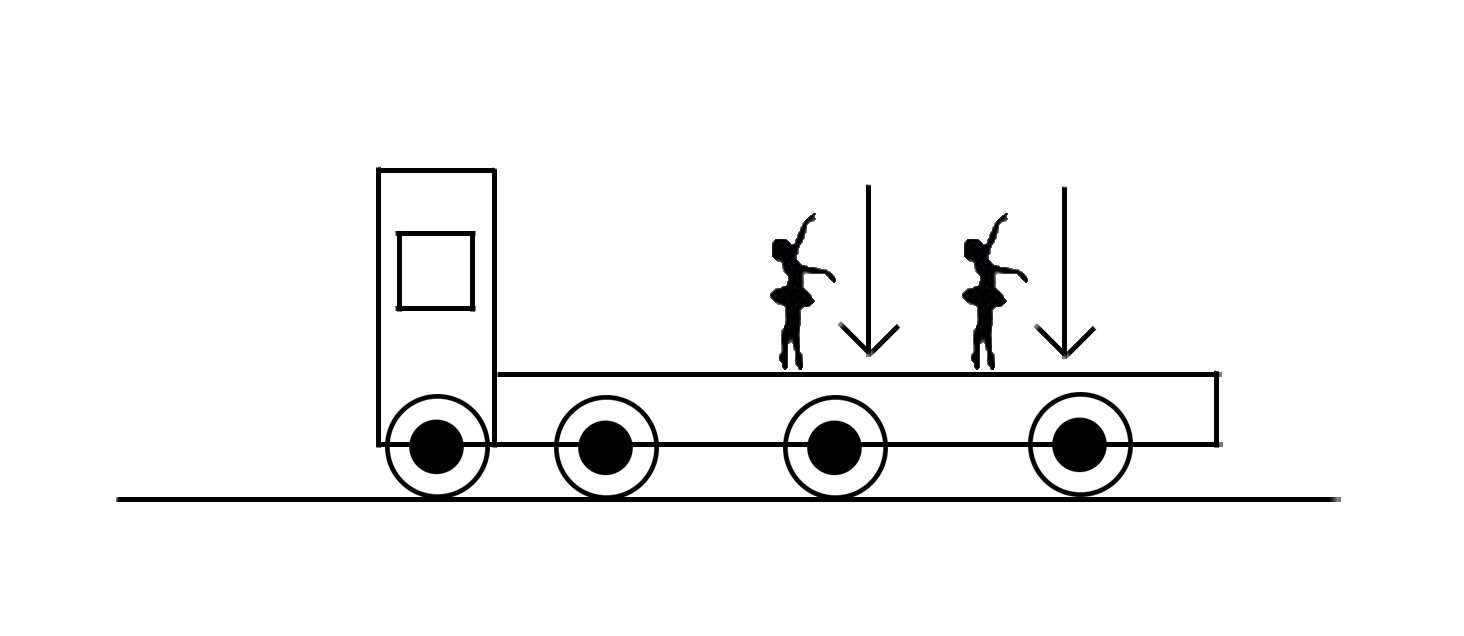
Two girls of equal mass $m$jump off the border line of a stationary carriage of mass $M$with the same horizontal velocity $u$relative to the carriage. Neglecting the effect of friction:
(A). They will impact greater velocity to the carriage by jumping off simultaneously.
(B). They will impact greater velocity to the carriage by jumping one after the other.
(C). They will impact greater velocity to the carriage in whatever manner they jump off.
(D). Insufficient data to reply.
Answer
 Verified
584.7k+ views
Hint: You can start by considering the case where the girls jump off simultaneously and use the concept of conservation of momentum i.e. $0 = mu + mu - Mv$to find the velocity of the carriage. Then use a similar method to calculate the velocity of carriage when girls jump off one after another. Then compare the velocities of the carriage in both the situations to reach the solution.
Complete step-by-step answer:
In the problem we are given a system with two girls of mass $m$ and a carriage of mass$M$. Now we have to figure out if the velocity of the carriage will be more when the two girls jump together or when they jump one after the other.
Case 1 – The girls jump off simultaneously.
Let the velocity of the carriage after the girls jump off be$v$.
By using the concept of conservation of momentum, we get
$0 = mu + mu - Mv$
$Mv = 2mu$
$v = \dfrac{{2mu}}{M}$(Equation 1)
Case 2 – The girl jumps off one after the other
Let the velocity of the carriage when one girl jumps off be ${v_1}$
By using the concept of conservation of momentum, we get
$0 = mu - (M + m){v_1}$
$mu = (M + m){v_1}$
${v_1} = \dfrac{{mu}}{{M + m}}$
Let the velocity of the carriage when the second girls jumps off be ${v_2}$
By using the concept of conservation of momentum, we get
$0 = mu - M{v_2}$
$mu = M{v_2}$
${v_2} = \dfrac{{mu}}{M}$
Let the net velocity of the carriage be${v_3}$.
So, ${v_3} = {v_1} + {v_2}$
${v_3} = \dfrac{{mu}}{{M + m}} + \dfrac{{mu}}{M}$
${v_3} = mu\left( {\dfrac{{M + M + m}}{{M(M + m)}}} \right)$
${v_3} = \dfrac{{mu}}{M}\left( {\dfrac{{2M + m}}{{M + m}}} \right)$
${v_3} = \dfrac{{2mu}}{M}\left( {\dfrac{{M + \dfrac{m}{2}}}{{M + m}}} \right)$
${v_3} = v\left( {\dfrac{{M + \dfrac{m}{2}}}{{M + m}}} \right)$(From equation 1)
$\because \left( {M + \dfrac{m}{2}} \right) < \left( {M + m} \right)$
$\therefore {v_3} > v$
Thus, they will impact greater velocity to the carriage by jumping one after the other.
Hence, option B is correct .
Note: In the solution, we used the concept of the conservation of momentum. The law of conservation of momentum states that for a system the momentum is always conserved when no external force is applied. It means for a system of two bodies if one body gets momentum then the other body will get an equal momentum but in the opposite direction.
Complete step-by-step answer:
In the problem we are given a system with two girls of mass $m$ and a carriage of mass$M$. Now we have to figure out if the velocity of the carriage will be more when the two girls jump together or when they jump one after the other.
Case 1 – The girls jump off simultaneously.
Let the velocity of the carriage after the girls jump off be$v$.
By using the concept of conservation of momentum, we get
$0 = mu + mu - Mv$
$Mv = 2mu$
$v = \dfrac{{2mu}}{M}$(Equation 1)
Case 2 – The girl jumps off one after the other
Let the velocity of the carriage when one girl jumps off be ${v_1}$
By using the concept of conservation of momentum, we get
$0 = mu - (M + m){v_1}$
$mu = (M + m){v_1}$
${v_1} = \dfrac{{mu}}{{M + m}}$
Let the velocity of the carriage when the second girls jumps off be ${v_2}$
By using the concept of conservation of momentum, we get
$0 = mu - M{v_2}$
$mu = M{v_2}$
${v_2} = \dfrac{{mu}}{M}$
Let the net velocity of the carriage be${v_3}$.
So, ${v_3} = {v_1} + {v_2}$
${v_3} = \dfrac{{mu}}{{M + m}} + \dfrac{{mu}}{M}$
${v_3} = mu\left( {\dfrac{{M + M + m}}{{M(M + m)}}} \right)$
${v_3} = \dfrac{{mu}}{M}\left( {\dfrac{{2M + m}}{{M + m}}} \right)$
${v_3} = \dfrac{{2mu}}{M}\left( {\dfrac{{M + \dfrac{m}{2}}}{{M + m}}} \right)$
${v_3} = v\left( {\dfrac{{M + \dfrac{m}{2}}}{{M + m}}} \right)$(From equation 1)
$\because \left( {M + \dfrac{m}{2}} \right) < \left( {M + m} \right)$
$\therefore {v_3} > v$
Thus, they will impact greater velocity to the carriage by jumping one after the other.
Hence, option B is correct .
Note: In the solution, we used the concept of the conservation of momentum. The law of conservation of momentum states that for a system the momentum is always conserved when no external force is applied. It means for a system of two bodies if one body gets momentum then the other body will get an equal momentum but in the opposite direction.
Recently Updated Pages
Master Class 11 Computer Science: Engaging Questions & Answers for Success

Master Class 11 Business Studies: Engaging Questions & Answers for Success
Master Class 11 Economics: Engaging Questions & Answers for Success
Master Class 11 English: Engaging Questions & Answers for Success
Master Class 11 Maths: Engaging Questions & Answers for Success
Master Class 11 Biology: Engaging Questions & Answers for Success
Trending doubts
One Metric ton is equal to kg A 10000 B 1000 C 100 class 11 physics CBSE
There are 720 permutations of the digits 1 2 3 4 5 class 11 maths CBSE
Discuss the various forms of bacteria class 11 biology CBSE
Draw a diagram of a plant cell and label at least eight class 11 biology CBSE
State the laws of reflection of light
Explain zero factorial class 11 maths CBSE