




Two geometrical isomers are given by the following compound
A. Ethylidene bromide
B. Acetylene tetrachloride
C. Acetylene tetrabromide
D. Acetylene dibromide
Answer
 Verified
612.9k+ views
Hint: The chemical which has the same chemical formula and exists in different forms is called isomers. The compounds or chemicals which have a double bond in its structure generally show geometrical isomerism.
Complete step by step answer:
- In the question it is asked which molecules among the given options will show two geometrical isomers.
- To find it we have to draw each and every structure of the compound given in the options.
- Coming to option A, Ethylidiene bromide.
- The structure of ethylidene bromide is as follows:
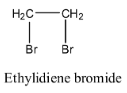
- In the above structure we can clearly see that there is no double bond present in it.
- Therefore option A does not show that geometrical isomerism.
- Coming to option B, acetylene tetrachloride.
- The structure of acetylene tetrachloride is as follows.
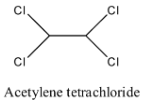
- In the structure of option B, there is no double bond.
- Therefore acetylene tetrachloride is not going to exhibit geometrical isomerism.
- Coming to option C, Acetylene tetrabromide.
- The structure of Acetylene tetrabromide is as follows:
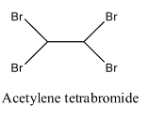
- In the structure of option C, there is no double bond.
- Therefore acetylene tetrabromide is not going to exhibit geometrical isomerism.
- Coming to option D, Acetylene dibromide.
- The structure of Acetylene dibromide is as follows.
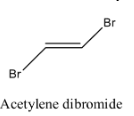
- In the structure of the acetylene dibromide there is a presence of double bond.
- Therefore acetylene dibromide is going to show geometrical isomerism.
- The geometrical isomerism of the compound acetylene dibromide is as follows.
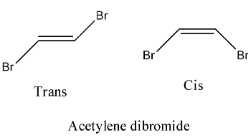
Therefore option D is correct.
Note: The compound which exhibits geometrical isomerism shows two types of isomers. The two types of geometrical isomers are cis and trans. Trans form of a compound is more stable then the cis form because of the less steric hindrance.
Complete step by step answer:
- In the question it is asked which molecules among the given options will show two geometrical isomers.
- To find it we have to draw each and every structure of the compound given in the options.
- Coming to option A, Ethylidiene bromide.
- The structure of ethylidene bromide is as follows:
- In the above structure we can clearly see that there is no double bond present in it.
- Therefore option A does not show that geometrical isomerism.
- Coming to option B, acetylene tetrachloride.
- The structure of acetylene tetrachloride is as follows.
- In the structure of option B, there is no double bond.
- Therefore acetylene tetrachloride is not going to exhibit geometrical isomerism.
- Coming to option C, Acetylene tetrabromide.
- The structure of Acetylene tetrabromide is as follows:
- In the structure of option C, there is no double bond.
- Therefore acetylene tetrabromide is not going to exhibit geometrical isomerism.
- Coming to option D, Acetylene dibromide.
- The structure of Acetylene dibromide is as follows.
- In the structure of the acetylene dibromide there is a presence of double bond.
- Therefore acetylene dibromide is going to show geometrical isomerism.
- The geometrical isomerism of the compound acetylene dibromide is as follows.
Therefore option D is correct.
Note: The compound which exhibits geometrical isomerism shows two types of isomers. The two types of geometrical isomers are cis and trans. Trans form of a compound is more stable then the cis form because of the less steric hindrance.
Recently Updated Pages
Which will be the least stable resonating structure class 11 chemistry CBSE

How many 5 digit telephone numbers can be construc-class-11-maths-CBSE
How do you find the angle of the resultant vector class 11 physics CBSE
Draw labelled diagram of the following i Gram seed class 11 biology CBSE
1 Quintal is equal to a 110 kg b 10 kg c 100kg d 1000 class 11 physics CBSE
What is the need and importance of classification class 11 biology CBSE
Trending doubts
Find the value of the expression given below sin 30circ class 11 maths CBSE
One Metric ton is equal to kg A 10000 B 1000 C 100 class 11 physics CBSE
10 examples of friction in our daily life
Draw a diagram of a plant cell and label at least eight class 11 biology CBSE
Difference between physical and chemical change class 11 chemistry CBSE
Proton was discovered by A Thomson B Rutherford C Chadwick class 11 chemistry CBSE