




Two forces P and Q of magnitude 2F and 3F, respectively, are at an angle 𝛉 with each other. If the force Q is doubled, then their resultant also gets doubled. then, the angle is
A. 30˚
B. 60˚
C. 90˚
D. 120˚
Answer
 Verified
569.1k+ views
Hint: we will use the formula, to find the magnitude of resultant of two vectors.
Complete step by step solution:
In the question we are given two forces P and Q of magnitude;
\[P = 2F\]and \[Q = 3F\]and the angle between the vectors is 𝛉, then it is said that if force Q is doubled then their resultant also get doubled so, we required to find the value of θ
First let us draw the diagram of these vectors
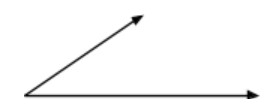
let the resultant of vector P and Q is vector R
SO, \[\overrightarrow P + \overrightarrow Q = \overrightarrow R \] and |\[\overrightarrow P + \overrightarrow Q = |R|\]=\[\sqrt {{P^2} + {Q^2} + 2PQCOS\theta } \]
Here, \[P = 2F\]and \[Q = 3F\] so put the value in above equation
\[R = \sqrt {{{(2F)}^2} + {{(3F)}^2} + 2(2F)(3F)COS\theta } \] =\[\sqrt {13{{(F)}^2} + 12{{(F)}^2}COS\theta } \]
now the vectors Q gets doubled, so, Q= 6F and the resultant vector also get doubled, so ,
\[{R_1} = 2\sqrt {13{{(F)}^2} + 12{{(F)}^2}COS\theta } \] …………..(1)
And the magnitude of new resultant is given as \[{R_1} = \sqrt {{{(2F)}^2} + {{(6F)}^2} + 2(2F)(6F)COS\theta } \]
=\[\sqrt {40{{(F)}^2} + 24{{(F)}^2}COS\theta } \]
From equation 1 \[\sqrt {40{{(F)}^2} + 24{{(F)}^2}COS\theta } \] =\[2\sqrt {13{{(F)}^2} + 12{{(F)}^2}COS\theta } \]
Now squaring both side, we get
\[40{(F)^2} + 24{(F)^2}COS\theta \]=\[4\,(13{(F)^2} + 12{(F)^2}COS\theta )\]
On simplifying we get
\[40{F^2} + 24{F^2}COS\theta {\text{ }} = 52{F^2} + 48{F^2}COS\theta \]
\[ - 12{F^2} = {\text{ }}24{F^2}COS\theta \]
∴ \[cos{\text{ }}\theta {\text{ }} = \; - \dfrac{1}{2}\]
Hence, \[\theta = 120^\circ \]
Note: If two vectors acting simultaneously at a point can be represented both in magnitude and direction by the adjacent sides of a parallelogram drawn from a point, then the resultant vector is represented both in magnitude and direction by the diagonal of the parallelogram passing through that point.
Complete step by step solution:
In the question we are given two forces P and Q of magnitude;
\[P = 2F\]and \[Q = 3F\]and the angle between the vectors is 𝛉, then it is said that if force Q is doubled then their resultant also get doubled so, we required to find the value of θ
First let us draw the diagram of these vectors
let the resultant of vector P and Q is vector R
SO, \[\overrightarrow P + \overrightarrow Q = \overrightarrow R \] and |\[\overrightarrow P + \overrightarrow Q = |R|\]=\[\sqrt {{P^2} + {Q^2} + 2PQCOS\theta } \]
Here, \[P = 2F\]and \[Q = 3F\] so put the value in above equation
\[R = \sqrt {{{(2F)}^2} + {{(3F)}^2} + 2(2F)(3F)COS\theta } \] =\[\sqrt {13{{(F)}^2} + 12{{(F)}^2}COS\theta } \]
now the vectors Q gets doubled, so, Q= 6F and the resultant vector also get doubled, so ,
\[{R_1} = 2\sqrt {13{{(F)}^2} + 12{{(F)}^2}COS\theta } \] …………..(1)
And the magnitude of new resultant is given as \[{R_1} = \sqrt {{{(2F)}^2} + {{(6F)}^2} + 2(2F)(6F)COS\theta } \]
=\[\sqrt {40{{(F)}^2} + 24{{(F)}^2}COS\theta } \]
From equation 1 \[\sqrt {40{{(F)}^2} + 24{{(F)}^2}COS\theta } \] =\[2\sqrt {13{{(F)}^2} + 12{{(F)}^2}COS\theta } \]
Now squaring both side, we get
\[40{(F)^2} + 24{(F)^2}COS\theta \]=\[4\,(13{(F)^2} + 12{(F)^2}COS\theta )\]
On simplifying we get
\[40{F^2} + 24{F^2}COS\theta {\text{ }} = 52{F^2} + 48{F^2}COS\theta \]
\[ - 12{F^2} = {\text{ }}24{F^2}COS\theta \]
∴ \[cos{\text{ }}\theta {\text{ }} = \; - \dfrac{1}{2}\]
Hence, \[\theta = 120^\circ \]
Note: If two vectors acting simultaneously at a point can be represented both in magnitude and direction by the adjacent sides of a parallelogram drawn from a point, then the resultant vector is represented both in magnitude and direction by the diagonal of the parallelogram passing through that point.
Recently Updated Pages
Master Class 11 Computer Science: Engaging Questions & Answers for Success

Master Class 11 Business Studies: Engaging Questions & Answers for Success
Master Class 11 Economics: Engaging Questions & Answers for Success
Master Class 11 English: Engaging Questions & Answers for Success
Master Class 11 Maths: Engaging Questions & Answers for Success
Master Class 11 Biology: Engaging Questions & Answers for Success
Trending doubts
One Metric ton is equal to kg A 10000 B 1000 C 100 class 11 physics CBSE
There are 720 permutations of the digits 1 2 3 4 5 class 11 maths CBSE
Discuss the various forms of bacteria class 11 biology CBSE
Draw a diagram of a plant cell and label at least eight class 11 biology CBSE
State the laws of reflection of light
Explain zero factorial class 11 maths CBSE