




Two figures can have the same area but different perimeters.
a. True
b. False
Answer
 Verified
560.4k+ views
Hint: In this type of question we have to use the concept of area and perimeter. We know that, we come across different shapes whose required space and distance around it have to be calculated which is termed as area and perimeter of the corresponding shape. In this question first we define area and perimeter and then with the help of an example we check whether the given statement is true or false.
Complete step by step answer:
Now, we have to check whether the statement “Two figures can have the same area but different perimeters” is true or false.
Let us define area and perimeter first.
The area is defined as the space occupied by the shape. While perimeter is defined as the distance around the shape.
Now we consider one example where we take one rectangle and one square. Then we calculate area and perimeter for both and check whether the given statement is true or false.
For a rectangle, let us assume its length is equal to 9 cm and breadth is say 4 cm.
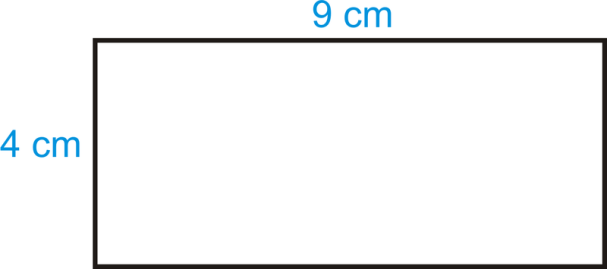
Then we can calculate area and perimeter for the rectangle as:
\[\begin{align}
& \Rightarrow \text{Area of rectangle = length }\times \text{ Breadth} \\
& \Rightarrow \text{Area of rectangle =9}\times 4 \\
& \Rightarrow \text{Area of rectangle =}36\text{ sq}\text{. cm}\text{.} \\
\end{align}\]
\[\begin{align}
& \Rightarrow \text{Perimeter = 2}\times \left( \text{length + breadth} \right) \\
& \Rightarrow \text{Perimeter = 2}\times \left( 9+4 \right) \\
& \Rightarrow \text{Perimeter = 2}6\text{ cm} \\
\end{align}\]
Now, for the square let us take the side of the square is 6 cm.
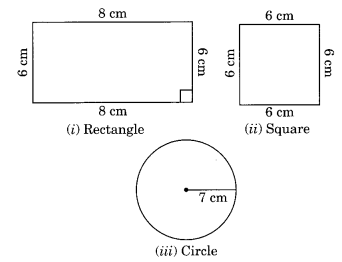
Then we can find area and perimeter for the square as:
\[\begin{align}
& \Rightarrow \text{Area of square = }{{\left( \text{Side} \right)}^{2}} \\
& \Rightarrow \text{Area of square = }{{\left( 6 \right)}^{2}} \\
& \Rightarrow \text{Area of square = }36\text{ sq}\text{. cm}\text{.} \\
\end{align}\]
\[\begin{align}
& \Rightarrow \text{Perimeter = 4}\times \left( \text{side} \right) \\
& \Rightarrow \text{Perimeter = 4}\times \left( 6 \right) \\
& \Rightarrow \text{Perimeter = }24\text{ cm} \\
\end{align}\]
Hence, we can clearly observe that the area of the rectangle and square are the same but perimeters are different.
Hence, the given statement is true.
So, the correct answer is “Option a”.
Note: Students have to note that the area is the space bounded by the closed shapes or polygon just inside it and perimeter is the sum of all sides of the closed shapes or polygon. Also as the unit of area is square units and that of perimeter is linear units we can say that the area can be measured for two dimensional shapes and perimeter can be measured for one dimensional shapes.
Complete step by step answer:
Now, we have to check whether the statement “Two figures can have the same area but different perimeters” is true or false.
Let us define area and perimeter first.
The area is defined as the space occupied by the shape. While perimeter is defined as the distance around the shape.
Now we consider one example where we take one rectangle and one square. Then we calculate area and perimeter for both and check whether the given statement is true or false.
For a rectangle, let us assume its length is equal to 9 cm and breadth is say 4 cm.
Then we can calculate area and perimeter for the rectangle as:
\[\begin{align}
& \Rightarrow \text{Area of rectangle = length }\times \text{ Breadth} \\
& \Rightarrow \text{Area of rectangle =9}\times 4 \\
& \Rightarrow \text{Area of rectangle =}36\text{ sq}\text{. cm}\text{.} \\
\end{align}\]
\[\begin{align}
& \Rightarrow \text{Perimeter = 2}\times \left( \text{length + breadth} \right) \\
& \Rightarrow \text{Perimeter = 2}\times \left( 9+4 \right) \\
& \Rightarrow \text{Perimeter = 2}6\text{ cm} \\
\end{align}\]
Now, for the square let us take the side of the square is 6 cm.
Then we can find area and perimeter for the square as:
\[\begin{align}
& \Rightarrow \text{Area of square = }{{\left( \text{Side} \right)}^{2}} \\
& \Rightarrow \text{Area of square = }{{\left( 6 \right)}^{2}} \\
& \Rightarrow \text{Area of square = }36\text{ sq}\text{. cm}\text{.} \\
\end{align}\]
\[\begin{align}
& \Rightarrow \text{Perimeter = 4}\times \left( \text{side} \right) \\
& \Rightarrow \text{Perimeter = 4}\times \left( 6 \right) \\
& \Rightarrow \text{Perimeter = }24\text{ cm} \\
\end{align}\]
Hence, we can clearly observe that the area of the rectangle and square are the same but perimeters are different.
Hence, the given statement is true.
So, the correct answer is “Option a”.
Note: Students have to note that the area is the space bounded by the closed shapes or polygon just inside it and perimeter is the sum of all sides of the closed shapes or polygon. Also as the unit of area is square units and that of perimeter is linear units we can say that the area can be measured for two dimensional shapes and perimeter can be measured for one dimensional shapes.
Recently Updated Pages
Master Class 11 English: Engaging Questions & Answers for Success

Master Class 11 Social Science: Engaging Questions & Answers for Success
Master Class 11 Maths: Engaging Questions & Answers for Success
Master Class 11 Biology: Engaging Questions & Answers for Success
Master Class 11 Physics: Engaging Questions & Answers for Success
Master Class 11 Chemistry: Engaging Questions & Answers for Success
Trending doubts