



Two distinct lines in a plane.................
A. always intersect
B. always either intersects or are parallel
C. always has two common points
D. none of these
Answer
 Verified
640.8k+ views
Hint – In order to solve this problem, draw a rough diagram and think of all the possible conditions when two distinct lines lie in a plane.
Complete step-by-step answer:
The figure for this problem can be drawn as:
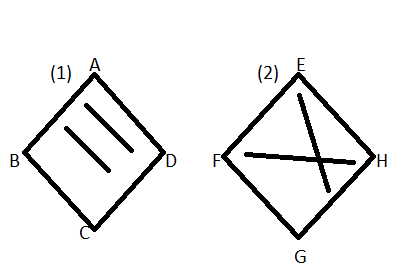
So, there are two figures (1) and (2) in which ABCD and EFGH are the planes and the two distinct lines are drawn. We can notice that there are only two possible conditions when two distinct lines lie in the plane and that is either they are parallel or intersecting.
So, the correct option is B.
Note – In this problem we need to consider all the possible conditions when the two distinct lines lie in the plane. Students may forget that we have to use two distinct lines. If we don't consider this condition we will get the wrong solution.
Complete step-by-step answer:
The figure for this problem can be drawn as:
So, there are two figures (1) and (2) in which ABCD and EFGH are the planes and the two distinct lines are drawn. We can notice that there are only two possible conditions when two distinct lines lie in the plane and that is either they are parallel or intersecting.
So, the correct option is B.
Note – In this problem we need to consider all the possible conditions when the two distinct lines lie in the plane. Students may forget that we have to use two distinct lines. If we don't consider this condition we will get the wrong solution.
Recently Updated Pages
Master Class 12 Business Studies: Engaging Questions & Answers for Success

Master Class 12 Biology: Engaging Questions & Answers for Success
Master Class 12 Chemistry: Engaging Questions & Answers for Success
Class 12 Question and Answer - Your Ultimate Solutions Guide
Master Class 11 Social Science: Engaging Questions & Answers for Success
Master Class 11 English: Engaging Questions & Answers for Success
Trending doubts
Find the sum of series 1 + 2 + 3 + 4 + 5 + + 100 class 9 maths CBSE
Name 10 Living and Non living things class 9 biology CBSE
On an outline map of India show its neighbouring c class 9 social science CBSE
Write an Article on Save Earth Save Life
On an outline map of India mark the Karakoram range class 9 social science CBSE
If HCF of 210 and 55 is expressed in the form of 210 class 9 maths CBSE