




Two different artificial satellites are orbiting with equal time periods around the earth and having angular momenta as $2:1$. The ratio of masses of the satellites will be given as,
$\begin{align}
& A.2:1 \\
& B.1:2 \\
& C.1:1 \\
& D.1:3 \\
\end{align}$
Answer
 Verified
584.4k+ views
Hint: First of all take the relation between the orbital velocity and radius of the orbit. Then find the time period. As they are mentioned to be equal, equate it and find the relation between the velocity and radius from that also. Compare both these results. The angular momentum is given as the product of mass of the body, orbital velocity and radius of the orbital. From this relation, find the answer. Hope these all may help you to solve this question.
Complete answer:
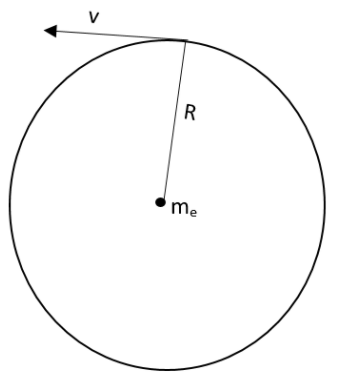
Let us assume that the orbital velocity is given as $v$.
It is expressed in the form of an equation as,
\[v=\sqrt{\dfrac{GM}{R}}=\sqrt{gR}\]
Therefore we can write that for the first satellite,
\[{{v}_{1}}=\sqrt{g{{R}_{1}}}\]
And for the second satellite, we can write that,
\[{{v}_{2}}=\sqrt{g{{R}_{2}}}\]
That is,
\[\dfrac{{{v}_{1}}}{{{v}_{2}}}=\dfrac{\sqrt{{{R}_{1}}}}{\sqrt{{{R}_{2}}}}\]
The time period of the orbit is given by taking the ratio of the distance covered to the velocity of the body. Distance covered will be the circumference of the circular path. That is for each satellite we can write that,
\[{{T}_{1}}=\dfrac{2\pi {{R}_{1}}}{{{v}_{1}}}\]
\[{{T}_{2}}=\dfrac{2\pi {{R}_{2}}}{{{v}_{2}}}\]
As it is already mentioned that the time periods are equal, we can equate both the equation as,
\[\begin{align}
& {{T}_{1}}={{T}_{2}} \\
& \Rightarrow \dfrac{2\pi {{R}_{1}}}{{{v}_{1}}}=\dfrac{2\pi {{R}_{2}}}{{{v}_{2}}} \\
\end{align}\]
Cancelling the common terms in the equation will give,
\[\dfrac{{{R}_{1}}}{{{v}_{1}}}=\dfrac{{{R}_{2}}}{{{v}_{2}}}\]
Rearranging the equation,
\[\dfrac{{{R}_{1}}}{{{R}_{2}}}=\dfrac{{{v}_{1}}}{{{v}_{2}}}\]
As we already obtained the ratio of orbital velocities above, we can substitute that here,
\[\dfrac{{{R}_{1}}}{{{R}_{2}}}=\dfrac{\sqrt{{{R}_{1}}}}{\sqrt{{{R}_{2}}}}\]
This will be true only if the radius is equal.
\[{{R}_{1}}={{R}_{2}}\]
Therefore,
\[{{v}_{1}}={{v}_{2}}\]
The angular momentum of these satellites can be expressed in the form of equations as,
\[{{L}_{1}}={{m}_{1}}{{v}_{1}}{{R}_{1}}\]
\[{{L}_{2}}={{m}_{2}}{{v}_{2}}{{R}_{2}}\]
This can be written as,
\[\dfrac{{{L}_{1}}}{{{L}_{2}}}=\dfrac{{{m}_{1}}vR}{{{m}_{2}}vR}\]
Therefore after cancelling all the terms we can write that,
\[\dfrac{{{L}_{1}}}{{{L}_{2}}}=\dfrac{{{m}_{1}}}{{{m}_{2}}}\]
It is already given in the question that the ratio of angular momentum is,
\[\dfrac{{{L}_{1}}}{{{L}_{2}}}=\dfrac{2}{1}\]
Therefore the ratio of their masses will also be,
\[\dfrac{{{m}_{1}}}{{{m}_{2}}}=\dfrac{2}{1}\]
Hence the correct answer is given as option A.
Note:
The angular momentum is the rotational equivalent for the linear momentum in classical physics. The total angular momentum is a conserved quantity. And also it is a vector quantity. It is having a magnitude as well as the direction.
Complete answer:
Let us assume that the orbital velocity is given as $v$.
It is expressed in the form of an equation as,
\[v=\sqrt{\dfrac{GM}{R}}=\sqrt{gR}\]
Therefore we can write that for the first satellite,
\[{{v}_{1}}=\sqrt{g{{R}_{1}}}\]
And for the second satellite, we can write that,
\[{{v}_{2}}=\sqrt{g{{R}_{2}}}\]
That is,
\[\dfrac{{{v}_{1}}}{{{v}_{2}}}=\dfrac{\sqrt{{{R}_{1}}}}{\sqrt{{{R}_{2}}}}\]
The time period of the orbit is given by taking the ratio of the distance covered to the velocity of the body. Distance covered will be the circumference of the circular path. That is for each satellite we can write that,
\[{{T}_{1}}=\dfrac{2\pi {{R}_{1}}}{{{v}_{1}}}\]
\[{{T}_{2}}=\dfrac{2\pi {{R}_{2}}}{{{v}_{2}}}\]
As it is already mentioned that the time periods are equal, we can equate both the equation as,
\[\begin{align}
& {{T}_{1}}={{T}_{2}} \\
& \Rightarrow \dfrac{2\pi {{R}_{1}}}{{{v}_{1}}}=\dfrac{2\pi {{R}_{2}}}{{{v}_{2}}} \\
\end{align}\]
Cancelling the common terms in the equation will give,
\[\dfrac{{{R}_{1}}}{{{v}_{1}}}=\dfrac{{{R}_{2}}}{{{v}_{2}}}\]
Rearranging the equation,
\[\dfrac{{{R}_{1}}}{{{R}_{2}}}=\dfrac{{{v}_{1}}}{{{v}_{2}}}\]
As we already obtained the ratio of orbital velocities above, we can substitute that here,
\[\dfrac{{{R}_{1}}}{{{R}_{2}}}=\dfrac{\sqrt{{{R}_{1}}}}{\sqrt{{{R}_{2}}}}\]
This will be true only if the radius is equal.
\[{{R}_{1}}={{R}_{2}}\]
Therefore,
\[{{v}_{1}}={{v}_{2}}\]
The angular momentum of these satellites can be expressed in the form of equations as,
\[{{L}_{1}}={{m}_{1}}{{v}_{1}}{{R}_{1}}\]
\[{{L}_{2}}={{m}_{2}}{{v}_{2}}{{R}_{2}}\]
This can be written as,
\[\dfrac{{{L}_{1}}}{{{L}_{2}}}=\dfrac{{{m}_{1}}vR}{{{m}_{2}}vR}\]
Therefore after cancelling all the terms we can write that,
\[\dfrac{{{L}_{1}}}{{{L}_{2}}}=\dfrac{{{m}_{1}}}{{{m}_{2}}}\]
It is already given in the question that the ratio of angular momentum is,
\[\dfrac{{{L}_{1}}}{{{L}_{2}}}=\dfrac{2}{1}\]
Therefore the ratio of their masses will also be,
\[\dfrac{{{m}_{1}}}{{{m}_{2}}}=\dfrac{2}{1}\]
Hence the correct answer is given as option A.
Note:
The angular momentum is the rotational equivalent for the linear momentum in classical physics. The total angular momentum is a conserved quantity. And also it is a vector quantity. It is having a magnitude as well as the direction.
Recently Updated Pages
Master Class 11 Computer Science: Engaging Questions & Answers for Success

Master Class 11 Business Studies: Engaging Questions & Answers for Success
Master Class 11 Economics: Engaging Questions & Answers for Success
Master Class 11 English: Engaging Questions & Answers for Success
Master Class 11 Maths: Engaging Questions & Answers for Success
Master Class 11 Biology: Engaging Questions & Answers for Success
Trending doubts
One Metric ton is equal to kg A 10000 B 1000 C 100 class 11 physics CBSE
There are 720 permutations of the digits 1 2 3 4 5 class 11 maths CBSE
Discuss the various forms of bacteria class 11 biology CBSE
Draw a diagram of a plant cell and label at least eight class 11 biology CBSE
State the laws of reflection of light
Explain zero factorial class 11 maths CBSE