




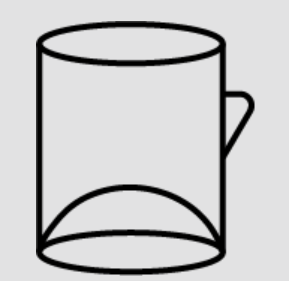
Two dairy owners A and B sell flavoured milk filled to capacity in mugs of negligible thickness, which are cylindrical in shape with a raised hemispherical bottom. The mugs are 14 cm high and have a diameter of 7 cm as shown in the given figure. Both A and B sell flavoured milk at the rate of Rs.80 per litre. The dairy owner A uses the formula $\pi {{\text{r}}^{2}}\text{h}$ to find the volume of milk in the mug and charges Rs.43.12 for it. The dairy owner B is of the view that the price of the actual quantity of milk should be charged. What according to him should be the price of one mug of milk? Which value is exhibited by the dairy owner B? (Use$\pi \text{ = }\dfrac{22}{7}$)
Answer
 Verified
630k+ views
Hint: Find the actual volume of the mug by subtracting the volume of the raised hemisphere in the volume from the cylindrical portion of the mug. The mug can hold that volume of milk inside it, converting the volume obtained from $\text{c}{{\text{m}}^{3}}$ to litre. Now find the price of this volume of milk at the rate of Rs.80 per litre.
Complete step-by-step answer:
We know the formula for the volume of a cylinder is $\pi {{\text{r}}^{2}}\text{h}$, where r is the radius of the cylinder and h is the height of the cylinder.
Diameter of the cylindrical mug $=\text{ 7 cm}\text{.}$
$\therefore $ Radius of the cylindrical mug
$\begin{align}
& =\text{ }\dfrac{7}{2}\text{ cm}\text{.} \\
& \text{= 3}\text{.5 cm} \\
\end{align}$
Height of the mug $=\text{ 14 cm}\text{.}$
Therefore, putting $\text{r = 3}\text{.5 cm}$ and $\text{h = 14cm}$in the above mentioned formula, we get
Volume of the cylindrical portion of the mug
$\begin{align}
& =\text{ }\pi \text{ x (3}\text{.5}{{\text{)}}^{2}}\text{ x 14 c}{{\text{m}}^{3}} \\
& =\text{ }\dfrac{22}{7}\text{ x (3}\text{.5}{{\text{)}}^{2}}\text{ x 14 c}{{\text{m}}^{3}}\text{ }\left( \because \text{ }\pi \text{ = }\dfrac{22}{7} \right) \\
& =\text{ 539 c}{{\text{m}}^{3}} \\
\end{align}$
Now, we know that,
$\begin{align}
& 1\text{ litre = 1 d}{{\text{m}}^{3}}\text{ = 1000 c}{{\text{m}}^{3}} \\
& \therefore \text{ 1 c}{{\text{m}}^{3}}\text{ = }\dfrac{1}{1000}\text{ c}{{\text{m}}^{3}} \\
& \text{ = 0}\text{.001 c}{{\text{m}}^{3}}\text{ }......\text{(A)} \\
\end{align}$
Thus, the volume of the cylindrical portion of the mug
$\begin{align}
& =\text{ 539 x 0}\text{.001 litre} \\
& =\text{ 0}\text{.539 litre} \\
\end{align}$
The dairy owner A uses the formula $\pi {{\text{r}}^{2}}\text{h}$ to find the volume of the milk and sets the price accordingly.
It is given that, price of 1 litre of milk $=\text{ Rs}\text{. 80}$
$\therefore $ Price of 0.539 litre of milk
$\begin{align}
& =\text{ Rs}\text{. (80 x 0}\text{.539)} \\
& \text{= Rs}\text{. 43}\text{.12} \\
\end{align}$
Now, dairy owner B decides to charge money for flavoured milk according to its quantity inside the mug. The actual volume of milk is lesser than the volume of the cylindrical portion because the mug has a raised hemispherical bottom.
We know, the volume of a hemisphere is $\dfrac{2}{3}\pi {{\text{r}}^{3}}$, where r is the radius of the hemisphere.
Radius of the hemisphere inside the mug $=\text{ 3}\text{.5 cm}$(since, radius of the hemisphere = radius of the cylinder)
Putting the value of r = 3.5 cm in the above mentioned formula,
Volume of the hemispherical bottom
$\begin{align}
& =\text{ }\dfrac{2}{3}\text{ x }\pi \text{ x }{{\left( 3.5 \right)}^{3}}\text{ c}{{\text{m}}^{3}} \\
& =\text{ }\dfrac{2}{3}\text{ x }\dfrac{22}{7}\text{ x }{{\left( 3.5 \right)}^{3}}\text{ c}{{\text{m}}^{3}}\text{ }\left( \because \text{ }\pi \text{ = }\dfrac{22}{7} \right) \\
& =\text{ 89}\text{.83 c}{{\text{m}}^{3}} \\
\end{align}$
$\therefore $ Volume of milk inside the mug = Volume of the cylindrical portion – Volume of the hemispherical bottom
$\begin{align}
& =\text{ (539 }-\text{ 89}\text{.83) c}{{\text{m}}^{3}} \\
& =\text{ 449}\text{.17 c}{{\text{m}}^{3}} \\
\end{align}$
From formula in (A), we can say, Volume of the milk inside the mug
$\begin{align}
& =\text{ 449}\text{.17 x 0}\text{.001 litre} \\
& \text{= 0}\text{.44917 litre} \\
\end{align}$
Therefore, Price of 0.44917 litre of milk
$\begin{align}
&=\text{ Rs}\text{. (80 x 0}\text{.44917)} \\
& \text{= Rs}\text{. 35}\text{.93 } \\
\end{align}$
Hence, the dairy owner B took Rs.35.93 for one mug of flavoured milk.
Note: The dairy owner A charged more Rs.( 43.12 – 35.93) = Rs.7.12 more than that of the actual quantity of milk, whereas dairy owner B charged the right amount for the quantity of milk inside the mug. So, it can be concluded that dairy owner B was much more honest than dairy owner A.
Complete step-by-step answer:
We know the formula for the volume of a cylinder is $\pi {{\text{r}}^{2}}\text{h}$, where r is the radius of the cylinder and h is the height of the cylinder.
Diameter of the cylindrical mug $=\text{ 7 cm}\text{.}$
$\therefore $ Radius of the cylindrical mug
$\begin{align}
& =\text{ }\dfrac{7}{2}\text{ cm}\text{.} \\
& \text{= 3}\text{.5 cm} \\
\end{align}$
Height of the mug $=\text{ 14 cm}\text{.}$
Therefore, putting $\text{r = 3}\text{.5 cm}$ and $\text{h = 14cm}$in the above mentioned formula, we get
Volume of the cylindrical portion of the mug
$\begin{align}
& =\text{ }\pi \text{ x (3}\text{.5}{{\text{)}}^{2}}\text{ x 14 c}{{\text{m}}^{3}} \\
& =\text{ }\dfrac{22}{7}\text{ x (3}\text{.5}{{\text{)}}^{2}}\text{ x 14 c}{{\text{m}}^{3}}\text{ }\left( \because \text{ }\pi \text{ = }\dfrac{22}{7} \right) \\
& =\text{ 539 c}{{\text{m}}^{3}} \\
\end{align}$
Now, we know that,
$\begin{align}
& 1\text{ litre = 1 d}{{\text{m}}^{3}}\text{ = 1000 c}{{\text{m}}^{3}} \\
& \therefore \text{ 1 c}{{\text{m}}^{3}}\text{ = }\dfrac{1}{1000}\text{ c}{{\text{m}}^{3}} \\
& \text{ = 0}\text{.001 c}{{\text{m}}^{3}}\text{ }......\text{(A)} \\
\end{align}$
Thus, the volume of the cylindrical portion of the mug
$\begin{align}
& =\text{ 539 x 0}\text{.001 litre} \\
& =\text{ 0}\text{.539 litre} \\
\end{align}$
The dairy owner A uses the formula $\pi {{\text{r}}^{2}}\text{h}$ to find the volume of the milk and sets the price accordingly.
It is given that, price of 1 litre of milk $=\text{ Rs}\text{. 80}$
$\therefore $ Price of 0.539 litre of milk
$\begin{align}
& =\text{ Rs}\text{. (80 x 0}\text{.539)} \\
& \text{= Rs}\text{. 43}\text{.12} \\
\end{align}$
Now, dairy owner B decides to charge money for flavoured milk according to its quantity inside the mug. The actual volume of milk is lesser than the volume of the cylindrical portion because the mug has a raised hemispherical bottom.
We know, the volume of a hemisphere is $\dfrac{2}{3}\pi {{\text{r}}^{3}}$, where r is the radius of the hemisphere.
Radius of the hemisphere inside the mug $=\text{ 3}\text{.5 cm}$(since, radius of the hemisphere = radius of the cylinder)
Putting the value of r = 3.5 cm in the above mentioned formula,
Volume of the hemispherical bottom
$\begin{align}
& =\text{ }\dfrac{2}{3}\text{ x }\pi \text{ x }{{\left( 3.5 \right)}^{3}}\text{ c}{{\text{m}}^{3}} \\
& =\text{ }\dfrac{2}{3}\text{ x }\dfrac{22}{7}\text{ x }{{\left( 3.5 \right)}^{3}}\text{ c}{{\text{m}}^{3}}\text{ }\left( \because \text{ }\pi \text{ = }\dfrac{22}{7} \right) \\
& =\text{ 89}\text{.83 c}{{\text{m}}^{3}} \\
\end{align}$
$\therefore $ Volume of milk inside the mug = Volume of the cylindrical portion – Volume of the hemispherical bottom
$\begin{align}
& =\text{ (539 }-\text{ 89}\text{.83) c}{{\text{m}}^{3}} \\
& =\text{ 449}\text{.17 c}{{\text{m}}^{3}} \\
\end{align}$
From formula in (A), we can say, Volume of the milk inside the mug
$\begin{align}
& =\text{ 449}\text{.17 x 0}\text{.001 litre} \\
& \text{= 0}\text{.44917 litre} \\
\end{align}$
Therefore, Price of 0.44917 litre of milk
$\begin{align}
&=\text{ Rs}\text{. (80 x 0}\text{.44917)} \\
& \text{= Rs}\text{. 35}\text{.93 } \\
\end{align}$
Hence, the dairy owner B took Rs.35.93 for one mug of flavoured milk.
Note: The dairy owner A charged more Rs.( 43.12 – 35.93) = Rs.7.12 more than that of the actual quantity of milk, whereas dairy owner B charged the right amount for the quantity of milk inside the mug. So, it can be concluded that dairy owner B was much more honest than dairy owner A.
Recently Updated Pages
Basicity of sulphurous acid and sulphuric acid are

Master Class 11 Business Studies: Engaging Questions & Answers for Success
Master Class 11 Computer Science: Engaging Questions & Answers for Success
Master Class 11 Economics: Engaging Questions & Answers for Success
Master Class 11 Social Science: Engaging Questions & Answers for Success
Master Class 11 English: Engaging Questions & Answers for Success
Trending doubts
One Metric ton is equal to kg A 10000 B 1000 C 100 class 11 physics CBSE
The largest wind power cluster is located in the state class 11 social science CBSE
Explain zero factorial class 11 maths CBSE
State and prove Bernoullis theorem class 11 physics CBSE
Which among the following are examples of coming together class 11 social science CBSE
Can anyone list 10 advantages and disadvantages of friction