




Two cubes each of volume $64c{m^2}$ are joined end to end. Find the surface area of the resulting cuboid.
Answer
 Verified
644.4k+ views
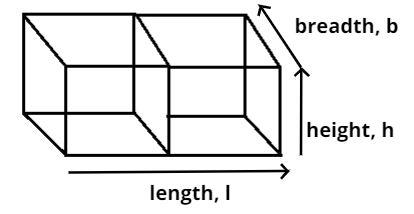
Hint – In this question use the formula of volume of the cube which is ${(side)^3}$ to get the side of the cube. The length of the resulting cuboid is simply twice the side of the cube, the height is equal to the side of the cube and the breadth is also equal to the side of the cube.
Complete step-by-step answer:
Given data volume of each cube = 64 $cm^2$.
Now as we know that volume (V) of the cube is the side cube.
Let the side of the cube be a cm.
$ \Rightarrow V = 64 = {a^3}$
$ \Rightarrow a = \sqrt[3]{{64}} = 4$ cm.
So the side of the cube is 4 cm.
Now two cubes are joined together as shown in figure to make a cuboid.
So as we see that the length (l) of the cuboid is double the side of the cube but breadth (b) and height (h) of the cuboid remain the same.
Therefore l = 2a, b = a and h = a cm.
Therefore l = 8 cm, b = 4 cm and h = 4 cm.
Now as we know that the surface area (S.A) of the cuboid is $2\left( {lb + bh + hl} \right)$.
$ \Rightarrow S.A = 2\left( {lb + bh + hl} \right) cm^2$.
\[ \Rightarrow S.A = 2\left( {\left( {8 \times 4} \right) + \left( {4 \times 4} \right) + \left( {4 \times 8} \right)} \right) = 2\left( {32 + 16 + 32} \right) = 2\left( {80} \right) = 160 cm^2\].
So this is the required surface area of the resulting cuboid.
Note – Cube is a symmetrical three dimensional shape, either solid or hollow contained by six equal squares thus combination of two cubes leads to formation of a cuboid. A cuboid has 6 faces so to find the surface area of a cuboid, add the areas of all the 6 faces, that’s why the formula for surface area $S.A = 2\left( {lb + bh + hl} \right)$.
Complete step-by-step answer:
Given data volume of each cube = 64 $cm^2$.
Now as we know that volume (V) of the cube is the side cube.
Let the side of the cube be a cm.
$ \Rightarrow V = 64 = {a^3}$
$ \Rightarrow a = \sqrt[3]{{64}} = 4$ cm.
So the side of the cube is 4 cm.
Now two cubes are joined together as shown in figure to make a cuboid.
So as we see that the length (l) of the cuboid is double the side of the cube but breadth (b) and height (h) of the cuboid remain the same.
Therefore l = 2a, b = a and h = a cm.
Therefore l = 8 cm, b = 4 cm and h = 4 cm.
Now as we know that the surface area (S.A) of the cuboid is $2\left( {lb + bh + hl} \right)$.
$ \Rightarrow S.A = 2\left( {lb + bh + hl} \right) cm^2$.
\[ \Rightarrow S.A = 2\left( {\left( {8 \times 4} \right) + \left( {4 \times 4} \right) + \left( {4 \times 8} \right)} \right) = 2\left( {32 + 16 + 32} \right) = 2\left( {80} \right) = 160 cm^2\].
So this is the required surface area of the resulting cuboid.
Note – Cube is a symmetrical three dimensional shape, either solid or hollow contained by six equal squares thus combination of two cubes leads to formation of a cuboid. A cuboid has 6 faces so to find the surface area of a cuboid, add the areas of all the 6 faces, that’s why the formula for surface area $S.A = 2\left( {lb + bh + hl} \right)$.
Recently Updated Pages
Master Class 12 Economics: Engaging Questions & Answers for Success

Master Class 12 English: Engaging Questions & Answers for Success
Master Class 12 Social Science: Engaging Questions & Answers for Success
Master Class 12 Maths: Engaging Questions & Answers for Success
Master Class 12 Physics: Engaging Questions & Answers for Success
Master Class 9 General Knowledge: Engaging Questions & Answers for Success
Trending doubts
Explain the Treaty of Vienna of 1815 class 10 social science CBSE
Who Won 36 Oscar Awards? Record Holder Revealed
What is the median of the first 10 natural numbers class 10 maths CBSE
Why is it 530 pm in india when it is 1200 afternoon class 10 social science CBSE
Make a sketch of the human nerve cell What function class 10 biology CBSE
What is the full form of POSCO class 10 social science CBSE