




Two circles touch each other externally at P. AB is a common tangent to the circles touching them at A and B. The value $\angle APB$ is
A. ${30^ \circ }$
B. ${45^ \circ }$
C. ${60^ \circ }$
D. ${90^ \circ }$
Answer
 Verified
627.9k+ views
Hint: First we will find the angles of the triangles having radii as the sides of the triangle using properties like angles opposite to equal sides. Now we will find the measures of the angles of the triangle of which $\angle APB$ is an angle, resulting in an equation.
Now using the property of a straight line that sum of all angles on a straight line measures ${180^ \circ }$we’ll get another equation.
Solving the equation formed we’ll get the measure of $\angle APB$.
Complete step-by-step answer:
Given data: Both circles touch each other at P
AB is the common tangent touching the circles at A and B
Let the centers of the circle be L and M
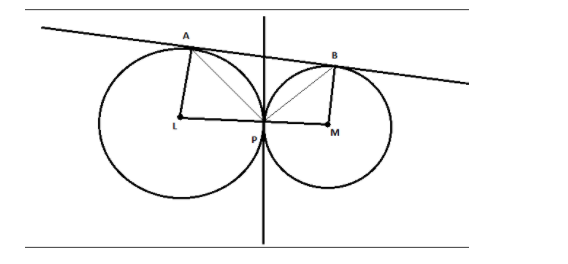
Let $\angle LPA = \alpha $ and $\angle MPB = \beta $
In triangle ALP, we know that $AL = LP$ as both are the radius of the circle, therefore angles opposite to equal sides state that angle opposite sides will also be equal i.e. $\angle LPA = \angle LAP$
$\therefore \angle LAP = \alpha $
Similarly, in triangle BMP, $BM = PM$ as they are the radius of the circle
Therefore, $\angle MPB = \angle MBP$
$\therefore \angle MBP = \beta $
We know that the tangent to a circle is always perpendicular to the radius at the point tangency.
Therefore, $LA \bot AB\,$ and $BM \bot AB\,$
i.e. $\angle LAP + \angle PAB = {90^ \circ }$
Now substituting $\angle LAP = \alpha $, we get,
$ \Rightarrow \angle PAB = {90^ \circ } - \alpha $
Similarly, $\angle MBP + \angle PBA = {90^ \circ }$
Now substituting $\angle MBP = \beta $
$ \Rightarrow \angle PBA = {90^ \circ } - \beta $
We know that the sum of angles of triangle measures ${180^ \circ }$
Therefore, in triangle APB
$ \Rightarrow \angle PAB + \angle PBA + \angle APB = {180^ \circ }$
Substituting $\angle PBA = {90^ \circ } - \beta $ and $\angle PAB = {90^ \circ } - \alpha $
$ \Rightarrow {180^ \circ } - \alpha - \beta + \angle APB = {180^ \circ }$
$ \Rightarrow \alpha + \beta = \angle APB$
Now we know that sum of all angles on a straight line measures ${180^ \circ }$
Therefore, $\angle LPA + \angle APB + \angle MPB = {180^ \circ }$
Now substituting the values of $\angle LPA,\angle MPB$ , we get,
\[ \Rightarrow \alpha + \beta + \angle APB = {180^ \circ }\]
Now substituting $\alpha + \beta = \angle APB$, we get,
\[ \Rightarrow 2\angle APB = {180^ \circ }\]
Dividing by 2, we get,
\[ \Rightarrow \angle APB = {90^ \circ }\]
Hence, Option (D) is correct.
Note: Here we have given the tangent of the circle, so let us discuss some properties related to the tangent of a circle
A tangent of a circle always touches the circle at a single point.
Tangent is always perpendicular to the radius made at the point of tangency.
The length of two tangents drawn to a single point to a circle is always equal.
Now using the property of a straight line that sum of all angles on a straight line measures ${180^ \circ }$we’ll get another equation.
Solving the equation formed we’ll get the measure of $\angle APB$.
Complete step-by-step answer:
Given data: Both circles touch each other at P
AB is the common tangent touching the circles at A and B
Let the centers of the circle be L and M
Let $\angle LPA = \alpha $ and $\angle MPB = \beta $
In triangle ALP, we know that $AL = LP$ as both are the radius of the circle, therefore angles opposite to equal sides state that angle opposite sides will also be equal i.e. $\angle LPA = \angle LAP$
$\therefore \angle LAP = \alpha $
Similarly, in triangle BMP, $BM = PM$ as they are the radius of the circle
Therefore, $\angle MPB = \angle MBP$
$\therefore \angle MBP = \beta $
We know that the tangent to a circle is always perpendicular to the radius at the point tangency.
Therefore, $LA \bot AB\,$ and $BM \bot AB\,$
i.e. $\angle LAP + \angle PAB = {90^ \circ }$
Now substituting $\angle LAP = \alpha $, we get,
$ \Rightarrow \angle PAB = {90^ \circ } - \alpha $
Similarly, $\angle MBP + \angle PBA = {90^ \circ }$
Now substituting $\angle MBP = \beta $
$ \Rightarrow \angle PBA = {90^ \circ } - \beta $
We know that the sum of angles of triangle measures ${180^ \circ }$
Therefore, in triangle APB
$ \Rightarrow \angle PAB + \angle PBA + \angle APB = {180^ \circ }$
Substituting $\angle PBA = {90^ \circ } - \beta $ and $\angle PAB = {90^ \circ } - \alpha $
$ \Rightarrow {180^ \circ } - \alpha - \beta + \angle APB = {180^ \circ }$
$ \Rightarrow \alpha + \beta = \angle APB$
Now we know that sum of all angles on a straight line measures ${180^ \circ }$
Therefore, $\angle LPA + \angle APB + \angle MPB = {180^ \circ }$
Now substituting the values of $\angle LPA,\angle MPB$ , we get,
\[ \Rightarrow \alpha + \beta + \angle APB = {180^ \circ }\]
Now substituting $\alpha + \beta = \angle APB$, we get,
\[ \Rightarrow 2\angle APB = {180^ \circ }\]
Dividing by 2, we get,
\[ \Rightarrow \angle APB = {90^ \circ }\]
Hence, Option (D) is correct.
Note: Here we have given the tangent of the circle, so let us discuss some properties related to the tangent of a circle
A tangent of a circle always touches the circle at a single point.
Tangent is always perpendicular to the radius made at the point of tangency.
The length of two tangents drawn to a single point to a circle is always equal.
Recently Updated Pages
Master Class 11 English: Engaging Questions & Answers for Success

Master Class 11 Social Science: Engaging Questions & Answers for Success
Master Class 11 Maths: Engaging Questions & Answers for Success
Master Class 11 Biology: Engaging Questions & Answers for Success
Master Class 11 Physics: Engaging Questions & Answers for Success
Master Class 11 Chemistry: Engaging Questions & Answers for Success
Trending doubts
One Metric ton is equal to kg A 10000 B 1000 C 100 class 11 physics CBSE
Difference Between Prokaryotic Cells and Eukaryotic Cells
Find the value of the expression given below sin 30circ class 11 maths CBSE
Difference between physical and chemical change class 11 chemistry CBSE
Two of the body parts which do not appear in MRI are class 11 biology CBSE
Draw a diagram of a plant cell and label at least eight class 11 biology CBSE