




Two circles touch each other externally at C and AB is a common tangent to the circles. Then, $\angle {\text{ACB = }}$
$
{\text{A}}{\text{. 6}}{0^ \circ } \\
{\text{B}}{\text{. 4}}{{\text{5}}^ \circ } \\
{\text{C}}{\text{. 3}}{0^ \circ } \\
{\text{D}}{\text{. }}{90^ \circ } \\
$
Answer
 Verified
651k+ views
Hint:- In this question , first we need to do some construction like drawing a tangent at C meet AB at N. Now we have to find the relation between angles of triangle ABC using properties of isosceles triangles. Then, using property of triangle that sum of interior angles is ${180^ \circ }$ find the value of $\angle {\text{ACB}}{\text{.}}$
Complete step-by-step answer:
Let point A be on the circle with centre O and B be the point on the circle with centre at ${\text{O}}'$and AB be the tangent to both the circles touching A and B.
Let the two circles touch at point C.
We know, tangent is a line which intersects or touches the circle at only a single point. According to properties of tangent, from the same external point the tangent segments to a circle are equal.
Let the tangent at C meet AB at N.
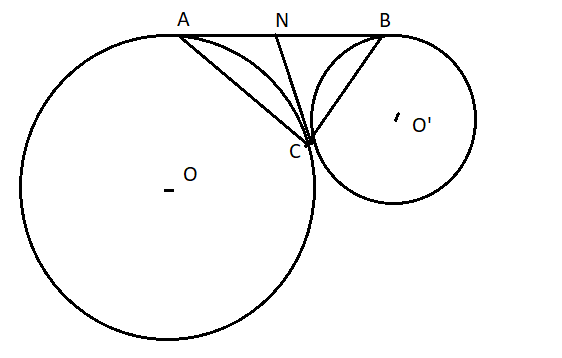
Now, NA and NC are the tangents to the circle with centre O. And we know, from the same external point the tangent segments to a circle are equal.
Therefore, NA=NC --- eq.1 { property of tangent}
Similarly, NB and NC are the tangents to the circle with centre ${\text{O}}'$. And we know, from the same external point the tangent segments to a circle are equal.
Therefore, NB=NC --- eq.2 {property of tangent}
From eq.1 and eq.2 we get
NA=NB
Therefore, NC is the bisector of AB.
Now, on considering the $\Delta {\text{NAC}}$ and $\Delta {\text{NBC}}$.
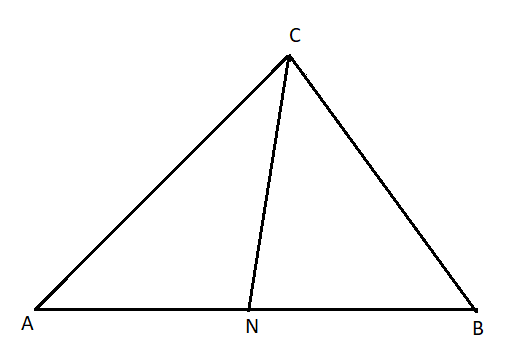
Now, in $\Delta {\text{NAC}}$,
$\angle {\text{NAC = }}\angle {\text{NCA}}$ { $\Delta {\text{NAC}}$ is isosceles a triangle} ---eq.3
Now, in $\Delta {\text{NBC}}$,
$\angle {\text{NBC = }}\angle {\text{NCB}}$ { $\Delta {\text{NBC}}$ is isosceles a triangle} --- eq.4
Now, add eq.3 and eq.4 we get
$
\Rightarrow \angle {\text{NAC}} + \angle {\text{NBC = }}\angle {\text{NCA + }}\angle {\text{NCB}} \\
\Rightarrow \angle {\text{NAC}} + \angle {\text{NBC = }}\angle {\text{ACB --- eq}}{\text{.5}} \\
$
We know, sum of interior angles is ${180^ \circ }$.
Then ,in $\Delta {\text{ACB}}$
$
\Rightarrow \angle {\text{ACB}} + \angle {\text{NBC}} + \angle {\text{NAC = 18}}{0^ \circ } \\
\Rightarrow 2\angle {\text{ACB}} = {\text{18}}{0^ \circ }{\text{ \{ from eq}}{\text{.5\} }} \\
\Rightarrow \angle {\text{ACB}} = {90^ \circ } \\
$
Hence, option D is correct.
Note:- Whenever you get this type of question the key concept to solve this is to make a rough figure using given information. And do some construction if needed. Then using properties of different types of triangles try to get the required relation like in this question we require the property of isosceles triangle(consists of two equal sides) that in it two angles opposite to the equal sides are congruent to each other.
Complete step-by-step answer:
Let point A be on the circle with centre O and B be the point on the circle with centre at ${\text{O}}'$and AB be the tangent to both the circles touching A and B.
Let the two circles touch at point C.
We know, tangent is a line which intersects or touches the circle at only a single point. According to properties of tangent, from the same external point the tangent segments to a circle are equal.
Let the tangent at C meet AB at N.
Now, NA and NC are the tangents to the circle with centre O. And we know, from the same external point the tangent segments to a circle are equal.
Therefore, NA=NC --- eq.1 { property of tangent}
Similarly, NB and NC are the tangents to the circle with centre ${\text{O}}'$. And we know, from the same external point the tangent segments to a circle are equal.
Therefore, NB=NC --- eq.2 {property of tangent}
From eq.1 and eq.2 we get
NA=NB
Therefore, NC is the bisector of AB.
Now, on considering the $\Delta {\text{NAC}}$ and $\Delta {\text{NBC}}$.
Now, in $\Delta {\text{NAC}}$,
$\angle {\text{NAC = }}\angle {\text{NCA}}$ { $\Delta {\text{NAC}}$ is isosceles a triangle} ---eq.3
Now, in $\Delta {\text{NBC}}$,
$\angle {\text{NBC = }}\angle {\text{NCB}}$ { $\Delta {\text{NBC}}$ is isosceles a triangle} --- eq.4
Now, add eq.3 and eq.4 we get
$
\Rightarrow \angle {\text{NAC}} + \angle {\text{NBC = }}\angle {\text{NCA + }}\angle {\text{NCB}} \\
\Rightarrow \angle {\text{NAC}} + \angle {\text{NBC = }}\angle {\text{ACB --- eq}}{\text{.5}} \\
$
We know, sum of interior angles is ${180^ \circ }$.
Then ,in $\Delta {\text{ACB}}$
$
\Rightarrow \angle {\text{ACB}} + \angle {\text{NBC}} + \angle {\text{NAC = 18}}{0^ \circ } \\
\Rightarrow 2\angle {\text{ACB}} = {\text{18}}{0^ \circ }{\text{ \{ from eq}}{\text{.5\} }} \\
\Rightarrow \angle {\text{ACB}} = {90^ \circ } \\
$
Hence, option D is correct.
Note:- Whenever you get this type of question the key concept to solve this is to make a rough figure using given information. And do some construction if needed. Then using properties of different types of triangles try to get the required relation like in this question we require the property of isosceles triangle(consists of two equal sides) that in it two angles opposite to the equal sides are congruent to each other.
Recently Updated Pages
Master Class 11 English: Engaging Questions & Answers for Success

Master Class 11 Social Science: Engaging Questions & Answers for Success
Master Class 11 Maths: Engaging Questions & Answers for Success
Master Class 11 Biology: Engaging Questions & Answers for Success
Master Class 11 Physics: Engaging Questions & Answers for Success
Master Class 11 Chemistry: Engaging Questions & Answers for Success
Trending doubts
Explain the Treaty of Vienna of 1815 class 10 social science CBSE
What is the full form of POSCO class 10 social science CBSE
Define Potential, Developed, Stock and Reserved resources
Why is Venus called Earths sister planet class 10 physics CBSE
10 examples of evaporation in daily life with explanations
Identify the plural form of the word child from the class 10 english CBSE