




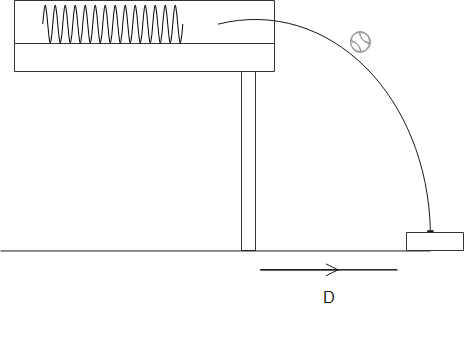
Two children are playing a game in which they try to hit a small box on the floor with a marvel fired from a spring-loaded gun that is mounted on a table. The target box is at a horizontal distance D = $2.2m$ from the edge of the table. Bobby compresses the spring $1.7cm$, but the center of the marble falls $27cm$ short of the center of the box. How far should Rhoda compress the spring to score a direct hit? Assume that neither the spring nor the ball encounters friction in the gun.
Answer
 Verified
554.4k+ views
Hint:For solving this question, we would require the concept of Range from projectile motion and the concept of spring forces and the conservation of mechanical energy. We see from the diagram that the value of desired range D is given and the value of range Bobby got is given.
Complete step by step solution:
Note that the question is of a projectile in horizontal direction launched from its maximum height, thus the vertical component of the launch is zero. The range of the ball can be found by the product of time taken and the initial speed of the ball. Now this speed is generated as the compression potential energy of the spring is converted to the kinetic energy of the ball. Now for horizontal projectiles, the height can also be easily found out. Thus the formulas are:
Distance \[\]$x = {v_0}t$ $ - - - - (1)$, where ${v_0}$ is the initial speed of the launch. Now the height of the table is:
$h = \dfrac{1}{2}g{t^2}$ $ - - - - (2)$ . Now $t$ is the time required for the travel from table to desired point.
By solving 1 and 2 we get $x = {v_0}\sqrt {2h/g} $ $ - - - - (3)$ . Thus we can see that distance of travel is directly proportional to the initial velocity of the ball.
Thus ${x^{}} \propto {v_0}^{}$$ - - - - (4)$
Now for Bobby’s shot, we see $x = 2.2 - 0.27 = 1.93m$ .
Now for the spring we see , if it's compressed to a length $l$ , the spring potential energy is $\dfrac{1}{2}k{l^2}$ . Now by conservation of mechanical energy, we see this potential is converted to kinetic of the ball, hence $\dfrac{1}{2}k{l^2} = \dfrac{1}{2}m{v_0}^2$. As both spring constant and mass are constant thus we can say the length of compressed spring is proportional to the initial velocity. Thus ${l^{}} \propto {v_0}^{}$$ - - - - (5)$
From 5 and 4 we can say: \[\dfrac{{{l_2}}}{{{l_1}}} = \dfrac{{{x_2}}}{{{x_1}}}\]
\[ \Rightarrow {l_2} = (\dfrac{{2.2}}{{1.93}}) \times 1.1 = 1.25cm\]
Note:These questions require the concept of energy transformation to solve, note that you do not make mistakes while making the relations as direct proportions or indirect proportions. The formulas of range, maximum height are to be remembered from projectile motion.
Complete step by step solution:
Note that the question is of a projectile in horizontal direction launched from its maximum height, thus the vertical component of the launch is zero. The range of the ball can be found by the product of time taken and the initial speed of the ball. Now this speed is generated as the compression potential energy of the spring is converted to the kinetic energy of the ball. Now for horizontal projectiles, the height can also be easily found out. Thus the formulas are:
Distance \[\]$x = {v_0}t$ $ - - - - (1)$, where ${v_0}$ is the initial speed of the launch. Now the height of the table is:
$h = \dfrac{1}{2}g{t^2}$ $ - - - - (2)$ . Now $t$ is the time required for the travel from table to desired point.
By solving 1 and 2 we get $x = {v_0}\sqrt {2h/g} $ $ - - - - (3)$ . Thus we can see that distance of travel is directly proportional to the initial velocity of the ball.
Thus ${x^{}} \propto {v_0}^{}$$ - - - - (4)$
Now for Bobby’s shot, we see $x = 2.2 - 0.27 = 1.93m$ .
Now for the spring we see , if it's compressed to a length $l$ , the spring potential energy is $\dfrac{1}{2}k{l^2}$ . Now by conservation of mechanical energy, we see this potential is converted to kinetic of the ball, hence $\dfrac{1}{2}k{l^2} = \dfrac{1}{2}m{v_0}^2$. As both spring constant and mass are constant thus we can say the length of compressed spring is proportional to the initial velocity. Thus ${l^{}} \propto {v_0}^{}$$ - - - - (5)$
From 5 and 4 we can say: \[\dfrac{{{l_2}}}{{{l_1}}} = \dfrac{{{x_2}}}{{{x_1}}}\]
\[ \Rightarrow {l_2} = (\dfrac{{2.2}}{{1.93}}) \times 1.1 = 1.25cm\]
Note:These questions require the concept of energy transformation to solve, note that you do not make mistakes while making the relations as direct proportions or indirect proportions. The formulas of range, maximum height are to be remembered from projectile motion.
Recently Updated Pages
Master Class 11 Social Science: Engaging Questions & Answers for Success

Master Class 11 English: Engaging Questions & Answers for Success
Master Class 11 Accountancy: Engaging Questions & Answers for Success
Master Class 11 Physics: Engaging Questions & Answers for Success
Master Class 11 Computer Science: Engaging Questions & Answers for Success
Master Class 11 Business Studies: Engaging Questions & Answers for Success
Trending doubts
One Metric ton is equal to kg A 10000 B 1000 C 100 class 11 physics CBSE
Find the value of the expression given below sin 30circ class 11 maths CBSE
Draw a diagram of nephron and explain its structur class 11 biology CBSE
10 examples of friction in our daily life
Proton was discovered by A Thomson B Rutherford C Chadwick class 11 chemistry CBSE
The teeth used for biting and cutting food are called class 11 biology CBSE