




Two charge particle P & Q having same charge \[1{\rm{\mu C}}\] and mass \[{\rm{4\mu kg}}\] are initially kept at the distance of \[1\;{\rm{mm}}\]. Charge P is fixed, then the velocity of charge particle Q when the separation between them becomes \[{\rm{9mm}}\].
A) $3 \times {10^8}\,{\rm{m/s}}$
B) $2 \times {10^8}\,{\rm{m/s}}$
C) $5 \times {10^8}\,{\rm{m/s}}$
D) $7 \times {10^8}\,{\rm{m/s}}$
Answer
 Verified
586.8k+ views
Hint: When two charged particles are kept at a distance say d, then there will be potential energy between the charges. This potential energy is due to the field created due to these charges.
Complete step by step answer:
Given:
The magnitude of charges on P and Q is \[1{\rm{\mu C}}\].
The mass of charges on P and Q is \[{\rm{4\mu kg}}\].
The distance between the charges is \[1\;{\rm{mm}}\].
The following diagram represents the given scenario:
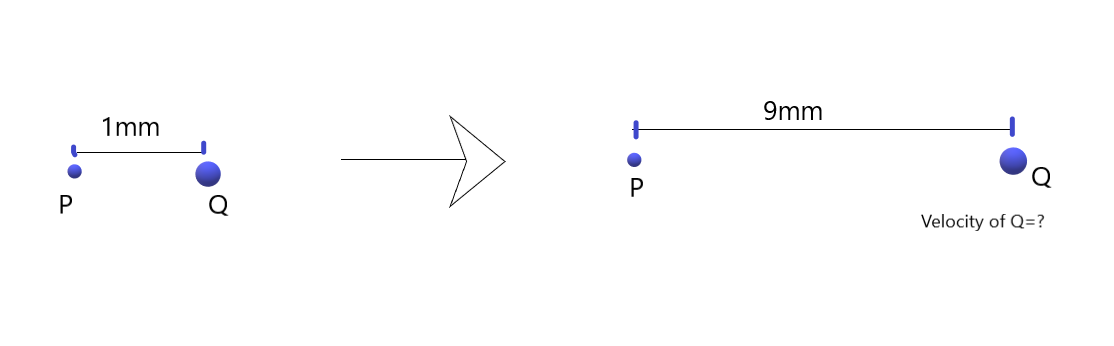
When the separation between the charged particle is increased, then there will be a considerable amount of work done in doing so that will decrease the potential energy.
We know that the formula for loss in potential energy is,
$PE = kQq\left[ {\dfrac{1}{{{r_1}}} - \dfrac{1}{{{r_2}}}} \right]$
Here, $k$ is constant and is $9 \times {10^9}\;{\rm{N }}{{\rm{m}}^2}/{\rm{C}}$, $Q$, $q$ are the two charges and ${r_1}$, ${r_2}$ are the initial and final separation between the charges.
This energy will increase the kinetic energy of the charged particle.
The formula for kinetic energy can be given as,
$KE = \dfrac{1}{2}m{v^2}$
Here, $m$ is mass and $v$ is velocity.
We know that the energy is conserved, only its form is changed, so the loss in potential energy is the gain in kinetic energy.
$\Rightarrow PE = KE$
$\Rightarrow kQq\left[ {\dfrac{1}{{{r_1}}} - \dfrac{1}{{{r_2}}}} \right] = \dfrac{1}{2}m{v^2}$
$\Rightarrow v = \sqrt {\dfrac{{2kQq}}{m}\left[ {\dfrac{1}{{{r_1}}} - \dfrac{1}{{{r_2}}}} \right]} $
We can now substitute the known values in the above equation.
$\Rightarrow v = \sqrt {\dfrac{{2 \times 9 \times {{10}^9} \times {{10}^{ - 6}} \times {{10}^{ - 6}}}}{{4 \times {{10}^{ - 6}}}}\left[ {\dfrac{1}{{{{10}^{ - 3}}}} - \dfrac{1}{{9 \times {{10}^{ - 3}}}}} \right]}$
$\Rightarrow v= 2 \times {10^3}\;{\rm{m/s}}$
$\therefore$ The velocity of charge particle Q when the separation between them becomes \[{\rm{9mm}}\] is $2 \times {10^3}\;{\rm{m/s}}$, so from the given options, option B is correct.
Note:
Make sure to remember that there will be a loss in potential energy. This loss in potential will be converted to gain in kinetic energy. The law of conservation of energy will be applied here. Also, convert the units to standard units, as the units in the question are not in standard form.
Complete step by step answer:
Given:
The magnitude of charges on P and Q is \[1{\rm{\mu C}}\].
The mass of charges on P and Q is \[{\rm{4\mu kg}}\].
The distance between the charges is \[1\;{\rm{mm}}\].
The following diagram represents the given scenario:
When the separation between the charged particle is increased, then there will be a considerable amount of work done in doing so that will decrease the potential energy.
We know that the formula for loss in potential energy is,
$PE = kQq\left[ {\dfrac{1}{{{r_1}}} - \dfrac{1}{{{r_2}}}} \right]$
Here, $k$ is constant and is $9 \times {10^9}\;{\rm{N }}{{\rm{m}}^2}/{\rm{C}}$, $Q$, $q$ are the two charges and ${r_1}$, ${r_2}$ are the initial and final separation between the charges.
This energy will increase the kinetic energy of the charged particle.
The formula for kinetic energy can be given as,
$KE = \dfrac{1}{2}m{v^2}$
Here, $m$ is mass and $v$ is velocity.
We know that the energy is conserved, only its form is changed, so the loss in potential energy is the gain in kinetic energy.
$\Rightarrow PE = KE$
$\Rightarrow kQq\left[ {\dfrac{1}{{{r_1}}} - \dfrac{1}{{{r_2}}}} \right] = \dfrac{1}{2}m{v^2}$
$\Rightarrow v = \sqrt {\dfrac{{2kQq}}{m}\left[ {\dfrac{1}{{{r_1}}} - \dfrac{1}{{{r_2}}}} \right]} $
We can now substitute the known values in the above equation.
$\Rightarrow v = \sqrt {\dfrac{{2 \times 9 \times {{10}^9} \times {{10}^{ - 6}} \times {{10}^{ - 6}}}}{{4 \times {{10}^{ - 6}}}}\left[ {\dfrac{1}{{{{10}^{ - 3}}}} - \dfrac{1}{{9 \times {{10}^{ - 3}}}}} \right]}$
$\Rightarrow v= 2 \times {10^3}\;{\rm{m/s}}$
$\therefore$ The velocity of charge particle Q when the separation between them becomes \[{\rm{9mm}}\] is $2 \times {10^3}\;{\rm{m/s}}$, so from the given options, option B is correct.
Note:
Make sure to remember that there will be a loss in potential energy. This loss in potential will be converted to gain in kinetic energy. The law of conservation of energy will be applied here. Also, convert the units to standard units, as the units in the question are not in standard form.
Recently Updated Pages
Master Class 12 Economics: Engaging Questions & Answers for Success

Master Class 12 Physics: Engaging Questions & Answers for Success
Master Class 12 English: Engaging Questions & Answers for Success
Master Class 12 Social Science: Engaging Questions & Answers for Success
Master Class 12 Maths: Engaging Questions & Answers for Success
Master Class 12 Business Studies: Engaging Questions & Answers for Success
Trending doubts
Which are the Top 10 Largest Countries of the World?
What are the major means of transport Explain each class 12 social science CBSE
Draw a labelled sketch of the human eye class 12 physics CBSE
Differentiate between insitu conservation and exsitu class 12 biology CBSE
Draw a neat and well labeled diagram of TS of ovary class 12 biology CBSE
Give 10 examples of unisexual and bisexual flowers