




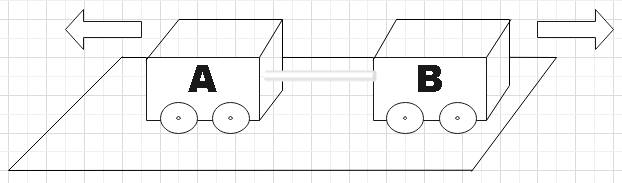
Two carts of masses 200kg and 300kg on horizontal rails are pushed apart. Suppose the coefficient of friction between the carts and the rails are the same. If the 200kg cart travels a distance of 36m and stops, then the distance traveled by the cart weighing 300kg is
A. 32m
B. 24m
C. 16m
D. 12m
Answer
 Verified
561.9k+ views
Hint: As a first step, read and understand the given question properly and then list down the given quantities in the question. You could then use conservation of momentum to get the ratio of velocities of the carts after being pushed apart. Then, apply the law of conservation of energy and use this above found ratio and find the answer.
Formula used:
Kinetic energy,
$K.E=\dfrac{1}{2}m{{v}^{2}}$
Momentum,
$p=mv$
Frictional force,
$f=\mu mg$
Complete answer:
Here, we have two carts of different masses that are being pushed apart. By applying the law conservation of momentum, we get,
We get,
${{m}_{1}}{{v}_{1}}={{m}_{2}}{{v}_{2}}$
$\Rightarrow 200{{v}_{1}}=300{{v}_{2}}$
$\Rightarrow \dfrac{{{v}_{1}}}{{{v}_{2}}}=\dfrac{3}{2}$ …………………………………………. (1)
From the law of conservation of energy we know that the kinetic energy obtained by the carts on being pushed apart is equal to the work done by the frictional force to stop them. So,
$\dfrac{K.{{E}_{1}}}{K.{{E}_{2}}}=\dfrac{\dfrac{1}{2}{{m}_{1}}{{v}_{1}}^{2}}{\dfrac{1}{2}{{m}_{2}}{{v}_{2}}^{2}}=\dfrac{{{W}_{1}}}{{{W}_{2}}}=\dfrac{{{f}_{1}}\times {{x}_{1}}}{{{f}_{2}}\times {{x}_{2}}}$
$\Rightarrow \dfrac{{{m}_{1}}}{{{m}_{2}}}{{\left( \dfrac{{{v}_{1}}}{{{v}_{2}}} \right)}^{2}}=\dfrac{{{f}_{1}}{{x}_{1}}}{{{f}_{2}}{{x}_{2}}}$
We know that the frictional force is given by, $f=\mu mg$
Here, the coefficient of friction $\mu $ is same for both the carts, so,
$\dfrac{{{m}_{1}}}{{{m}_{2}}}{{\left( \dfrac{{{v}_{1}}}{{{v}_{2}}} \right)}^{2}}=\dfrac{\mu {{m}_{1}}g{{x}_{1}}}{\mu {{m}_{2}}g{{x}_{2}}}$
$\Rightarrow {{\left( \dfrac{{{v}_{1}}}{{{v}_{2}}} \right)}^{2}}=\dfrac{{{x}_{1}}}{{{x}_{2}}}$
We are given that, ${{x}_{1}}=36m$ also, from (1) we get,
$\Rightarrow \dfrac{9}{4}=\dfrac{36}{{{x}_{2}}}$
$\therefore {{x}_{2}}=16m$
Therefore, we found that the cart B will move by a distance of 16m.
Hence, option C is correct.
Note:
Law of conservation of momentum states that, after any event, say an explosion or collision, the total momentum remains constant. The law of conservation of energy states that the energy can neither be created nor be destroyed but can be converted from one form to another. These are the two principles used in this solution.
Formula used:
Kinetic energy,
$K.E=\dfrac{1}{2}m{{v}^{2}}$
Momentum,
$p=mv$
Frictional force,
$f=\mu mg$
Complete answer:
Here, we have two carts of different masses that are being pushed apart. By applying the law conservation of momentum, we get,
We get,
${{m}_{1}}{{v}_{1}}={{m}_{2}}{{v}_{2}}$
$\Rightarrow 200{{v}_{1}}=300{{v}_{2}}$
$\Rightarrow \dfrac{{{v}_{1}}}{{{v}_{2}}}=\dfrac{3}{2}$ …………………………………………. (1)
From the law of conservation of energy we know that the kinetic energy obtained by the carts on being pushed apart is equal to the work done by the frictional force to stop them. So,
$\dfrac{K.{{E}_{1}}}{K.{{E}_{2}}}=\dfrac{\dfrac{1}{2}{{m}_{1}}{{v}_{1}}^{2}}{\dfrac{1}{2}{{m}_{2}}{{v}_{2}}^{2}}=\dfrac{{{W}_{1}}}{{{W}_{2}}}=\dfrac{{{f}_{1}}\times {{x}_{1}}}{{{f}_{2}}\times {{x}_{2}}}$
$\Rightarrow \dfrac{{{m}_{1}}}{{{m}_{2}}}{{\left( \dfrac{{{v}_{1}}}{{{v}_{2}}} \right)}^{2}}=\dfrac{{{f}_{1}}{{x}_{1}}}{{{f}_{2}}{{x}_{2}}}$
We know that the frictional force is given by, $f=\mu mg$
Here, the coefficient of friction $\mu $ is same for both the carts, so,
$\dfrac{{{m}_{1}}}{{{m}_{2}}}{{\left( \dfrac{{{v}_{1}}}{{{v}_{2}}} \right)}^{2}}=\dfrac{\mu {{m}_{1}}g{{x}_{1}}}{\mu {{m}_{2}}g{{x}_{2}}}$
$\Rightarrow {{\left( \dfrac{{{v}_{1}}}{{{v}_{2}}} \right)}^{2}}=\dfrac{{{x}_{1}}}{{{x}_{2}}}$
We are given that, ${{x}_{1}}=36m$ also, from (1) we get,
$\Rightarrow \dfrac{9}{4}=\dfrac{36}{{{x}_{2}}}$
$\therefore {{x}_{2}}=16m$
Therefore, we found that the cart B will move by a distance of 16m.
Hence, option C is correct.
Note:
Law of conservation of momentum states that, after any event, say an explosion or collision, the total momentum remains constant. The law of conservation of energy states that the energy can neither be created nor be destroyed but can be converted from one form to another. These are the two principles used in this solution.
Recently Updated Pages
Master Class 11 Social Science: Engaging Questions & Answers for Success

Master Class 11 English: Engaging Questions & Answers for Success
Master Class 11 Maths: Engaging Questions & Answers for Success
Master Class 11 Chemistry: Engaging Questions & Answers for Success
Master Class 11 Biology: Engaging Questions & Answers for Success
Master Class 11 Physics: Engaging Questions & Answers for Success
Trending doubts
Differentiate between an exothermic and an endothermic class 11 chemistry CBSE
One Metric ton is equal to kg A 10000 B 1000 C 100 class 11 physics CBSE
Difference Between Prokaryotic Cells and Eukaryotic Cells
There are 720 permutations of the digits 1 2 3 4 5 class 11 maths CBSE
Two of the body parts which do not appear in MRI are class 11 biology CBSE
Which gas is abundant in air class 11 chemistry CBSE