




Two cars start out simultaneously from an appointment in the same direction, one of them going at a speed $50kmh^{-1}$ and the other at $40kmh^{-1}$. In half an hour a third car starts from the same point and overtakes the first car in\[1.5h\] after catching up with the second car. The speed of the third car is:
\[\begin{align}
& A.\text{ }55km{{h}^{-1}} \\
& B.\text{ }60km{{h}^{-1}} \\
& C.\text{ }72km{{h}^{-1}} \\
& D.\text{ }90km{{h}^{-1}} \\
\end{align}\]
Answer
 Verified
590.7k+ views
Hint: First, we need to calculate the distance travelled by $A$ and $B$ before $C$ started. Then we must equate the distance covered by $C$ when it tries to overtake $B$ and $A$ respectively. Solving the equations, we can find the speed of $C$.
Formula used: distance =speed $\times$ time
Complete step by step solution:
To begin with let us name the first car as $A$ with speed $v_{A}=50km/h$, second car $B$ with speed $v_{B}=40km/h$ and the third car $C$ with speed $v$.
Then, when $C$ starts \[0.5h\] after $A$ and $B$, $A$ and $B$ would have covered a certain distance, the distance covered by $A$ and $B$ is given as, $distance =speed\times time$
Then $d_{A}=v_{A}\times t=50\times 0.5=25km$ and $d_{B}=v_{B}\times t=40\times 0.5=20km$
We can represent the above data on as follows:
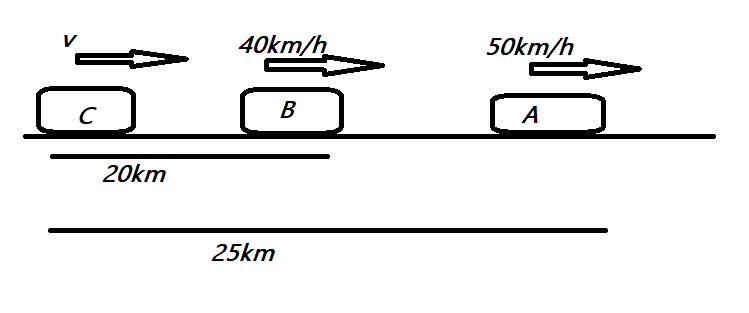
Let us assume that, $C$ overtakes $B$ after $T$ hrs time from when it started, then, the distance covered by $C$ should be equal to the distance covered by $B$,then we can represent this statement mathematically as:
$vT=40T+20$ as the $B$ is still in motion and ahead of $C$ by \[20km\]
Or $T=\dfrac{20}{v-40}$
Also, it is given that $C$ overtakes $A$,\[1.5h\] after catching up with , then we cay ,$C$ overtakes $A$, after $T+1.5$ hrs, then, the distance covered by $C$ should be equal to the distance covered by $A$ then we can represent this statement mathematically as:
$v(T+1.5)=50(T+1.5)+25$ as $A$ is still in motion and ahead of $C$ by \[25km\]
Or $vT=50T+75+25-1.5v$
Or $vT=50T+100-1.5v$
Or$T(v-50)=100-1.5v$
We can substitute for $T$, we get,
Or, $1.5v^{2}-140v+3000=0$
$v=\dfrac{140\pm\sqrt{(-140^{2}-1.5\times 3000)}}{2\times 1.5}$
Solving, we get,$v=60km/h$ or $\dfrac{100}{3}km/h$
To overtake $A$ the speed of $C$ must be greater than the speed of $A$ hence $v=60km/h$
So, the correct answer is “Option B”.
Note: To overtake $A$ and $B$ which started earlier than $C$ the speed of $C$ must be the greatest of all three speeds. Also, for easy calculations, convert all the distances to kilometres and all the time taken to hours as speed is expressed by $km/h$.
Formula used: distance =speed $\times$ time
Complete step by step solution:
To begin with let us name the first car as $A$ with speed $v_{A}=50km/h$, second car $B$ with speed $v_{B}=40km/h$ and the third car $C$ with speed $v$.
Then, when $C$ starts \[0.5h\] after $A$ and $B$, $A$ and $B$ would have covered a certain distance, the distance covered by $A$ and $B$ is given as, $distance =speed\times time$
Then $d_{A}=v_{A}\times t=50\times 0.5=25km$ and $d_{B}=v_{B}\times t=40\times 0.5=20km$
We can represent the above data on as follows:
Let us assume that, $C$ overtakes $B$ after $T$ hrs time from when it started, then, the distance covered by $C$ should be equal to the distance covered by $B$,then we can represent this statement mathematically as:
$vT=40T+20$ as the $B$ is still in motion and ahead of $C$ by \[20km\]
Or $T=\dfrac{20}{v-40}$
Also, it is given that $C$ overtakes $A$,\[1.5h\] after catching up with , then we cay ,$C$ overtakes $A$, after $T+1.5$ hrs, then, the distance covered by $C$ should be equal to the distance covered by $A$ then we can represent this statement mathematically as:
$v(T+1.5)=50(T+1.5)+25$ as $A$ is still in motion and ahead of $C$ by \[25km\]
Or $vT=50T+75+25-1.5v$
Or $vT=50T+100-1.5v$
Or$T(v-50)=100-1.5v$
We can substitute for $T$, we get,
Or, $1.5v^{2}-140v+3000=0$
$v=\dfrac{140\pm\sqrt{(-140^{2}-1.5\times 3000)}}{2\times 1.5}$
Solving, we get,$v=60km/h$ or $\dfrac{100}{3}km/h$
To overtake $A$ the speed of $C$ must be greater than the speed of $A$ hence $v=60km/h$
So, the correct answer is “Option B”.
Note: To overtake $A$ and $B$ which started earlier than $C$ the speed of $C$ must be the greatest of all three speeds. Also, for easy calculations, convert all the distances to kilometres and all the time taken to hours as speed is expressed by $km/h$.
Recently Updated Pages
Master Class 11 Social Science: Engaging Questions & Answers for Success

Master Class 11 Physics: Engaging Questions & Answers for Success
Master Class 11 Maths: Engaging Questions & Answers for Success
Master Class 11 Economics: Engaging Questions & Answers for Success
Master Class 11 Computer Science: Engaging Questions & Answers for Success
Master Class 11 Chemistry: Engaging Questions & Answers for Success
Trending doubts
Discuss the various forms of bacteria class 11 biology CBSE
10 examples of friction in our daily life
What organs are located on the left side of your body class 11 biology CBSE
Draw a labelled diagram showing structure of LS of class 11 biology CBSE
How many rings are present in MEDTA+n class 11 chemistry CBSE
Draw the molecular orbital diagram of N2N2 + N2 Write class 11 chemistry CBSE