




Two cars start from opposite places on a main road, 150 km apart. First car runs 25 km and takes a right turn and then runs 15 km. It then turns left and runs for another 25 km and then takes the direction to reach the main road. In the meantime, due to a minor breakdown the other car has only 35 km along the main road. What would be the distance between two cars at this instant?
A. 65 km
B. 75 km
C. 80 km
D. 85 km
Answer
 Verified
621.9k+ views
Hint: In order to understand the question, first we need to draw a diagram according to the directions given for the cars. The distance between car A and car B at an instant will be the difference of their final positions at that instant of time. The direction of motion of car A and car B is opposite to each other and travelling towards each other.
Complete step-by-step answer:
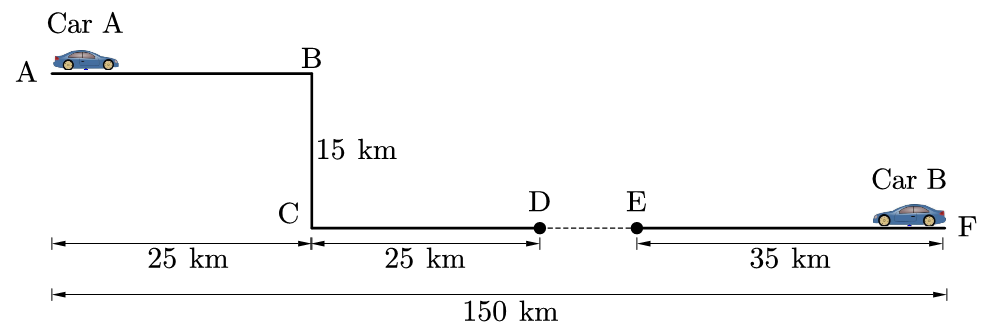
Distance between car A and car B is 150 km.
For car A
The distance covered AB = 25 km
Then, after taking right turn, it covers distance BC = 15 km
Then, again after taking left turn, it covers distance CD = 25 km
So, the net horizontal distance covered by car A = AB + CD
${{s}_{carA}}=25+25=50km$
For car B
The net distance it covers is FE.
${{s}_{carB}}=35km$
Hence, by applying geometrical mathematics we can calculate the distance between them.
The distance between them is DE = Total distance – (distance covered by car A + distance covered by car B)
$DE=AF-({{s}_{carA}}+{{s}_{carB}})$
$DE=150-(50+35)$
$DE=65km$
Therefore, the distance between car A and car B is 65 km.
Note: 1. In these types of questions, it is important to draw a diagram to understand the problem.
2. It should be noted that the distance 15 km between the cars does not affect the overall distance as this distance of 15 km is covered in vertical direction and does not need to be added to the total distance.
Complete step-by-step answer:
Distance between car A and car B is 150 km.
For car A
The distance covered AB = 25 km
Then, after taking right turn, it covers distance BC = 15 km
Then, again after taking left turn, it covers distance CD = 25 km
So, the net horizontal distance covered by car A = AB + CD
${{s}_{carA}}=25+25=50km$
For car B
The net distance it covers is FE.
${{s}_{carB}}=35km$
Hence, by applying geometrical mathematics we can calculate the distance between them.
The distance between them is DE = Total distance – (distance covered by car A + distance covered by car B)
$DE=AF-({{s}_{carA}}+{{s}_{carB}})$
$DE=150-(50+35)$
$DE=65km$
Therefore, the distance between car A and car B is 65 km.
Note: 1. In these types of questions, it is important to draw a diagram to understand the problem.
2. It should be noted that the distance 15 km between the cars does not affect the overall distance as this distance of 15 km is covered in vertical direction and does not need to be added to the total distance.
Recently Updated Pages
Master Class 11 Social Science: Engaging Questions & Answers for Success

Master Class 11 English: Engaging Questions & Answers for Success
Master Class 11 Maths: Engaging Questions & Answers for Success
Master Class 11 Chemistry: Engaging Questions & Answers for Success
Master Class 11 Biology: Engaging Questions & Answers for Success
Master Class 11 Physics: Engaging Questions & Answers for Success
Trending doubts
Differentiate between an exothermic and an endothermic class 11 chemistry CBSE
One Metric ton is equal to kg A 10000 B 1000 C 100 class 11 physics CBSE
Difference Between Prokaryotic Cells and Eukaryotic Cells
There are 720 permutations of the digits 1 2 3 4 5 class 11 maths CBSE
Two of the body parts which do not appear in MRI are class 11 biology CBSE
Which gas is abundant in air class 11 chemistry CBSE