




Two cars A and B are initially 100m apart with A behind B car A starts from rest with a constant acceleration $2m/s^2$ towards car B and at the same instant car B starts moving with constant velocity 10m/s in the same direction. Time after which car A overtakes car B is:
A. 14.36s
B. 16.18s
C. 10s
D. 16.54s
Answer
 Verified
584.4k+ views
Hint: We have provided two cars A and B. Distance between these two cars is 100m. Car A is at rest, initially. So we use kinematic equation to calculate the distance travel by car A. similarly calculate the distance travel by car B. In case of the B, velocity is uniform therefore the value of the acceleration will be zero then calculate distance when car A overtakes car B. Put values in this equation, you will get a quadratic equation. Solve the quadratic equation and get the value of the time.
Formula used:
Kinetic equation is given as
$s=ut+\dfrac{1}{2}a{{t}^{2}}$
Where u= initial velocity, t= time , a= acceleration , s = displacement
Complete answer:
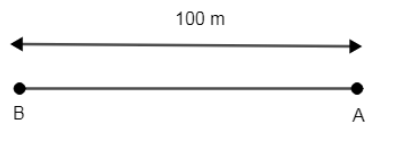
We have given two cars named as A and B which are 100m away from each other. Car A starts from rest. So the distance travelled by car A is ${{s}_{A}}$ after that car B also starts moving. So the distance travelled by car B is${{s}_{B}}$. Note that both cars start at the same instant. So according to kinematic formula distance (s) is given by $s=ut+\dfrac{1}{2}a{{t}^{2}}......(1)$
For car A:
Apply equation (1) for car A. Since car a starts from rest, therefore value of initial velocity is zero. Which is denoted as u=0 hence, equation (1) is given as,
$\begin{align}
& {{s}_{A}}=0t+\dfrac{1}{2}\times 2{{t}^{2}} \\
& {{s}_{A}}={{t}^{2}}.....(1) \\
\end{align}$
For car B: since A and B starts at the same instant and A was the rest (initially) and the initial velocity of the car B is 10m/s. hence, equation (1) is given as
${{s}_{B}}=10t+\dfrac{1}{2}\times a{{t}^{2}}$
Since, car B is moving with the constant velocity therefore derivative of the velocity is nothing but the acceleration is zero i.e. a=0 thus,
$\begin{align}
& {{s}_{B}}=10t+\dfrac{1}{2}0{{t}^{2}} \\
& {{s}_{B}}=10t.....(2) \\
\end{align}$
It is given that car A will overtake car B when ${{s}_{A}}={{s}_{B}}+100$
Now put value of ${{s}_{A}}$ and ${{s}_{B}}$ , we get
$\begin{align}
& {{t}^{2}}=10t+100 \\
& {{t}^{2}}-10t-100=0 \\
\end{align}$
Now, solve above quadratic equation
$\begin{align}
& t=\dfrac{-b\pm \sqrt{{{b}^{2}}-4ae}}{2a} \\
& =\dfrac{-(-10)\pm \sqrt{{{(10)}^{2}}-4\times 1\times (-100)}}{2\times 1} \\
& t=\dfrac{10\pm \sqrt{100+400}}{2} \\
& {{t}_{1}}=\dfrac{10+\sqrt{500}}{2};{{t}_{2}}=\dfrac{10-\sqrt{500}}{2} \\
& {{t}_{1}}=16.18\sec ;{{t}_{2}}=-6.10\sec \\
\end{align}$
We know that, time $t_2=-6.10$sec will not be possible hence, time after which car A overtakes car B is 16.18sec.
Therefore the correct option is (B).
Note:
In this case car A and the car B Is overtaking and they are not colliding. Because of overtaking, extra distance has been covered which is given as ${{s}_{A}}-{{s}_{B}}=100$. Velocity of car B is uniform while moving, it means car B must be possessing uniform motion. Hence car travelling along a straight road, perform reclinear i.e., linear motion. These cars take turns along a curved road. Then it performs a curvy linear motion.
Formula used:
Kinetic equation is given as
$s=ut+\dfrac{1}{2}a{{t}^{2}}$
Where u= initial velocity, t= time , a= acceleration , s = displacement
Complete answer:
We have given two cars named as A and B which are 100m away from each other. Car A starts from rest. So the distance travelled by car A is ${{s}_{A}}$ after that car B also starts moving. So the distance travelled by car B is${{s}_{B}}$. Note that both cars start at the same instant. So according to kinematic formula distance (s) is given by $s=ut+\dfrac{1}{2}a{{t}^{2}}......(1)$
For car A:
Apply equation (1) for car A. Since car a starts from rest, therefore value of initial velocity is zero. Which is denoted as u=0 hence, equation (1) is given as,
$\begin{align}
& {{s}_{A}}=0t+\dfrac{1}{2}\times 2{{t}^{2}} \\
& {{s}_{A}}={{t}^{2}}.....(1) \\
\end{align}$
For car B: since A and B starts at the same instant and A was the rest (initially) and the initial velocity of the car B is 10m/s. hence, equation (1) is given as
${{s}_{B}}=10t+\dfrac{1}{2}\times a{{t}^{2}}$
Since, car B is moving with the constant velocity therefore derivative of the velocity is nothing but the acceleration is zero i.e. a=0 thus,
$\begin{align}
& {{s}_{B}}=10t+\dfrac{1}{2}0{{t}^{2}} \\
& {{s}_{B}}=10t.....(2) \\
\end{align}$
It is given that car A will overtake car B when ${{s}_{A}}={{s}_{B}}+100$
Now put value of ${{s}_{A}}$ and ${{s}_{B}}$ , we get
$\begin{align}
& {{t}^{2}}=10t+100 \\
& {{t}^{2}}-10t-100=0 \\
\end{align}$
Now, solve above quadratic equation
$\begin{align}
& t=\dfrac{-b\pm \sqrt{{{b}^{2}}-4ae}}{2a} \\
& =\dfrac{-(-10)\pm \sqrt{{{(10)}^{2}}-4\times 1\times (-100)}}{2\times 1} \\
& t=\dfrac{10\pm \sqrt{100+400}}{2} \\
& {{t}_{1}}=\dfrac{10+\sqrt{500}}{2};{{t}_{2}}=\dfrac{10-\sqrt{500}}{2} \\
& {{t}_{1}}=16.18\sec ;{{t}_{2}}=-6.10\sec \\
\end{align}$
We know that, time $t_2=-6.10$sec will not be possible hence, time after which car A overtakes car B is 16.18sec.
Therefore the correct option is (B).
Note:
In this case car A and the car B Is overtaking and they are not colliding. Because of overtaking, extra distance has been covered which is given as ${{s}_{A}}-{{s}_{B}}=100$. Velocity of car B is uniform while moving, it means car B must be possessing uniform motion. Hence car travelling along a straight road, perform reclinear i.e., linear motion. These cars take turns along a curved road. Then it performs a curvy linear motion.
Recently Updated Pages
Master Class 11 Computer Science: Engaging Questions & Answers for Success

Master Class 11 Business Studies: Engaging Questions & Answers for Success
Master Class 11 Economics: Engaging Questions & Answers for Success
Master Class 11 English: Engaging Questions & Answers for Success
Master Class 11 Maths: Engaging Questions & Answers for Success
Master Class 11 Biology: Engaging Questions & Answers for Success
Trending doubts
One Metric ton is equal to kg A 10000 B 1000 C 100 class 11 physics CBSE
There are 720 permutations of the digits 1 2 3 4 5 class 11 maths CBSE
Discuss the various forms of bacteria class 11 biology CBSE
Draw a diagram of a plant cell and label at least eight class 11 biology CBSE
State the laws of reflection of light
Explain zero factorial class 11 maths CBSE