




Two brands of chocolates are available in packs of 24 and 15 respectively. If I need to buy an equal number of chocolates of both kinds, what is the least number of boxes of each kind I would need to buy?
A. 2 of first kind, 8 of second kind
B. 5 of first kind, 8 of second kind
C. 5 of first kind, 7 of second kind
D. 2 of first kind, 7 of second kind
Answer
 Verified
637.2k+ views
Hint: By prime factorization method take the LCM of the number of chocolates of both brands. To get the least number of boxes, find LCM (24, 15) to the number of chocolate per box.
“Complete step-by-step answer:”
Given the number of chocolate of ${{1}^{st}}$ brand in one pack = 24
The number of chocolate of ${{2}^{nd}}$ brand in one pack = 15
To find the least number of boxes of each kind first we have to find the LCM of 24 and 15.
LCM by prime factorization method.
The method of prime factorization is used to “break down” or express a given number as a product of prime numbers.
The prime number will occur more than once in the prime factorization.
Where the prime number is a whole number which is greater than 1, it is only divisible by 1 and itself.
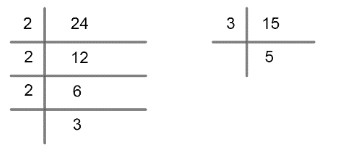
LCM of 24 $=2\times 2\times 2\times 3={{2}^{3}}\times 3$
LCM of 15 $=3\times 5$
LCM of two numbers = product of the greater power of each prime factor involved in the numbers, with highest power.
LCM of 24 \[=2\times 2\times 2\times \times 5\]
LCM of 15 $=\times 5$
$\therefore $ LCM of 24 and 15 $=2\times 2\times 2\times 3\times 5$
LCM (24, 15) = 120
Hence, the number of packet of ${{1}^{st}}$ brand $=\dfrac{\text{LCM }\left( 24,15 \right)}{\text{Number of chocolate in }{{\text{1}}^{st}}\text{ brand}}$
$=\dfrac{120}{24}=5$
Number of packets in ${{2}^{nd}}$ brand $=\dfrac{\text{LCM }\left( 24,15 \right)}{\text{Number of chocolate in }{{\text{2}}^{nd}}\text{ brand}}$
$=\dfrac{120}{15}=8$
$\therefore $ 5 of first kind, 8 of second kind
Note: Another way of finding the least number of boxes of both kind,
Number of packet of ${{1}^{st}}$ brand = 24 = 3 x 8
Number of packets in ${{2}^{nd}}$ brand = 15 = 3 x 5
24 = 3 x 8
15 = 3 x 5
$\therefore $ 8 of ${{1}^{st}}$kind and 5 of ${{2}^{nd}}$kind.
“Complete step-by-step answer:”
Given the number of chocolate of ${{1}^{st}}$ brand in one pack = 24
The number of chocolate of ${{2}^{nd}}$ brand in one pack = 15
To find the least number of boxes of each kind first we have to find the LCM of 24 and 15.
LCM by prime factorization method.
The method of prime factorization is used to “break down” or express a given number as a product of prime numbers.
The prime number will occur more than once in the prime factorization.
Where the prime number is a whole number which is greater than 1, it is only divisible by 1 and itself.
LCM of 24 $=2\times 2\times 2\times 3={{2}^{3}}\times 3$
LCM of 15 $=3\times 5$
LCM of two numbers = product of the greater power of each prime factor involved in the numbers, with highest power.
LCM of 24 \[=2\times 2\times 2\times \times 5\]
LCM of 15 $=\times 5$
$\therefore $ LCM of 24 and 15 $=2\times 2\times 2\times 3\times 5$
LCM (24, 15) = 120
Hence, the number of packet of ${{1}^{st}}$ brand $=\dfrac{\text{LCM }\left( 24,15 \right)}{\text{Number of chocolate in }{{\text{1}}^{st}}\text{ brand}}$
$=\dfrac{120}{24}=5$
Number of packets in ${{2}^{nd}}$ brand $=\dfrac{\text{LCM }\left( 24,15 \right)}{\text{Number of chocolate in }{{\text{2}}^{nd}}\text{ brand}}$
$=\dfrac{120}{15}=8$
$\therefore $ 5 of first kind, 8 of second kind
Note: Another way of finding the least number of boxes of both kind,
Number of packet of ${{1}^{st}}$ brand = 24 = 3 x 8
Number of packets in ${{2}^{nd}}$ brand = 15 = 3 x 5
24 = 3 x 8
15 = 3 x 5
$\therefore $ 8 of ${{1}^{st}}$kind and 5 of ${{2}^{nd}}$kind.
Recently Updated Pages
Master Class 11 English: Engaging Questions & Answers for Success

Master Class 11 Maths: Engaging Questions & Answers for Success
Class 11 Question and Answer - Your Ultimate Solutions Guide
Master Class 11 Biology: Engaging Questions & Answers for Success
Master Class 11 Physics: Engaging Questions & Answers for Success
Master Class 11 Accountancy: Engaging Questions & Answers for Success
Trending doubts
Differentiate between an exothermic and an endothermic class 11 chemistry CBSE
One Metric ton is equal to kg A 10000 B 1000 C 100 class 11 physics CBSE
There are 720 permutations of the digits 1 2 3 4 5 class 11 maths CBSE
In what year Guru Nanak Dev ji was born A15 April 1469 class 11 social science CBSE
Difference Between Prokaryotic Cells and Eukaryotic Cells
Draw a diagram of a plant cell and label at least eight class 11 biology CBSE