




Two boys are holding a horizontal rod of length L and weight W through its two ends. If now one of the boys suddenly leaves the rod, what is the instantaneous reaction force experienced by the other boy?
A. $\dfrac{W}{4}$
B. $\dfrac{W}{2}$
C. $\dfrac{{3W}}{4}$
D. W
Answer
 Verified
646.5k+ views
Hint: In this question, when both the boys are holding the rod there is no motion of the rod. The system is in equilibrium. As soon as one of the boys suddenly leaves the rod, torque acts on the rod. The center of mass will have some acceleration. By balancing the equations, we can find the instantaneous reaction force.
Complete step by step answer:
Initially the two boys are holding the rod in a horizontal manner. In this position the rod is balanced. As soon as one of the boys leaves the rod, there is unbalanced force at one end of the rod. We know that when we apply force to one end of the rod there is rotational motion of the rod. Let us draw the free body diagram for the same:
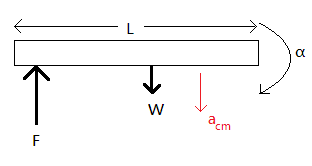
Consider, F is the force given by one boy.
W is the weight of the rod
m is the mass of the rod
L is the length of the rod
${a_{cm}}$ is the acceleration of the centre of mass of the rod
$\alpha $ is the instantaneous angular acceleration of the rod
As soon as one boy leaves the rod, torque acts on the rod and this torque $\tau $ is given as
$\tau = {\rm I}\alpha $
Where I is the moment of inertia of the rod and has value ${\rm I} = \dfrac{{m{L^2}}}{3}$
$ \Rightarrow \tau = \dfrac{{m{L^2}}}{3}\alpha $
The torque acts at the centre of the rod and has force equal to the product of its mass and acceleration due to gravity
$ \Rightarrow mg\dfrac{L}{2} = \dfrac{{m{L^2}}}{3}\alpha $
$ \Rightarrow \dfrac{{3g}}{{2L}} = \alpha $ --equation $1$
The acceleration of the centre of the mass of the rod is given as
${a_{cm}} = \dfrac{L}{2}\alpha $ --equation $2$
The vertical linear forces on the rod are
$W - F = ma$
$ \Rightarrow mg - F = m\left( {\dfrac{{3g}}{4}} \right)$
$ \Rightarrow F = \dfrac{{mg}}{4}$
$ \Rightarrow F = \dfrac{W}{4}$
This is the instantaneous reaction force acting on the second boy.
So, the correct answer is “Option A”.
Note:
The forces on the rod are balanced vertically.
As soon as one of the boys leaves the rod, the rod has a tendency to perform rotational motion.
The centre through to the rod performs rotational motion is known as instantaneous centre of rotation.
The rod will have linear as well as angular acceleration.
Complete step by step answer:
Initially the two boys are holding the rod in a horizontal manner. In this position the rod is balanced. As soon as one of the boys leaves the rod, there is unbalanced force at one end of the rod. We know that when we apply force to one end of the rod there is rotational motion of the rod. Let us draw the free body diagram for the same:
Consider, F is the force given by one boy.
W is the weight of the rod
m is the mass of the rod
L is the length of the rod
${a_{cm}}$ is the acceleration of the centre of mass of the rod
$\alpha $ is the instantaneous angular acceleration of the rod
As soon as one boy leaves the rod, torque acts on the rod and this torque $\tau $ is given as
$\tau = {\rm I}\alpha $
Where I is the moment of inertia of the rod and has value ${\rm I} = \dfrac{{m{L^2}}}{3}$
$ \Rightarrow \tau = \dfrac{{m{L^2}}}{3}\alpha $
The torque acts at the centre of the rod and has force equal to the product of its mass and acceleration due to gravity
$ \Rightarrow mg\dfrac{L}{2} = \dfrac{{m{L^2}}}{3}\alpha $
$ \Rightarrow \dfrac{{3g}}{{2L}} = \alpha $ --equation $1$
The acceleration of the centre of the mass of the rod is given as
${a_{cm}} = \dfrac{L}{2}\alpha $ --equation $2$
The vertical linear forces on the rod are
$W - F = ma$
$ \Rightarrow mg - F = m\left( {\dfrac{{3g}}{4}} \right)$
$ \Rightarrow F = \dfrac{{mg}}{4}$
$ \Rightarrow F = \dfrac{W}{4}$
This is the instantaneous reaction force acting on the second boy.
So, the correct answer is “Option A”.
Note:
The forces on the rod are balanced vertically.
As soon as one of the boys leaves the rod, the rod has a tendency to perform rotational motion.
The centre through to the rod performs rotational motion is known as instantaneous centre of rotation.
The rod will have linear as well as angular acceleration.
Recently Updated Pages
Which will be the least stable resonating structure class 11 chemistry CBSE

How many 5 digit telephone numbers can be construc-class-11-maths-CBSE
How do you find the angle of the resultant vector class 11 physics CBSE
Draw labelled diagram of the following i Gram seed class 11 biology CBSE
1 Quintal is equal to a 110 kg b 10 kg c 100kg d 1000 class 11 physics CBSE
What is the need and importance of classification class 11 biology CBSE
Trending doubts
Find the value of the expression given below sin 30circ class 11 maths CBSE
One Metric ton is equal to kg A 10000 B 1000 C 100 class 11 physics CBSE
10 examples of friction in our daily life
Draw a diagram of a plant cell and label at least eight class 11 biology CBSE
Difference between physical and chemical change class 11 chemistry CBSE
Proton was discovered by A Thomson B Rutherford C Chadwick class 11 chemistry CBSE