




two bodies begin to fall freely from the same height. The second one begins to fall $\tau s$after the first. The time after which the 1st body begins to fall, the distance between bodies equals $l$ is.
A. $\dfrac{l}{{g\tau }} + \dfrac{\tau }{2}$
B. $\dfrac{{g\tau }}{l} + \tau $
C. $\dfrac{\tau }{{\lg }} + \dfrac{2}{\tau }$
D. $\dfrac{g}{{l\tau }} + \dfrac{\tau }{2}$
Answer
 Verified
490.2k+ views
Hint:this question is from the kinematics section, so we will be using the kinematics equation $s = ut + \dfrac{1}{2}a{t^2}$ . We have been given two bodies which are at the same height falling freely which means we will take the initial velocity as zero. We will find the distance covered by body $1$ and body $2$ . We will subtract the distance and will put it equal to $l$. Will solve the equation and find our required time.
Complete step by step answer:
Initially it has given that both bodies are at the same height and fall freely.
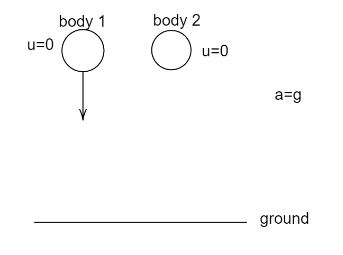
After $\tau s$ body $1$ will move, and body $2$ would have been moved to $t + \tau $, it is given in the question that after $t + \tau $ the difference between two bodies is $l$ , then we have to find the value of $t$. See the following diagram,
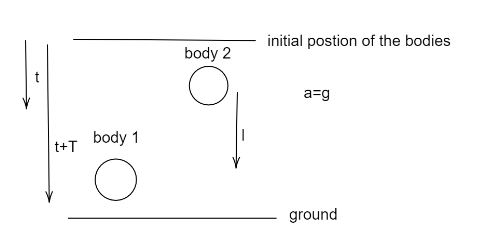
Here $t + T = t + \tau $. We will find the distance covered by body $1$ in time $t + \tau $ and by body $2$ in time $t$ . And by subtracting both and putting it equal to $l$ we will find our required $t$. Using the second equation of motion
$s = ut + \dfrac{1}{2}a{t^2}$
We know $u = 0$ and $a = g$
So, $s = \dfrac{1}{2}g{t^2}$
Let distance covered by body $1$ be ${s_1}$ and distance covered by body $2$ be ${s_2}$
Therefore, ${s_1} = \dfrac{1}{2}g{\left( {t + \tau } \right)^2}$
${s_2} = \dfrac{1}{2}g{t^2}$
Now we have to find the value of $t$
So ${s_2} - {s_1} = l$
Putting values from above
$\dfrac{1}{2}g{t^2} - \dfrac{1}{2}g{\left( {t + \tau } \right)^2} = l$
Solving this we will get
$\dfrac{1}{2}g\left[ {{t^2} - {{\left( {t - \tau } \right)}^2}} \right] = l$
$\Rightarrow \left( {t + t - \tau } \right)\left( {t - t + \tau } \right) = \dfrac{{2l}}{g}$
$\Rightarrow 2t - \tau = \dfrac{{2l}}{{g\tau }}$
$\Rightarrow t = \dfrac{1}{2}\left[ {\dfrac{{2l}}{{g\tau }} + \tau } \right]$
$\therefore t = \dfrac{l}{{g\tau }} + \dfrac{\tau }{2}$
Therefore, option A is the correct answer.
Note:There are two important motion properties that free-falling objects possess:
-Air resistance does not exist for free-falling objects.
-On Earth, all free-falling objects accelerate downwards.
The time measured is from that instant from which the second body was released. Since both the bodies were initially at zero their initial velocity is taken as zero. Acceleration is due to gravity that is why we have taken $a = g$.
Complete step by step answer:
Initially it has given that both bodies are at the same height and fall freely.
After $\tau s$ body $1$ will move, and body $2$ would have been moved to $t + \tau $, it is given in the question that after $t + \tau $ the difference between two bodies is $l$ , then we have to find the value of $t$. See the following diagram,
Here $t + T = t + \tau $. We will find the distance covered by body $1$ in time $t + \tau $ and by body $2$ in time $t$ . And by subtracting both and putting it equal to $l$ we will find our required $t$. Using the second equation of motion
$s = ut + \dfrac{1}{2}a{t^2}$
We know $u = 0$ and $a = g$
So, $s = \dfrac{1}{2}g{t^2}$
Let distance covered by body $1$ be ${s_1}$ and distance covered by body $2$ be ${s_2}$
Therefore, ${s_1} = \dfrac{1}{2}g{\left( {t + \tau } \right)^2}$
${s_2} = \dfrac{1}{2}g{t^2}$
Now we have to find the value of $t$
So ${s_2} - {s_1} = l$
Putting values from above
$\dfrac{1}{2}g{t^2} - \dfrac{1}{2}g{\left( {t + \tau } \right)^2} = l$
Solving this we will get
$\dfrac{1}{2}g\left[ {{t^2} - {{\left( {t - \tau } \right)}^2}} \right] = l$
$\Rightarrow \left( {t + t - \tau } \right)\left( {t - t + \tau } \right) = \dfrac{{2l}}{g}$
$\Rightarrow 2t - \tau = \dfrac{{2l}}{{g\tau }}$
$\Rightarrow t = \dfrac{1}{2}\left[ {\dfrac{{2l}}{{g\tau }} + \tau } \right]$
$\therefore t = \dfrac{l}{{g\tau }} + \dfrac{\tau }{2}$
Therefore, option A is the correct answer.
Note:There are two important motion properties that free-falling objects possess:
-Air resistance does not exist for free-falling objects.
-On Earth, all free-falling objects accelerate downwards.
The time measured is from that instant from which the second body was released. Since both the bodies were initially at zero their initial velocity is taken as zero. Acceleration is due to gravity that is why we have taken $a = g$.
Recently Updated Pages
Master Class 11 Computer Science: Engaging Questions & Answers for Success

Master Class 11 Business Studies: Engaging Questions & Answers for Success
Master Class 11 Economics: Engaging Questions & Answers for Success
Master Class 11 English: Engaging Questions & Answers for Success
Master Class 11 Maths: Engaging Questions & Answers for Success
Master Class 11 Biology: Engaging Questions & Answers for Success
Trending doubts
One Metric ton is equal to kg A 10000 B 1000 C 100 class 11 physics CBSE
There are 720 permutations of the digits 1 2 3 4 5 class 11 maths CBSE
Discuss the various forms of bacteria class 11 biology CBSE
Draw a diagram of a plant cell and label at least eight class 11 biology CBSE
State the laws of reflection of light
Explain zero factorial class 11 maths CBSE