




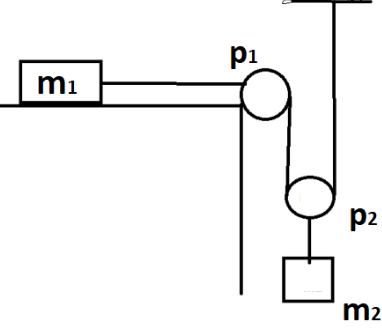
Two blocks of masses ${m_1} = 1.5kg$ and ${m_2} = 2kg$ are attached to each other by strings and pulleys as shown in figure. Assume that pulleys are massless and frictionless and strings are massless. The system is released. If the table is frictionless, find the acceleration of ${m_1}$ and ${m_2}$. Take $g = 10m{s^{ - 2}}$
A. $5m{s^{ - 2}}$and $2.5m{s^{ - 2}}$
B. $10m{s^{ - 2}}$ and $5m{s^{ - 2}}$
C. $15m{s^{ - 2}}$ and $7.5m{s^{ - 2}}$
D. $20m{s^{ - 2}}$ and $10m{s^{ - 2}}$
Answer
 Verified
614.4k+ views
Hint:To find the acceleration along the two masses we have to find the motion in which the respective masses are moving after that we can apply the formula for tension. Tension is defined as the product of masses and the gravitational force $\left( g \right)$ subtracting the acceleration. After getting the equation of tension we can simply find the acceleration.
Complete step by step answer:
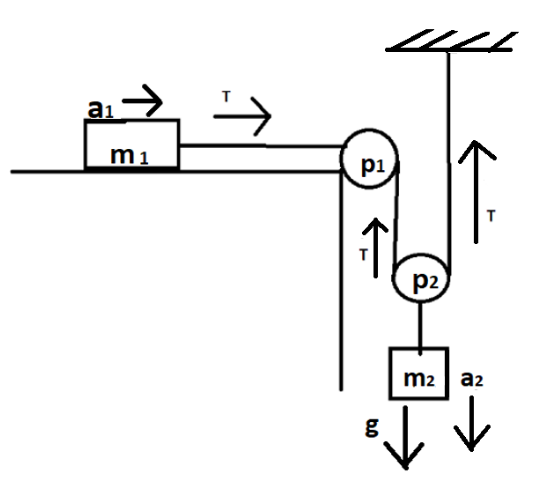
Consider two masses ${m_1}$ and ${m_2}$ as shown in figure. Applying tension $\left( T \right)$ on the two masses, mass ${m_1}$ is moveable because the mass of the first one is lesser than the second one hence the force applied by the second one should be larger. The acceleration on the masses is given by ${a_1}$and ${a_2}$ respectively. Applying tension trick,
$T{a_1} - 2T{a_2} = 0$
The tension on ${m_2}$ is upward on ${P_1}$ and the second tension is applied upward towards a fixed path. Hence, $2T$is applied on ${m_2}$.
$ \Rightarrow T{a_1} = 2T{a_2}$
${a_1} = 2a_2^{}$ $ \ldots \ldots \left( 1 \right)$
Now applying forces on the block one, tension is pulling the box in right direction and also acceleration is applying in right hand direction $T = \left( {{m_1}{a_1}} \right) = \left( {1.5} \right){a_1}$ $ \ldots \ldots \left( 2 \right)$
Force on the second block be given the acceleration is pulling the block downward due to gravity.
$2g - 2T = {a_2}$ $ \ldots \ldots \left( 3 \right)$
Solving these three equations:
Putting vale of $\left( 1 \right)$ in $\left( 2 \right)$ , $T = \left( {1.5} \right)2{a_2}$ $ \ldots \ldots \left( 4 \right)$
Solving equations $\left( 3 \right)$ and $\left( 4 \right)$
$2g = 4{a_2}$
Hence, ${a_2} = \dfrac{{10}}{2} = 5m{s^{ - 2}}$
Putting in $\left( 1 \right)$
$\therefore{a_1} = 2\left( 5 \right) = 10m{s^{ - 2}}$
Hence the option that matches our answer is B.
Note:Tension is applied by means of string, cable, chain or a dimensional block. Tension can also be named as an action-reaction pair of forces acting at the end of block. Tension is opposite of compression. Length of the strings do not affect the tension.
Complete step by step answer:
Consider two masses ${m_1}$ and ${m_2}$ as shown in figure. Applying tension $\left( T \right)$ on the two masses, mass ${m_1}$ is moveable because the mass of the first one is lesser than the second one hence the force applied by the second one should be larger. The acceleration on the masses is given by ${a_1}$and ${a_2}$ respectively. Applying tension trick,
$T{a_1} - 2T{a_2} = 0$
The tension on ${m_2}$ is upward on ${P_1}$ and the second tension is applied upward towards a fixed path. Hence, $2T$is applied on ${m_2}$.
$ \Rightarrow T{a_1} = 2T{a_2}$
${a_1} = 2a_2^{}$ $ \ldots \ldots \left( 1 \right)$
Now applying forces on the block one, tension is pulling the box in right direction and also acceleration is applying in right hand direction $T = \left( {{m_1}{a_1}} \right) = \left( {1.5} \right){a_1}$ $ \ldots \ldots \left( 2 \right)$
Force on the second block be given the acceleration is pulling the block downward due to gravity.
$2g - 2T = {a_2}$ $ \ldots \ldots \left( 3 \right)$
Solving these three equations:
Putting vale of $\left( 1 \right)$ in $\left( 2 \right)$ , $T = \left( {1.5} \right)2{a_2}$ $ \ldots \ldots \left( 4 \right)$
Solving equations $\left( 3 \right)$ and $\left( 4 \right)$
$2g = 4{a_2}$
Hence, ${a_2} = \dfrac{{10}}{2} = 5m{s^{ - 2}}$
Putting in $\left( 1 \right)$
$\therefore{a_1} = 2\left( 5 \right) = 10m{s^{ - 2}}$
Hence the option that matches our answer is B.
Note:Tension is applied by means of string, cable, chain or a dimensional block. Tension can also be named as an action-reaction pair of forces acting at the end of block. Tension is opposite of compression. Length of the strings do not affect the tension.
Recently Updated Pages
Master Class 11 Social Science: Engaging Questions & Answers for Success

Master Class 11 English: Engaging Questions & Answers for Success
Master Class 11 Accountancy: Engaging Questions & Answers for Success
Master Class 11 Physics: Engaging Questions & Answers for Success
Master Class 11 Computer Science: Engaging Questions & Answers for Success
Master Class 11 Business Studies: Engaging Questions & Answers for Success
Trending doubts
Find the value of the expression given below sin 30circ class 11 maths CBSE
The teeth used for biting and cutting food are called class 11 biology CBSE
Frogs heart when taken out of the body continues to class 11 biology CBSE
Draw a diagram of a plant cell and label at least eight class 11 biology CBSE
What is the maximum height of a projectile class 11 physics CBSE
Derive an expression for maximum height and range of class 11 physics CBSE