




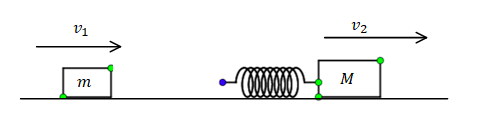
Two blocks of masses m and M are moving with speeds ${v_1}$ and ${v_2}$(${v_1} > {v_2}$) in the same direction on the frictionless surface respectively. M being ahead of m. An ideal spring of force constant k is attached to the backside of M (as shown). The maximum compression of the spring when the block collides is:
A) ${v_1}\sqrt {\dfrac{m}{k}} $.
B) ${v_2}\sqrt {\dfrac{M}{k}} $.
C) $\left( {{v_1} - {v_2}} \right)\sqrt {\dfrac{{mM}}{{\left( {M + m} \right)k}}} $.
D) None of the above is correct.
Answer
 Verified
590.4k+ views
Hint: The spring energy is the potential energy which is saved by the spring when it is expanded or compressed. The masses m and M will collide as the velocity of the m and is greater than the velocity of the mass M.
Formula used:The formula of the spring energy is given by,
$ \Rightarrow {E_{spring}} = \dfrac{1}{2}k \times {x^2}$
Where the spring constant is k and the length of compression or expansion is x.
The formula of kinetic energy is given by,
$ \Rightarrow K \cdot E = \dfrac{1}{2} \times m \times {v^2}$
Where the mass of the object is m and the velocity is v.
Complete step by step solution:
It is given in the problem that two blocks of masses m and M are moving with speeds ${v_1}$ and ${v_2}$(${v_1} > {v_2}$) in the same direction on the frictionless surface respectively block M being ahead of m an ideal spring of force constant k is attached to the backside of M and we need to find the maximum compression of the spring when the blocks collide.
The initial kinetic energy of the bodies is equal to,
$ \Rightarrow K \cdot {E_1} = \dfrac{1}{2}m{v_1}^2 + \dfrac{1}{2}M{v_2}^2$………eq. (1)
Let v be the velocity of the combined blocks after collision.
Applying the conservation of momentum we get,
$ \Rightarrow m{v_1} + M{v_2} = \left( {M + m} \right) \times v$
$ \Rightarrow v = \dfrac{{m{v_1} + M{v_2}}}{{M + m}}$………eq. (2)
The kinetic energy of the system after collision will be,
$ \Rightarrow K \cdot {E_2} = \dfrac{1}{2} \times m \times {v^2}$
$ \Rightarrow K \cdot {E_2} = \dfrac{1}{2} \times \left( {M + m} \right) \times {v^2}$………eq. (3)
Replacing the value of velocity from the equation (2) into equation (3) we get,
$ \Rightarrow K \cdot {E_2} = \dfrac{1}{2} \times \left( {M + m} \right) \times {v^2}$
$ \Rightarrow K \cdot {E_2} = \dfrac{1}{2} \times \left( {M + m} \right) \times {\left( {\dfrac{{m{v_1} + M{v_2}}}{{M + m}}} \right)^2}$
$ \Rightarrow K \cdot {E_2} = \dfrac{1}{2} \times \dfrac{{{{\left( {m{v_1} + M{v_2}} \right)}^2}}}{{M + m}}$.
The spring energy is given by,
$ \Rightarrow {E_{spring}} = \dfrac{1}{2}k \times {x_{\max .}}^2$
Where the spring constant is k and the length of compression or expansion is x.
The change in kinetic energy is equal to the spring energy,
$ \Rightarrow K \cdot {E_1} - K \cdot {E_2} = {E_{spring}}$
$ \Rightarrow \dfrac{1}{2}m{v_1}^2 + \dfrac{1}{2}M{v_2}^2 - \dfrac{1}{2} \times \dfrac{{{{\left( {m{v_1} + M{v_2}} \right)}^2}}}{{M + m}} = \dfrac{1}{2}k \times {x_{\max .}}^2$
$ \Rightarrow m{v_1}^2 + M{v_2}^2 - \dfrac{{{{\left( {m{v_1} + M{v_2}} \right)}^2}}}{{M + m}} = k \times {x_{\max .}}^2$
$ \Rightarrow \dfrac{{\left( {M + m} \right) \times \left( {m{v_1}^2 + M{v_2}^2} \right) - {{\left( {m{v_1} + M{v_2}} \right)}^2}}}{{M + m}} = k \times {x_{\max .}}^2$
$ \Rightarrow k \times {x_{\max .}}^2 = \dfrac{{\left( {M + m} \right) \times \left( {m{v_1}^2 + M{v_2}^2} \right) - {{\left( {m{v_1} + M{v_2}} \right)}^2}}}{{M + m}}$
\[ \Rightarrow k \times {x_{\max .}}^2 = \dfrac{{Mm{v_1}^2 + {M^2}{v_2}^2 + {m^2}{v_1}^2 + Mm{v_2}^2 - {m^2}{v_1}^2 - {M^2}{v_2}^2 - 2Mm{v_1}{v_2}}}{{M + m}}\]
\[ \Rightarrow k \times {x_{\max .}}^2 = \dfrac{{Mm{v_1}^2 + Mm{v_2}^2 - 2Mm{v_1}{v_2}}}{{M + m}}\]
\[ \Rightarrow k \times {x_{\max .}}^2 = Mm \times \left( {\dfrac{{{v_1}^2 + {v_2}^2 - 2{v_1}{v_2}}}{{M + m}}} \right)\]
\[ \Rightarrow k \times {x_{\max .}}^2 = \dfrac{{Mm}}{{M + m}} \times \left( {{v_1}^2 + {v_2}^2 - 2{v_1}{v_2}} \right)\]
\[ \Rightarrow k \times {x_{\max .}}^2 = \dfrac{{Mm}}{{M + m}} \times {\left( {{v_1} - {v_2}} \right)^2}\]
\[ \Rightarrow {x_{\max .}}^2 = \dfrac{{Mm}}{{k\left( {M + m} \right)}} \times {\left( {{v_1} - {v_2}} \right)^2}\]
\[ \Rightarrow {x_{\max .}} = \left( {{v_1} - {v_2}} \right) \times \sqrt {\dfrac{{Mm}}{{k\left( {M + m} \right)}}} \].
The maximum compression of the spring is equal to \[{x_{\max .}} = \left( {{v_1} - {v_2}} \right) \times \sqrt {\dfrac{{Mm}}{{k\left( {M + m} \right)}}} \].
The correct answer for this problem is option C.
Note: The linear conservation of momentum says that the total energy of the blocks before and after the collision will be conserved. It is advised to the students to understand and remember the formula of the momentum and also the formula of the spring energy as it is very useful in solving problems like these.
Formula used:The formula of the spring energy is given by,
$ \Rightarrow {E_{spring}} = \dfrac{1}{2}k \times {x^2}$
Where the spring constant is k and the length of compression or expansion is x.
The formula of kinetic energy is given by,
$ \Rightarrow K \cdot E = \dfrac{1}{2} \times m \times {v^2}$
Where the mass of the object is m and the velocity is v.
Complete step by step solution:
It is given in the problem that two blocks of masses m and M are moving with speeds ${v_1}$ and ${v_2}$(${v_1} > {v_2}$) in the same direction on the frictionless surface respectively block M being ahead of m an ideal spring of force constant k is attached to the backside of M and we need to find the maximum compression of the spring when the blocks collide.
The initial kinetic energy of the bodies is equal to,
$ \Rightarrow K \cdot {E_1} = \dfrac{1}{2}m{v_1}^2 + \dfrac{1}{2}M{v_2}^2$………eq. (1)
Let v be the velocity of the combined blocks after collision.
Applying the conservation of momentum we get,
$ \Rightarrow m{v_1} + M{v_2} = \left( {M + m} \right) \times v$
$ \Rightarrow v = \dfrac{{m{v_1} + M{v_2}}}{{M + m}}$………eq. (2)
The kinetic energy of the system after collision will be,
$ \Rightarrow K \cdot {E_2} = \dfrac{1}{2} \times m \times {v^2}$
$ \Rightarrow K \cdot {E_2} = \dfrac{1}{2} \times \left( {M + m} \right) \times {v^2}$………eq. (3)
Replacing the value of velocity from the equation (2) into equation (3) we get,
$ \Rightarrow K \cdot {E_2} = \dfrac{1}{2} \times \left( {M + m} \right) \times {v^2}$
$ \Rightarrow K \cdot {E_2} = \dfrac{1}{2} \times \left( {M + m} \right) \times {\left( {\dfrac{{m{v_1} + M{v_2}}}{{M + m}}} \right)^2}$
$ \Rightarrow K \cdot {E_2} = \dfrac{1}{2} \times \dfrac{{{{\left( {m{v_1} + M{v_2}} \right)}^2}}}{{M + m}}$.
The spring energy is given by,
$ \Rightarrow {E_{spring}} = \dfrac{1}{2}k \times {x_{\max .}}^2$
Where the spring constant is k and the length of compression or expansion is x.
The change in kinetic energy is equal to the spring energy,
$ \Rightarrow K \cdot {E_1} - K \cdot {E_2} = {E_{spring}}$
$ \Rightarrow \dfrac{1}{2}m{v_1}^2 + \dfrac{1}{2}M{v_2}^2 - \dfrac{1}{2} \times \dfrac{{{{\left( {m{v_1} + M{v_2}} \right)}^2}}}{{M + m}} = \dfrac{1}{2}k \times {x_{\max .}}^2$
$ \Rightarrow m{v_1}^2 + M{v_2}^2 - \dfrac{{{{\left( {m{v_1} + M{v_2}} \right)}^2}}}{{M + m}} = k \times {x_{\max .}}^2$
$ \Rightarrow \dfrac{{\left( {M + m} \right) \times \left( {m{v_1}^2 + M{v_2}^2} \right) - {{\left( {m{v_1} + M{v_2}} \right)}^2}}}{{M + m}} = k \times {x_{\max .}}^2$
$ \Rightarrow k \times {x_{\max .}}^2 = \dfrac{{\left( {M + m} \right) \times \left( {m{v_1}^2 + M{v_2}^2} \right) - {{\left( {m{v_1} + M{v_2}} \right)}^2}}}{{M + m}}$
\[ \Rightarrow k \times {x_{\max .}}^2 = \dfrac{{Mm{v_1}^2 + {M^2}{v_2}^2 + {m^2}{v_1}^2 + Mm{v_2}^2 - {m^2}{v_1}^2 - {M^2}{v_2}^2 - 2Mm{v_1}{v_2}}}{{M + m}}\]
\[ \Rightarrow k \times {x_{\max .}}^2 = \dfrac{{Mm{v_1}^2 + Mm{v_2}^2 - 2Mm{v_1}{v_2}}}{{M + m}}\]
\[ \Rightarrow k \times {x_{\max .}}^2 = Mm \times \left( {\dfrac{{{v_1}^2 + {v_2}^2 - 2{v_1}{v_2}}}{{M + m}}} \right)\]
\[ \Rightarrow k \times {x_{\max .}}^2 = \dfrac{{Mm}}{{M + m}} \times \left( {{v_1}^2 + {v_2}^2 - 2{v_1}{v_2}} \right)\]
\[ \Rightarrow k \times {x_{\max .}}^2 = \dfrac{{Mm}}{{M + m}} \times {\left( {{v_1} - {v_2}} \right)^2}\]
\[ \Rightarrow {x_{\max .}}^2 = \dfrac{{Mm}}{{k\left( {M + m} \right)}} \times {\left( {{v_1} - {v_2}} \right)^2}\]
\[ \Rightarrow {x_{\max .}} = \left( {{v_1} - {v_2}} \right) \times \sqrt {\dfrac{{Mm}}{{k\left( {M + m} \right)}}} \].
The maximum compression of the spring is equal to \[{x_{\max .}} = \left( {{v_1} - {v_2}} \right) \times \sqrt {\dfrac{{Mm}}{{k\left( {M + m} \right)}}} \].
The correct answer for this problem is option C.
Note: The linear conservation of momentum says that the total energy of the blocks before and after the collision will be conserved. It is advised to the students to understand and remember the formula of the momentum and also the formula of the spring energy as it is very useful in solving problems like these.
Recently Updated Pages
Master Class 11 Social Science: Engaging Questions & Answers for Success

Master Class 11 Physics: Engaging Questions & Answers for Success
Master Class 11 Maths: Engaging Questions & Answers for Success
Master Class 11 Economics: Engaging Questions & Answers for Success
Master Class 11 Computer Science: Engaging Questions & Answers for Success
Master Class 11 Chemistry: Engaging Questions & Answers for Success
Trending doubts
One Metric ton is equal to kg A 10000 B 1000 C 100 class 11 physics CBSE
There are 720 permutations of the digits 1 2 3 4 5 class 11 maths CBSE
1 Quintal is equal to a 110 kg b 10 kg c 100kg d 1000 class 11 physics CBSE
State and prove Bernoullis theorem class 11 physics CBSE
Difference Between Prokaryotic Cells and Eukaryotic Cells
Which among the following are examples of coming together class 11 social science CBSE