




Two blocks of masses $1kg$ and $2kg$ are connected by a metal wire going over a smooth pulley. The breaking stress of metal is $\dfrac{40}{3\pi }\times {{10}^{6}}N{{m}^{-2}}$ . What should be the minimum radius of wire used if it should not break? $\left( g=10m{{s}^{-2}} \right)$
A. $0.5mm$
B. $1mm$
C.$1.5mm$
D.$2mm$
Answer
 Verified
645.3k+ views
Hint: Tension due to a string
$T=\dfrac{2{{m}_{1}}{{m}_{2}}}{{{m}_{1}}+{{m}_{2}}}g$
In which ${{m}_{1}}$ and ${{m}_{2}}$ are the mass of the blocks connected to the metal wire.
$g$ is the acceleration due to gravity as well.
This equation should be used here for solving.
Complete answer:
First of all let us look at what tension means. The tension which is otherwise called as force is the force that is transmitted through a cable, rope, wire or a string when it is pulled tightly by the forces acting from the two opposite ends. It is getting directed along the length of the cable or wire and pulls equally on the objects on the two opposite ends of the wire. Tension is a scalar quantity. A string or rope or a metal wire is sometimes idealized as one dimension, having length. If there is no bend in the string, as occurs with vibrations or pulleys, then tension is a constant along the chord, equal to the magnitude of the forces applied by the ends of the string. These are the similar forces exerted on the ends of the chord by the masses to which the ends are attached.
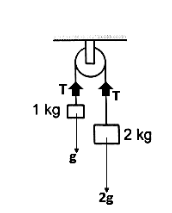
Tension due to a string is found using the free body diagram,
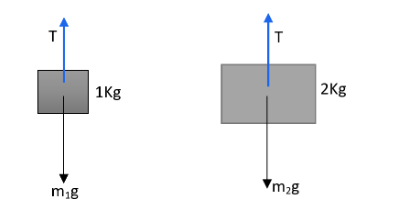
Force acting on ${m}_{1}$ is
${{\text{m}}_{1}}g-T={{m}_{1}}a $
Force acting on ${m}_{2}$ is
$T - m_2 g={{m}_{2}}a$
Using these, we can find the acceleration of the body,
$a=\dfrac{\left( {{m}_{1}}-{{m}_{2}} \right)g}{{{m}_{1}}+{{m}_{2}}}$
Substituting the value of acceleration in any of the above given equation,
$\begin{align}
& {{m}_{1}}g-T={{m}_{1}}a \\
& T={{m}_{1}}\left( g-a \right) \\
& T={{m}_{1}}\left( g-\dfrac{\left( {{m}_{1}}-{{m}_{2}} \right)g}{{{m}_{1}}+{{m}_{2}}} \right) \\
\end{align}$
Therefore tension is given as,
$T=\dfrac{2{{m}_{1}}{{m}_{2}}}{{{m}_{1}}+{{m}_{2}}}g$
In which ${{m}_{1}}$and ${{m}_{2}}$ are the mass of the blocks connected to the metal wire.
$g$ is the acceleration due to gravity.
$r=\dfrac{1}{{{10}^{3}}}\times {{10}^{3}}mm=1mm$
$T=\dfrac{2\times 1\times 2}{1+2}\times 10N$
$T=\dfrac{40}{3}N$
If r is the minimum radius, then breaking stress S is given by
$S=\left( \dfrac{\dfrac{40}{3}}{\pi {{r}^{2}}} \right)$
Substituting the value of r in this will give,
$\left( \dfrac{\dfrac{40}{3}}{\pi {{r}^{2}}} \right)=\dfrac{40}{3\pi }\times {{10}^{6}}$
Hence we get like this
${{r}^{2}}=\dfrac{1}{{{10}^{6}}}$
Therefore the minimum radius is
$r=\dfrac{1}{{{10}^{3}}}m$
$r=\dfrac{1}{{{10}^{3}}}\times {{10}^{3}}mm=1mm$
So, the correct answer is “Option B”.
Note:
The tension which is otherwise called as force is the force that is transmitted through a cable, rope, wire or a string when it is pulled tightly by the forces acting from the two opposite ends. The units of the quantities should be taken care of properly.
$T=\dfrac{2{{m}_{1}}{{m}_{2}}}{{{m}_{1}}+{{m}_{2}}}g$
In which ${{m}_{1}}$ and ${{m}_{2}}$ are the mass of the blocks connected to the metal wire.
$g$ is the acceleration due to gravity as well.
This equation should be used here for solving.
Complete answer:
First of all let us look at what tension means. The tension which is otherwise called as force is the force that is transmitted through a cable, rope, wire or a string when it is pulled tightly by the forces acting from the two opposite ends. It is getting directed along the length of the cable or wire and pulls equally on the objects on the two opposite ends of the wire. Tension is a scalar quantity. A string or rope or a metal wire is sometimes idealized as one dimension, having length. If there is no bend in the string, as occurs with vibrations or pulleys, then tension is a constant along the chord, equal to the magnitude of the forces applied by the ends of the string. These are the similar forces exerted on the ends of the chord by the masses to which the ends are attached.
Tension due to a string is found using the free body diagram,
Force acting on ${m}_{1}$ is
${{\text{m}}_{1}}g-T={{m}_{1}}a $
Force acting on ${m}_{2}$ is
$T - m_2 g={{m}_{2}}a$
Using these, we can find the acceleration of the body,
$a=\dfrac{\left( {{m}_{1}}-{{m}_{2}} \right)g}{{{m}_{1}}+{{m}_{2}}}$
Substituting the value of acceleration in any of the above given equation,
$\begin{align}
& {{m}_{1}}g-T={{m}_{1}}a \\
& T={{m}_{1}}\left( g-a \right) \\
& T={{m}_{1}}\left( g-\dfrac{\left( {{m}_{1}}-{{m}_{2}} \right)g}{{{m}_{1}}+{{m}_{2}}} \right) \\
\end{align}$
Therefore tension is given as,
$T=\dfrac{2{{m}_{1}}{{m}_{2}}}{{{m}_{1}}+{{m}_{2}}}g$
In which ${{m}_{1}}$and ${{m}_{2}}$ are the mass of the blocks connected to the metal wire.
$g$ is the acceleration due to gravity.
$r=\dfrac{1}{{{10}^{3}}}\times {{10}^{3}}mm=1mm$
$T=\dfrac{2\times 1\times 2}{1+2}\times 10N$
$T=\dfrac{40}{3}N$
If r is the minimum radius, then breaking stress S is given by
$S=\left( \dfrac{\dfrac{40}{3}}{\pi {{r}^{2}}} \right)$
Substituting the value of r in this will give,
$\left( \dfrac{\dfrac{40}{3}}{\pi {{r}^{2}}} \right)=\dfrac{40}{3\pi }\times {{10}^{6}}$
Hence we get like this
${{r}^{2}}=\dfrac{1}{{{10}^{6}}}$
Therefore the minimum radius is
$r=\dfrac{1}{{{10}^{3}}}m$
$r=\dfrac{1}{{{10}^{3}}}\times {{10}^{3}}mm=1mm$
So, the correct answer is “Option B”.
Note:
The tension which is otherwise called as force is the force that is transmitted through a cable, rope, wire or a string when it is pulled tightly by the forces acting from the two opposite ends. The units of the quantities should be taken care of properly.
Recently Updated Pages
Which will be the least stable resonating structure class 11 chemistry CBSE

How many 5 digit telephone numbers can be construc-class-11-maths-CBSE
How do you find the angle of the resultant vector class 11 physics CBSE
Draw labelled diagram of the following i Gram seed class 11 biology CBSE
1 Quintal is equal to a 110 kg b 10 kg c 100kg d 1000 class 11 physics CBSE
What is the need and importance of classification class 11 biology CBSE
Trending doubts
One Metric ton is equal to kg A 10000 B 1000 C 100 class 11 physics CBSE
Find the value of the expression given below sin 30circ class 11 maths CBSE
Draw a diagram of nephron and explain its structur class 11 biology CBSE
10 examples of friction in our daily life
Proton was discovered by A Thomson B Rutherford C Chadwick class 11 chemistry CBSE
The teeth used for biting and cutting food are called class 11 biology CBSE