




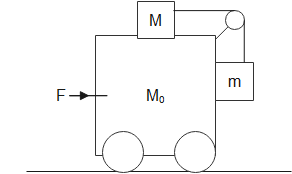
Two blocks of mass capital M and small M are kept on the trolley whose all surfaces are smooth. Select the correct statement.
1. If $F = 0$ blocks cannot remain stationary.
2. For one unique value of $F$ , blocks will be stationary.
3. Blocks cannot be stationary for any value of $F$ because all surfaces are smooth
4. Both $1{\text{ and 2}}$ .
Answer
 Verified
561k+ views
Hint: For solving questions related to block and wedge, we need to understand how to draw a free body diagram of the bodies provided. In the given diagram we can see there are three bodies with a force $F$ applied on mass ${M_0}$. Thus, we can use Newton's second law of motion to equate the force.
Complete step by step answer:
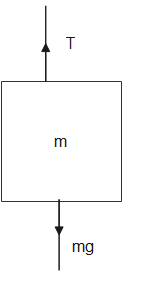
We can see the two masses M and m are connected by a string. Let its tension be T. Let us draw the Free body diagrams of M, m and ${M_0}$.
Now by drawing the free body diagrams, we can see that that tension T equals the weight of m.
Thus $T = mg --(1)$
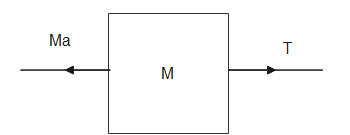
Now let the acceleration of the mass M be a. As the only force experienced by it is T (as the surface is smooth hence no friction), thus we can use Newton's second law of motion to equate the tension T.
Thus $T = Ma --(2)$
Hence from 1 and 2: $a = \dfrac{{mg}}{M} -- (3)$
Now as the applied force on the whole system is F, thus acceleration of system $a'$ will be: $a' = \dfrac{F}{{m + M + {M_0}}}- - - - (4$.
But we see in the question, we have to find when the blocks will move together, thus $a' = a$.
Hence from equation 3 and equation 4 we see:
$F = \dfrac{{mg({M_0} + M + m)}}{M}$ .
Now by checking each of the given options we see that:
Now by seeing the options we see only option 1 is correct.
This is because if $F = 0$, then a' = 0 , but there is an acceleration $a$ which is non zero, thus blocks move.
The second option is correct because there is a value of force for which both accelerations are equal, thus the blocks remain stationary.
Blocks cannot be stationary is a wrong statement because there is a value of force for which they are stationary.
Thus, we see that two options are the correct,
Hence the correct answer is option $4$.
Note: These types of questions are based on the combined application of tension, Newton's laws of motion. Just drawing the free-body diagrams would solve the problem. Remember the important condition that all the bodies move with equal acceleration.
Complete step by step answer:
We can see the two masses M and m are connected by a string. Let its tension be T. Let us draw the Free body diagrams of M, m and ${M_0}$.
Now by drawing the free body diagrams, we can see that that tension T equals the weight of m.
Thus $T = mg --(1)$
Now let the acceleration of the mass M be a. As the only force experienced by it is T (as the surface is smooth hence no friction), thus we can use Newton's second law of motion to equate the tension T.
Thus $T = Ma --(2)$
Hence from 1 and 2: $a = \dfrac{{mg}}{M} -- (3)$
Now as the applied force on the whole system is F, thus acceleration of system $a'$ will be: $a' = \dfrac{F}{{m + M + {M_0}}}- - - - (4$.
But we see in the question, we have to find when the blocks will move together, thus $a' = a$.
Hence from equation 3 and equation 4 we see:
$F = \dfrac{{mg({M_0} + M + m)}}{M}$ .
Now by checking each of the given options we see that:
Now by seeing the options we see only option 1 is correct.
This is because if $F = 0$, then a' = 0 , but there is an acceleration $a$ which is non zero, thus blocks move.
The second option is correct because there is a value of force for which both accelerations are equal, thus the blocks remain stationary.
Blocks cannot be stationary is a wrong statement because there is a value of force for which they are stationary.
Thus, we see that two options are the correct,
Hence the correct answer is option $4$.
Note: These types of questions are based on the combined application of tension, Newton's laws of motion. Just drawing the free-body diagrams would solve the problem. Remember the important condition that all the bodies move with equal acceleration.
Recently Updated Pages
If x a + bt + ct2 where x is in meters and t is in class 11 physics CBSE

A car covers the first half distance between two places class 11 physics CBSE
The resultant of two vectors overrightarrow P and overrightarrow class 11 physics CBSE
Find the value of cos 135 class 11 maths CBSE
A mass M is held in place by an applied force F and class 11 physics CBSE
A solution of glucose in water is labelled as 10 dfracwv class 11 chemistry CBSE
Trending doubts
Find the value of the expression given below sin 30circ class 11 maths CBSE
What is the maximum height of a projectile class 11 physics CBSE
Derive an expression for maximum height and range of class 11 physics CBSE
Describe various types of epithelial tissues with the class 11 biology CBSE
Lysosomes are known as suicidal bags of cell why class 11 biology CBSE
State and derive law of conservation of momentum class 11 physics CBSE