




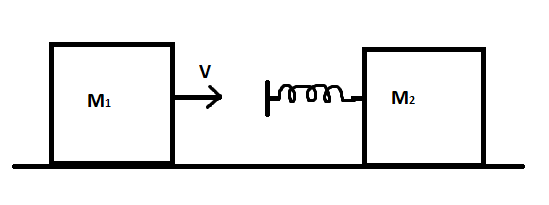
Two blocks ${M_1}$ and ${M_2}$ is attached to a massless spring as shown in figure. Initially ${M_2}$ is at rest and ${M_1}$ is moving toward ${M_2}$ with speed v and collides head-on with ${M_2}$.
(a) While spring is fully compressed, all the kinetic energy of ${M_1}$ is stored as potential energy of spring.
(b) While spring is fully compressed the system momentum is not conserved, though final momentum is equal to initial momentum.
(c) If spring is mass less, the final state of the ${M_2}$ is the state of rest.
(d) If the surface on which blocks are moving has friction, then collision cannot be elastic
Answer
 Verified
575.4k+ views
Hint: We will be evaluating every option and then conclude which one of the given is followed based upon the given conditions and there reasons to be correct or incorrect.
In elastic collision both momentum and energy is conserved while in inelastic collision neither momentum nor energy is conserved.
Complete step by step answer:
The given figure shows two masses, ${M_2}$ is at rest while ${M_1}$ is moving towards it:
Checking the options to conclude which one is true:
(a) While spring is fully compressed, all the kinetic energy of ${M_1}$ is stored as potential energy of spring:
When ${M_1}$ comes towards ${M_2}$ with a certain velocity, it has kinetic energy, some of which gets transferred to the spring as potential energy when it compresses and some of it also transfers to the block of mass ${M_2}$.
Thus, the given statement stating all the kinetic energy of ${M_1}$ is stored as potential energy of spring is incorrect.
(b) While spring is fully compressed the system momentum is not conserved, though final momentum is equal to initial momentum:
Momentum of a system is always conserved, be it any kind of collision.
Also, the conserved momentum means initial and final momentum are equal, so the statement too is contradictory to itself.
Thus this statement is also incorrect.
(c) If spring is mass less, the final state of the ${M_2}$ is state of rest:
This is a special case of collision,
${M_1}$ = ${M_2}$; then the velocities of the bodies get interchanged
${M_2}$ was at rest, after collision ${M_1}$ will be at rest and
${M_1}$ was moving with a certain velocity, after collision, ${M_2}$will acquire that velocity.
So, ${M_1}$ will be at rest instead of ${M_2}$ and thus this option is also incorrect.
(d) If the surface on which blocks are moving has friction, then collision cannot be elastic:
If we have friction, then there will always be a loss of energy mostly in the form of heat.
In elastic collision both momentum and energy is conserved while in inelastic collision neither momentum nor energy is conserved.
Thus the collision is inelastic and cannot be elastic and this option is correct.
Thus, it can be concluded that among the given options, option (d) is followed.
So, the correct answer is “Option D”.
Note:
According to the law of conservation of energy, energy can neither be created nor destroyed but transformed from one form to another. So when we say that the energy is not conserved, the energy remains unused and gets out in the environment in the form of heat or light and is known as degraded energy.
In elastic collision both momentum and energy is conserved while in inelastic collision neither momentum nor energy is conserved.
Complete step by step answer:
The given figure shows two masses, ${M_2}$ is at rest while ${M_1}$ is moving towards it:
Checking the options to conclude which one is true:
(a) While spring is fully compressed, all the kinetic energy of ${M_1}$ is stored as potential energy of spring:
When ${M_1}$ comes towards ${M_2}$ with a certain velocity, it has kinetic energy, some of which gets transferred to the spring as potential energy when it compresses and some of it also transfers to the block of mass ${M_2}$.
Thus, the given statement stating all the kinetic energy of ${M_1}$ is stored as potential energy of spring is incorrect.
(b) While spring is fully compressed the system momentum is not conserved, though final momentum is equal to initial momentum:
Momentum of a system is always conserved, be it any kind of collision.
Also, the conserved momentum means initial and final momentum are equal, so the statement too is contradictory to itself.
Thus this statement is also incorrect.
(c) If spring is mass less, the final state of the ${M_2}$ is state of rest:
This is a special case of collision,
${M_1}$ = ${M_2}$; then the velocities of the bodies get interchanged
${M_2}$ was at rest, after collision ${M_1}$ will be at rest and
${M_1}$ was moving with a certain velocity, after collision, ${M_2}$will acquire that velocity.
So, ${M_1}$ will be at rest instead of ${M_2}$ and thus this option is also incorrect.
(d) If the surface on which blocks are moving has friction, then collision cannot be elastic:
If we have friction, then there will always be a loss of energy mostly in the form of heat.
In elastic collision both momentum and energy is conserved while in inelastic collision neither momentum nor energy is conserved.
Thus the collision is inelastic and cannot be elastic and this option is correct.
Thus, it can be concluded that among the given options, option (d) is followed.
So, the correct answer is “Option D”.
Note:
According to the law of conservation of energy, energy can neither be created nor destroyed but transformed from one form to another. So when we say that the energy is not conserved, the energy remains unused and gets out in the environment in the form of heat or light and is known as degraded energy.
Recently Updated Pages
Master Class 11 Computer Science: Engaging Questions & Answers for Success

Master Class 11 Business Studies: Engaging Questions & Answers for Success
Master Class 11 Economics: Engaging Questions & Answers for Success
Master Class 11 English: Engaging Questions & Answers for Success
Master Class 11 Maths: Engaging Questions & Answers for Success
Master Class 11 Biology: Engaging Questions & Answers for Success
Trending doubts
One Metric ton is equal to kg A 10000 B 1000 C 100 class 11 physics CBSE
There are 720 permutations of the digits 1 2 3 4 5 class 11 maths CBSE
Discuss the various forms of bacteria class 11 biology CBSE
Draw a diagram of a plant cell and label at least eight class 11 biology CBSE
State the laws of reflection of light
Explain zero factorial class 11 maths CBSE