




Two blocks (A) 2kg and (B) 5kg rest one over the other on a smooth horizontal plane. The coefficient of static and dynamic friction between (A) and (B) is the same and equal to 0.60. The maximum horizontal force that can be applied to (B) in order that both (A) and (B) do not have any relative motion:
A. 42 N
B. 42 kgf
C. 5.4 kgf
D. 1.2 N
Answer
 Verified
577.8k+ views
Hint:Since there is no relative motion between the two blocks, the acceleration of the both blocks must be the same. For the block A to not move relative to the block B, the applied force on the block A must be equal to the frictional force between the blocks. Determine the force on the block B in units of newton.
Formula used:
Frictional force, \[{f_r} = \mu N = \mu mg\],
where, \[\mu \] is the coefficient of friction, N is the normal force, m is the mass and g is the acceleration due to gravity.
Complete step by step answer:
We have given that there is no relative motion between the two blocks. Therefore, the acceleration of the both blocks must be the same.
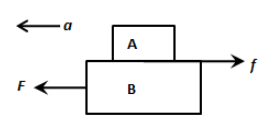
Using Newton’s second law, we can express the applied force on the system of the blocks as,
\[F = \left( {{m_A} + {m_B}} \right)a\]
\[ \Rightarrow a = \dfrac{F}{{{m_A} + {m_B}}}\]
Here, \[{m_A}\] is the mass of the block A, \[{m_B}\] is the mass of the block B and a is the acceleration of the two blocks.
Substitute 2 kg for \[{m_A}\] and 5 kg for \[{m_B}\] in the above equation, we get,
\[a = \dfrac{F}{{2 + 5}}\]
\[ \Rightarrow a = \dfrac{F}{7}\] …… (1)
For the block A to not move relative to the block B, the applied force on the block A must be equal to the frictional force between the blocks. Therefore, we can write,
\[{F_A} = f\]
\[ \Rightarrow {m_A}a = \mu {m_A}g\]
\[ \Rightarrow a = \mu g\]
Here, \[\mu \] is the coefficient of the friction and g is the acceleration due to gravity.
Using equation (1) in the above equation, we get,
\[\dfrac{F}{7} = \mu g\]
\[ \Rightarrow F = 7\mu g\]
Substituting \[\mu = 0.6\] and \[g = 10\,{\text{m/}}{{\text{s}}^2}\] in the above equation, we get,
\[F = 7\left( {0.6} \right)\left( {10} \right)\]
\[ \therefore F = 42\,{\text{N}}\]
Therefore, the maximum horizontal force applied to block B is 42 N.
So, the correct answer is option A.
Note: The value of coefficient of friction always lies between 0 and 1. The coefficient of friction is a unit less quantity. The unit of force is sometimes expressed as kgf. It is weight equivalent force and has the value equal to 9.8 N. Therefore, the option B cannot be true.
Formula used:
Frictional force, \[{f_r} = \mu N = \mu mg\],
where, \[\mu \] is the coefficient of friction, N is the normal force, m is the mass and g is the acceleration due to gravity.
Complete step by step answer:
We have given that there is no relative motion between the two blocks. Therefore, the acceleration of the both blocks must be the same.
Using Newton’s second law, we can express the applied force on the system of the blocks as,
\[F = \left( {{m_A} + {m_B}} \right)a\]
\[ \Rightarrow a = \dfrac{F}{{{m_A} + {m_B}}}\]
Here, \[{m_A}\] is the mass of the block A, \[{m_B}\] is the mass of the block B and a is the acceleration of the two blocks.
Substitute 2 kg for \[{m_A}\] and 5 kg for \[{m_B}\] in the above equation, we get,
\[a = \dfrac{F}{{2 + 5}}\]
\[ \Rightarrow a = \dfrac{F}{7}\] …… (1)
For the block A to not move relative to the block B, the applied force on the block A must be equal to the frictional force between the blocks. Therefore, we can write,
\[{F_A} = f\]
\[ \Rightarrow {m_A}a = \mu {m_A}g\]
\[ \Rightarrow a = \mu g\]
Here, \[\mu \] is the coefficient of the friction and g is the acceleration due to gravity.
Using equation (1) in the above equation, we get,
\[\dfrac{F}{7} = \mu g\]
\[ \Rightarrow F = 7\mu g\]
Substituting \[\mu = 0.6\] and \[g = 10\,{\text{m/}}{{\text{s}}^2}\] in the above equation, we get,
\[F = 7\left( {0.6} \right)\left( {10} \right)\]
\[ \therefore F = 42\,{\text{N}}\]
Therefore, the maximum horizontal force applied to block B is 42 N.
So, the correct answer is option A.
Note: The value of coefficient of friction always lies between 0 and 1. The coefficient of friction is a unit less quantity. The unit of force is sometimes expressed as kgf. It is weight equivalent force and has the value equal to 9.8 N. Therefore, the option B cannot be true.
Recently Updated Pages
Master Class 11 Social Science: Engaging Questions & Answers for Success

Master Class 11 Physics: Engaging Questions & Answers for Success
Master Class 11 Maths: Engaging Questions & Answers for Success
Master Class 11 Economics: Engaging Questions & Answers for Success
Master Class 11 Computer Science: Engaging Questions & Answers for Success
Master Class 11 Chemistry: Engaging Questions & Answers for Success
Trending doubts
One Metric ton is equal to kg A 10000 B 1000 C 100 class 11 physics CBSE
There are 720 permutations of the digits 1 2 3 4 5 class 11 maths CBSE
1 Quintal is equal to a 110 kg b 10 kg c 100kg d 1000 class 11 physics CBSE
State and prove Bernoullis theorem class 11 physics CBSE
Difference Between Prokaryotic Cells and Eukaryotic Cells
Which among the following are examples of coming together class 11 social science CBSE