




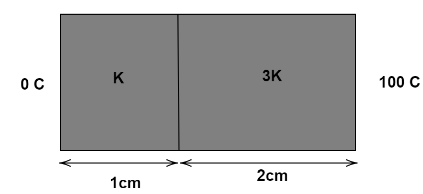
Two bars of thermal conductivities \[K\] and \[3K\] and lengths \[1{\text{ cm}}\] and \[{\text{2 cm}}\] respectively have equal cross-sectional area. They are joined lengthwise as shown in the figure. If the temperature of the ends of the composite bar is \[{0^ \circ }C\] and \[{100^ \circ }C\] respectively (see figure), then the temperature of the interface \[\left( \varphi \right)\] is
A. \[{50^ \circ }C\]
B. \[{\dfrac{{100}}{3}^ \circ }C\]
C. \[{60^ \circ }C\]
D. \[{\dfrac{{200}}{3}^ \circ }C\]
Answer
 Verified
557.1k+ views
Hint:In this question, we need to find the temperature of the interface of two composite slabs. As they are connected in series the heat current through both the slabs must be equal. Assume the temperature as \[{T^ \circ }C\] and write the heat current for both slabs and equate them as they must be equal. On solving, we get the temperature of interface
Formula used:
\[H = \dfrac{{dQ}}{{dt}} = - KA\dfrac{{dT}}{{dx}} = KA\dfrac{{\left( {{T_1} - {T_2}} \right)}}{l}\]
Where \[H\] is the heat current, \[K\] is the thermal conductivity, \[dT\] is the temperature difference and \[l\] is the length of the slab.
Complete step by step answer:
We are given two bars of thermal conductivities \[K\] and \[3K\].
The Length of the first bar is, \[{l_1} = 1{\text{ }}cm\]
The Length of the second bar is, \[{l_2} = 2{\text{ }}cm\]
The Area of cross-section of both the bars is \[A\]
\[{T_1} = {0^ \circ }C\]
\[\Rightarrow {T_2} = {100^ \circ }C\]
Let the temperature of the interface be \[{T^ \circ }C\]
Heat current through the first composite slab,
\[H = KA\dfrac{{\left( {{T_1} - T} \right)}}{1}\]
Heat current through the second composite slab,
\[H = 3KA\dfrac{{\left( {T - {T_2}} \right)}}{2}\]
But heat current through both the slabs must be equal. Therefore,
\[KA\dfrac{{\left( {{T_1} - T} \right)}}{1} = 3KA\dfrac{{\left( {T - {T_2}} \right)}}{2}\]
Dividing both sides by \[KA\] we get,
\[ \Rightarrow {T_1} - T = \dfrac{3}{2}\left( {T - {T_2}} \right)\]
Substituting \[{T_1} = {0^ \circ }C\] and \[{T_2} = {100^ \circ }C\] we get,
\[ \Rightarrow - T = \dfrac{3}{2}\left( {T - 100} \right)\]
\[ \Rightarrow \dfrac{5}{2}T = 150\]
\[ \therefore T = {60^ \circ }C\]
Hence, the temperature of the interference of the two composite blocks is\[{60^ \circ }C\].
Therefore, the correct option is C.
Note: The negative signed use is \[H = \dfrac{{dQ}}{{dt}} = - KA\dfrac{{dT}}{{dx}}\] is used to make \[\dfrac{{dQ}}{{dt}}\] a positive quantity since \[\dfrac{{dT}}{{dx}}\] is a negative quantity. The constant \[K\] , called thermal conductivity, is the measure of the ability of the material to conduct heat. A substance with a large value of \[K\] means it is a good conductor of heat. The value of \[K\] depends on temperature but can be taken practically constant if the temperature difference between the two ends of the substance is not too great.
Formula used:
\[H = \dfrac{{dQ}}{{dt}} = - KA\dfrac{{dT}}{{dx}} = KA\dfrac{{\left( {{T_1} - {T_2}} \right)}}{l}\]
Where \[H\] is the heat current, \[K\] is the thermal conductivity, \[dT\] is the temperature difference and \[l\] is the length of the slab.
Complete step by step answer:
We are given two bars of thermal conductivities \[K\] and \[3K\].
The Length of the first bar is, \[{l_1} = 1{\text{ }}cm\]
The Length of the second bar is, \[{l_2} = 2{\text{ }}cm\]
The Area of cross-section of both the bars is \[A\]
\[{T_1} = {0^ \circ }C\]
\[\Rightarrow {T_2} = {100^ \circ }C\]
Let the temperature of the interface be \[{T^ \circ }C\]
Heat current through the first composite slab,
\[H = KA\dfrac{{\left( {{T_1} - T} \right)}}{1}\]
Heat current through the second composite slab,
\[H = 3KA\dfrac{{\left( {T - {T_2}} \right)}}{2}\]
But heat current through both the slabs must be equal. Therefore,
\[KA\dfrac{{\left( {{T_1} - T} \right)}}{1} = 3KA\dfrac{{\left( {T - {T_2}} \right)}}{2}\]
Dividing both sides by \[KA\] we get,
\[ \Rightarrow {T_1} - T = \dfrac{3}{2}\left( {T - {T_2}} \right)\]
Substituting \[{T_1} = {0^ \circ }C\] and \[{T_2} = {100^ \circ }C\] we get,
\[ \Rightarrow - T = \dfrac{3}{2}\left( {T - 100} \right)\]
\[ \Rightarrow \dfrac{5}{2}T = 150\]
\[ \therefore T = {60^ \circ }C\]
Hence, the temperature of the interference of the two composite blocks is\[{60^ \circ }C\].
Therefore, the correct option is C.
Note: The negative signed use is \[H = \dfrac{{dQ}}{{dt}} = - KA\dfrac{{dT}}{{dx}}\] is used to make \[\dfrac{{dQ}}{{dt}}\] a positive quantity since \[\dfrac{{dT}}{{dx}}\] is a negative quantity. The constant \[K\] , called thermal conductivity, is the measure of the ability of the material to conduct heat. A substance with a large value of \[K\] means it is a good conductor of heat. The value of \[K\] depends on temperature but can be taken practically constant if the temperature difference between the two ends of the substance is not too great.
Recently Updated Pages
Which will be the least stable resonating structure class 11 chemistry CBSE

How many 5 digit telephone numbers can be construc-class-11-maths-CBSE
How do you find the angle of the resultant vector class 11 physics CBSE
Draw labelled diagram of the following i Gram seed class 11 biology CBSE
What is the need and importance of classification class 11 biology CBSE
The way in which the sparrows expressed their sorrow class 11 english CBSE
Trending doubts
One Metric ton is equal to kg A 10000 B 1000 C 100 class 11 physics CBSE
Find the value of the expression given below sin 30circ class 11 maths CBSE
1 Quintal is equal to a 110 kg b 10 kg c 100kg d 1000 class 11 physics CBSE
Draw a diagram of nephron and explain its structur class 11 biology CBSE
10 examples of friction in our daily life
Proton was discovered by A Thomson B Rutherford C Chadwick class 11 chemistry CBSE