




Two adjacent sides of parallelogram are $ 24\;cm $ and $ 18\;cm. $ If the distance between the longer sides is $ 12cm, $ find the distance between the shorter sides.
Answer
 Verified
594.3k+ views
Hint: A parallelogram is the simple quadrilateral with its two opposite sides parallel to each other. The opposite sides of the parallelogram are of same length and never intersect each other. Here we will draw a diagram with the given specifications and will use the formula of the area of the parallelogram to find the unknown side.
Complete step-by-step answer:
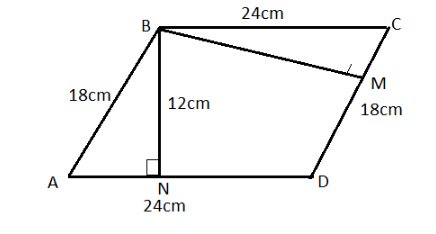
Given that ABCD is the parallelogram.
$ AB = 18\;cm $ and $ BC = 24\;cm. $
Draw the diagram using the given conditions - $ \overline {BM} \bot \overline {CD} $ and $ \overline {BN} \bot \overline {AD.} $
As we know that the formula of the area of the parallelogram can be given by –
Area $ = $ Base $ \times $ perpendicular height
Now, in the parallelogram ABCD, given that $ AD = 24\;cm $ and perpendicular distance, $ BN = 12\;cm $
$ \therefore A = AD \times BN $
Place the values in the above equations –
$ \therefore A = 24 \times 12 $
Simplify the above equation –
$ \therefore A = 288\;c{m^2} $ ..... (i)
Now, similarly for the area of the parallelogram using other perpendicular height-
Where, CD is the side of the parallelogram and the perpendicular height BM.
$ \therefore A = CD \times BM $
Since the area remains the same in the same parallelogram, place the value from the equation (i) and the other value in the given data.
$ \therefore 288 = 18 \times BM $
Make the required measure the subject and take other terms on one side. Remember when the term in multiplicative at one side is moved to the other side it goes to the denominator.
$ \Rightarrow BM = \dfrac{{288}}{{18}} $
Do division –
$ \Rightarrow BM = 16\;cm $ is the required answer.
So, the correct answer is “ $ 16\;cm$”.
Note: Follow the properties of the parallelogram properly. Always remember that the opposite two sides of the parallelogram are always equal. Be good in multiples and simplification for the accurate and an efficient solution.
Additional Information: Quadrilateral is the closed figure with four sides and the four vertices. It is also known as “quadrangle”. Basically, there are six types of quadrilaterals such as rectangle, square, kite, rhombus, trapezium and parallelogram. Refer the properties and know the difference among them.
Complete step-by-step answer:
Given that ABCD is the parallelogram.
$ AB = 18\;cm $ and $ BC = 24\;cm. $
Draw the diagram using the given conditions - $ \overline {BM} \bot \overline {CD} $ and $ \overline {BN} \bot \overline {AD.} $
As we know that the formula of the area of the parallelogram can be given by –
Area $ = $ Base $ \times $ perpendicular height
Now, in the parallelogram ABCD, given that $ AD = 24\;cm $ and perpendicular distance, $ BN = 12\;cm $
$ \therefore A = AD \times BN $
Place the values in the above equations –
$ \therefore A = 24 \times 12 $
Simplify the above equation –
$ \therefore A = 288\;c{m^2} $ ..... (i)
Now, similarly for the area of the parallelogram using other perpendicular height-
Where, CD is the side of the parallelogram and the perpendicular height BM.
$ \therefore A = CD \times BM $
Since the area remains the same in the same parallelogram, place the value from the equation (i) and the other value in the given data.
$ \therefore 288 = 18 \times BM $
Make the required measure the subject and take other terms on one side. Remember when the term in multiplicative at one side is moved to the other side it goes to the denominator.
$ \Rightarrow BM = \dfrac{{288}}{{18}} $
Do division –
$ \Rightarrow BM = 16\;cm $ is the required answer.
So, the correct answer is “ $ 16\;cm$”.
Note: Follow the properties of the parallelogram properly. Always remember that the opposite two sides of the parallelogram are always equal. Be good in multiples and simplification for the accurate and an efficient solution.
Additional Information: Quadrilateral is the closed figure with four sides and the four vertices. It is also known as “quadrangle”. Basically, there are six types of quadrilaterals such as rectangle, square, kite, rhombus, trapezium and parallelogram. Refer the properties and know the difference among them.

Recently Updated Pages
Master Class 12 Business Studies: Engaging Questions & Answers for Success

Master Class 12 Biology: Engaging Questions & Answers for Success
Master Class 12 Chemistry: Engaging Questions & Answers for Success
Class 12 Question and Answer - Your Ultimate Solutions Guide
Master Class 11 Social Science: Engaging Questions & Answers for Success
Master Class 11 English: Engaging Questions & Answers for Success
Trending doubts
What is BLO What is the full form of BLO class 8 social science CBSE
Citizens of India can vote at the age of A 18 years class 8 social science CBSE
Right to vote is a AFundamental Right BFundamental class 8 social science CBSE
10 slogans on organ donation class 8 english CBSE
Name the states through which the Tropic of Cancer class 8 social science CBSE
Explain land use pattern in India and why has the land class 8 social science CBSE