




Two adjacent angles of a parallelogram are${\left( {3x - 4} \right)^ \circ }$ and ${\left( {3x + 10} \right)^ \circ }$ .Find the angles of the parallelogram.
Answer
 Verified
580.8k+ views
Hint: Start by drawing a parallelogram and labelling the sides , consider any two adjacent sides as the given value. Apply the adjacent angle sum property of parallelogram to find the value of x , use alternate opposite angle property to find the other angles of parallelogram.
Complete step-by-step answer:
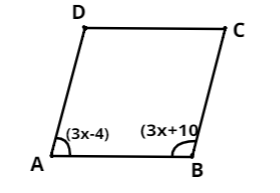
As we can see from figure parallelogram ABCD
Let A and B be the two given adjacent angles,
$\angle A = {\left( {3x - 4} \right)^ \circ }$ and \[\angle B = {\left( {3x + 10} \right)^ \circ }\]
Now, we know that the sum of adjacent angles of parallelogram are ${180^ \circ }$ .
We can write like this
$\angle A + \angle B = {180^ \circ } \to eqn.1$
Now , let us substitute the value of angles in equation 1, we get
$ \Rightarrow \left( {3x - 4} \right) + \left( {3x + 10} \right) = {180^ \circ }$
$ \Rightarrow 6x + 6 = {180^ \circ }$
Dividing by 6 on both the sides , we get
$ \Rightarrow x + 1 = {30^ \circ }$
$ \Rightarrow x = {29^ \circ }$
Now, putting $x = {29^ \circ }$ to find $\angle A$ and $\angle B$
$\angle A = {\left( {3 \times 29 - 4} \right)^ \circ }$ and $\angle B = {\left( {3 \times 29 + 10} \right)^ \circ }$
$ \Rightarrow \angle A = {83^ \circ }$ and $\angle B = {97^ \circ }$
As we know the opposite angles of parallelogram are equal
$\angle A = \angle C$ and $\angle B = \angle D$
$ \Rightarrow \angle C = {83^ \circ }$ and $\angle D = {97^ \circ }$
All angles of parallelogram A,B,C,D are ${83^ \circ },{97^ \circ },{83^ \circ },{97^ \circ } $respectively.
Note: Similar questions can be asked with different levels of intricacy with different shapes and can be solved using the above procedure. Students must know all the properties of parallelogram and triangles and other geometrical shapes in order to make and solve problems easier.
Complete step-by-step answer:
As we can see from figure parallelogram ABCD
Let A and B be the two given adjacent angles,
$\angle A = {\left( {3x - 4} \right)^ \circ }$ and \[\angle B = {\left( {3x + 10} \right)^ \circ }\]
Now, we know that the sum of adjacent angles of parallelogram are ${180^ \circ }$ .
We can write like this
$\angle A + \angle B = {180^ \circ } \to eqn.1$
Now , let us substitute the value of angles in equation 1, we get
$ \Rightarrow \left( {3x - 4} \right) + \left( {3x + 10} \right) = {180^ \circ }$
$ \Rightarrow 6x + 6 = {180^ \circ }$
Dividing by 6 on both the sides , we get
$ \Rightarrow x + 1 = {30^ \circ }$
$ \Rightarrow x = {29^ \circ }$
Now, putting $x = {29^ \circ }$ to find $\angle A$ and $\angle B$
$\angle A = {\left( {3 \times 29 - 4} \right)^ \circ }$ and $\angle B = {\left( {3 \times 29 + 10} \right)^ \circ }$
$ \Rightarrow \angle A = {83^ \circ }$ and $\angle B = {97^ \circ }$
As we know the opposite angles of parallelogram are equal
$\angle A = \angle C$ and $\angle B = \angle D$
$ \Rightarrow \angle C = {83^ \circ }$ and $\angle D = {97^ \circ }$
All angles of parallelogram A,B,C,D are ${83^ \circ },{97^ \circ },{83^ \circ },{97^ \circ } $respectively.
Note: Similar questions can be asked with different levels of intricacy with different shapes and can be solved using the above procedure. Students must know all the properties of parallelogram and triangles and other geometrical shapes in order to make and solve problems easier.
Recently Updated Pages
Master Class 10 Computer Science: Engaging Questions & Answers for Success

Master Class 10 General Knowledge: Engaging Questions & Answers for Success
Master Class 10 English: Engaging Questions & Answers for Success
Master Class 10 Social Science: Engaging Questions & Answers for Success
Master Class 10 Maths: Engaging Questions & Answers for Success
Master Class 10 Science: Engaging Questions & Answers for Success
Trending doubts
Which women's tennis player has 24 Grand Slam singles titles?
Who is the Brand Ambassador of Incredible India?
Why is there a time difference of about 5 hours between class 10 social science CBSE
Which Country is Called "The Land of Festivals"?
What type of cell is found in the Seminiferous tub class 10 biology CBSE
What are the public facilities provided by the government? Also explain each facility