




Turbellarians are free living
A. Nematodes
B. Cestodes
C. Flatworms
D. Trematodes
Answer
 Verified
580.5k+ views
Hint: The Turbellarians are one of the subdivisions of the phylum Platyhelminthes. Platyhelminthes are flat-worms as they are dorso-ventrally flattened and are acoelomate.
Complete answer:
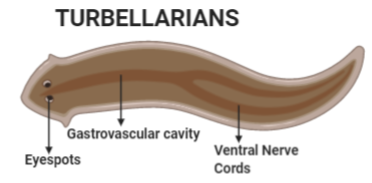
Turbellarians are also known as flatworms. Some characteristics of this class are:
- Bilateral symmetry is present.
- Epidermis is ciliated.
- Nerve fibres are sheathed.
- Dorso-ventral flattening of the organism’s body.
- No segments are present on the body.
- Parenchyma is present in between the epidermis and the gastrodermis.
- Some cephalization is also observed.
In option A, nematodes are mentioned. Nematodes are also referred to as roundworms. They are unsegmented. They can only be seen by microscope.
In option B, cestodes are mentioned. Cestodes are commonly known as tapeworms. Cestoda is a class of parasitic worms in the phylum flatworm. Tapeworms are multi-segmented and are ribbon-shaped. They generally rely on nutrients from the human intestine. They include dwarf tapeworms, rat tapeworms, beef tapeworms, pork tapeworms, and many more.
In option C, flatworms are mentioned.
In option D, trematodes are mentioned. The class belongs to the phylum Platyhelminthes. Trematodes are also known as flukes. They have a complex life cycle. They are known as flukes as they suck the nutrition out of the things they attach to. They cause some dangerous infections to human beings.
Hence option C is correct.
Note: The class turbellaria has more than 3000 species. They are found in both terrestrial and aquatic habitats. They are free-living organisms with some of them having regenerative properties. They are hermaphrodites. This means they do not differ in terms of sexes. For copulation, two turbellarians meet and form multiple eggs.
Complete answer:
Turbellarians are also known as flatworms. Some characteristics of this class are:
- Bilateral symmetry is present.
- Epidermis is ciliated.
- Nerve fibres are sheathed.
- Dorso-ventral flattening of the organism’s body.
- No segments are present on the body.
- Parenchyma is present in between the epidermis and the gastrodermis.
- Some cephalization is also observed.
In option A, nematodes are mentioned. Nematodes are also referred to as roundworms. They are unsegmented. They can only be seen by microscope.
In option B, cestodes are mentioned. Cestodes are commonly known as tapeworms. Cestoda is a class of parasitic worms in the phylum flatworm. Tapeworms are multi-segmented and are ribbon-shaped. They generally rely on nutrients from the human intestine. They include dwarf tapeworms, rat tapeworms, beef tapeworms, pork tapeworms, and many more.
In option C, flatworms are mentioned.
In option D, trematodes are mentioned. The class belongs to the phylum Platyhelminthes. Trematodes are also known as flukes. They have a complex life cycle. They are known as flukes as they suck the nutrition out of the things they attach to. They cause some dangerous infections to human beings.
Hence option C is correct.
Note: The class turbellaria has more than 3000 species. They are found in both terrestrial and aquatic habitats. They are free-living organisms with some of them having regenerative properties. They are hermaphrodites. This means they do not differ in terms of sexes. For copulation, two turbellarians meet and form multiple eggs.
Recently Updated Pages
Master Class 11 Computer Science: Engaging Questions & Answers for Success

Master Class 11 Business Studies: Engaging Questions & Answers for Success
Master Class 11 Economics: Engaging Questions & Answers for Success
Master Class 11 English: Engaging Questions & Answers for Success
Master Class 11 Maths: Engaging Questions & Answers for Success
Master Class 11 Biology: Engaging Questions & Answers for Success
Trending doubts
One Metric ton is equal to kg A 10000 B 1000 C 100 class 11 physics CBSE
There are 720 permutations of the digits 1 2 3 4 5 class 11 maths CBSE
Discuss the various forms of bacteria class 11 biology CBSE
Draw a diagram of a plant cell and label at least eight class 11 biology CBSE
State the laws of reflection of light
10 examples of friction in our daily life