




What is true about the relationship between hare and lynx if lynxes depend mainly on hares for food?
A. As the hare population decrease, the lynx population increase
B. As the hare population decrease, the lynx population stays the same
C. As the hare population increase, the lynx population increase
D. As the hare population increase, the lynx population stays the same
E. There is no relationship between populations of lynx and hares
Answer
 Verified
586.5k+ views
Hint: Communities, in ecological terms are groups of different species that occupy the same geographical area at a given point in time. The populations interact with each other and engage in eating and being eaten relationships. The population of two species increase/decrease with respect to each other.
Complete answer:
Community Ecology is the branch of ecology that deals with interactions between species that form a community. The community occupies the same area and utilizes similar resources at a given point of time.
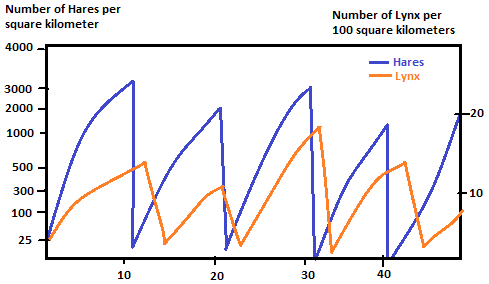
The graph depicts the number of lynxes and hares per square kilometre of an area over a period of time.
It can be seen from the figure that the lynx and hare populations are dependent on each other. The explanation for this conclusion can be described as follows:
While hares are primary consumers and belong to the herbivore level, lynxes depend upon hares for food and occupy the carnivore or secondary consumer level in the food chain.
The population dynamics of the two species follow a cycle of increase/decrease. The hares reproduce rapidly every year. As a result, the hare population steadily increases, the lynxes also increase in numbers. The lynx population then reaches a threshold level, at which, they predate upon so many hares that the hares begin to decrease in numbers. This in turn, leads to scarcity of food for lynxes and they too decrease in numbers. Low number of lynxes positively affects the hare populations and their population size increases. The cycle is renewed again.
Therefore, we can conclude that as the hare population increases, the lynx population increases.
Hence, the correct answer is option (C), that means, As the hare population increase, the lynx population increase.
Note: Community ecology deals with different species sharing a geographical area at the same time. These species form a community and depend on each other for resources. If the species belong to different trophic levels, they form a food chain based on eating and being eaten relationships. Such is the relationship between hares and lynxes. If the population size of hares increases, the increase in the number of lynxes follow. The reverse is also true.
Complete answer:
Community Ecology is the branch of ecology that deals with interactions between species that form a community. The community occupies the same area and utilizes similar resources at a given point of time.
The graph depicts the number of lynxes and hares per square kilometre of an area over a period of time.
It can be seen from the figure that the lynx and hare populations are dependent on each other. The explanation for this conclusion can be described as follows:
While hares are primary consumers and belong to the herbivore level, lynxes depend upon hares for food and occupy the carnivore or secondary consumer level in the food chain.
The population dynamics of the two species follow a cycle of increase/decrease. The hares reproduce rapidly every year. As a result, the hare population steadily increases, the lynxes also increase in numbers. The lynx population then reaches a threshold level, at which, they predate upon so many hares that the hares begin to decrease in numbers. This in turn, leads to scarcity of food for lynxes and they too decrease in numbers. Low number of lynxes positively affects the hare populations and their population size increases. The cycle is renewed again.
Therefore, we can conclude that as the hare population increases, the lynx population increases.
Hence, the correct answer is option (C), that means, As the hare population increase, the lynx population increase.
Note: Community ecology deals with different species sharing a geographical area at the same time. These species form a community and depend on each other for resources. If the species belong to different trophic levels, they form a food chain based on eating and being eaten relationships. Such is the relationship between hares and lynxes. If the population size of hares increases, the increase in the number of lynxes follow. The reverse is also true.
Recently Updated Pages
Master Class 11 English: Engaging Questions & Answers for Success

Master Class 11 Physics: Engaging Questions & Answers for Success
Master Class 11 Computer Science: Engaging Questions & Answers for Success
Master Class 11 Chemistry: Engaging Questions & Answers for Success
Master Class 11 Social Science: Engaging Questions & Answers for Success
Master Class 11 Accountancy: Engaging Questions & Answers for Success
Trending doubts
Difference Between Prokaryotic Cells and Eukaryotic Cells
Two of the body parts which do not appear in MRI are class 11 biology CBSE
One Metric ton is equal to kg A 10000 B 1000 C 100 class 11 physics CBSE
10 examples of friction in our daily life
Draw a diagram of nephron and explain its structur class 11 biology CBSE
Draw a diagram of a plant cell and label at least eight class 11 biology CBSE