




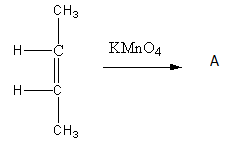
What is true about that reaction?
(A) A is meso, 2,3-butandiol is formed by syn addition
(B) A is meso, 2,3-butandiol is formed by anti addition
(C) A is a racemic mixture of d and l, 2,3-butandiol is formed by anti addition
(D) A is a racemic mixture of d and l, 2,3-butandiol is formed by syn addition
Answer
 Verified
611.1k+ views
Hint: Necessary requirement for a compound to be optically active is absence of all symmetry elements. Potassium permanganate always adds two -OH groups to alkene from the same side.
Complete answer:
Let’s find out the product first.
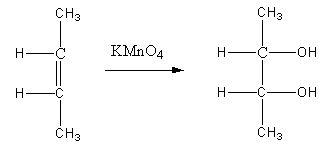
Here the product formed has a mirror plane that cuts the molecule into half.
So, any molecule that has this property is called a meso compound. Now even though the meso compound has a chiral carbon, the compound is not optically active. The reason is that elements of symmetry are present in the molecule. So, we can say that A is not a racemic mixture.
If the addition of two new groups in the alkene is from the same side, then the addition is called syn addition. We can see that in compound A -OH group is on the same side of the alkene. So it is a syn addition.
Hence the true answer is (A) A is meso, 2,3-butandiol is formed by syn addition.
Additional Information:
- Remember that being asymmetric is the primary requirement of the optically active compound. So, as in the case of meso compounds, even though the compound has chiral carbon, it is not optically active. This is because they have mirror planes present.
- If the addition of two new groups in the alkene is from the same side, then the addition is called syn addition.
- If the addition of two new groups in the alkene is from different sides, then the addition is called anti addition.
- Remember that Potassium Permanganate always does syn addition to alkenes and forms diols.
Note: Do not consider a meso compound optically active even though it contains a chiral carbon. It is possible that the compound contains chiral carbon but is not optically active. Remember that Potassium permanganate never does anti addition.
Complete answer:
Let’s find out the product first.
Here the product formed has a mirror plane that cuts the molecule into half.
So, any molecule that has this property is called a meso compound. Now even though the meso compound has a chiral carbon, the compound is not optically active. The reason is that elements of symmetry are present in the molecule. So, we can say that A is not a racemic mixture.
If the addition of two new groups in the alkene is from the same side, then the addition is called syn addition. We can see that in compound A -OH group is on the same side of the alkene. So it is a syn addition.
Hence the true answer is (A) A is meso, 2,3-butandiol is formed by syn addition.
Additional Information:
- Remember that being asymmetric is the primary requirement of the optically active compound. So, as in the case of meso compounds, even though the compound has chiral carbon, it is not optically active. This is because they have mirror planes present.
- If the addition of two new groups in the alkene is from the same side, then the addition is called syn addition.
- If the addition of two new groups in the alkene is from different sides, then the addition is called anti addition.
- Remember that Potassium Permanganate always does syn addition to alkenes and forms diols.
Note: Do not consider a meso compound optically active even though it contains a chiral carbon. It is possible that the compound contains chiral carbon but is not optically active. Remember that Potassium permanganate never does anti addition.
Recently Updated Pages
Master Class 12 Social Science: Engaging Questions & Answers for Success

Master Class 12 Physics: Engaging Questions & Answers for Success
Master Class 12 Maths: Engaging Questions & Answers for Success
Master Class 12 Economics: Engaging Questions & Answers for Success
Master Class 12 Chemistry: Engaging Questions & Answers for Success
Master Class 12 Business Studies: Engaging Questions & Answers for Success
Trending doubts
Which are the Top 10 Largest Countries of the World?
Draw a labelled sketch of the human eye class 12 physics CBSE
Explain the structure of megasporangium class 12 biology CBSE
What are the major means of transport Explain each class 12 social science CBSE
How many chromosomes are found in human ovum a 46 b class 12 biology CBSE
The diagram of the section of a maize grain is given class 12 biology CBSE