




Tropolone is an example of:
A. Benzenoid aromatic compound
B. non-benzenoid aromatic compound
C. alicyclic compound
D. heterocyclic aromatic compound
Answer
 Verified
565.2k+ views
Hint: Tropolone is an organic compound. It is a pale yellow solid that is soluble in organic solvents. The compound has been of interest to research chemists because of its unusual electronic structure and its role as a ligand precursor.
Complete answer:
For knowing each of the given compounds we must know the structure of tropolone. Therefore the structure of tropolone is,
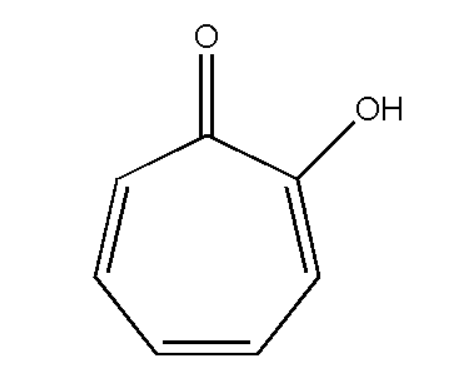
This is the basic structure of a tropolone. Its molecular formula is \[{{\text{C}}_7}{{\text{H}}_6}{{\text{O}}_2}\] having seven carbon atoms, six hydrogen atoms and two oxygen atoms. Now we will discuss each type of compound given and choose the right one. At first we had a benzenoid aromatic compound. These compounds are those which have benzene ring and they are aromatic in nature. Then we have, non-benzenoid aromatic compound. These are those compounds which do not have any benzene ring but they are aromatic in nature. Alicyclic compounds are those compounds which can be saturated or unsaturated but they do not show aromatic character. Thus these compounds are not aromatic in nature. Heterocyclic aromatic compounds are those which have more than one carbon atom but they are replaced by some group of atoms like nitrogen, oxygen and sulphur. Thus on observing each type of compound we can observe that tropolene is a non-benzenoid aromatic compound.
Hence the correct option is B.
Note:
Aromatic compounds are those which show aromaticity. We can also say that these compounds show resonance due to conjugate pi bond configuration which can be easily seen in tropolene. We can relate aromatic compounds to compounds which show resonance in its structure.
Complete answer:
For knowing each of the given compounds we must know the structure of tropolone. Therefore the structure of tropolone is,
This is the basic structure of a tropolone. Its molecular formula is \[{{\text{C}}_7}{{\text{H}}_6}{{\text{O}}_2}\] having seven carbon atoms, six hydrogen atoms and two oxygen atoms. Now we will discuss each type of compound given and choose the right one. At first we had a benzenoid aromatic compound. These compounds are those which have benzene ring and they are aromatic in nature. Then we have, non-benzenoid aromatic compound. These are those compounds which do not have any benzene ring but they are aromatic in nature. Alicyclic compounds are those compounds which can be saturated or unsaturated but they do not show aromatic character. Thus these compounds are not aromatic in nature. Heterocyclic aromatic compounds are those which have more than one carbon atom but they are replaced by some group of atoms like nitrogen, oxygen and sulphur. Thus on observing each type of compound we can observe that tropolene is a non-benzenoid aromatic compound.
Hence the correct option is B.
Note:
Aromatic compounds are those which show aromaticity. We can also say that these compounds show resonance due to conjugate pi bond configuration which can be easily seen in tropolene. We can relate aromatic compounds to compounds which show resonance in its structure.
Recently Updated Pages
Which of the following graphs shows the variation of class 12 physics CBSE

Draw a labelled diagram of the human male reproductive class 12 biology CBSE
Describe the experiment to compare the emf of two cells class 12 physics CBSE
What is standard hydrogen electrode
What is conventional current and electric current class 12 physics CBSE
2Bromopentane is treated with an alcoholic KOH solution class 12 chemistry CBSE
Trending doubts
Draw a labelled sketch of the human eye class 12 physics CBSE
Which are the Top 10 Largest Countries of the World?
Differentiate between homogeneous and heterogeneous class 12 chemistry CBSE
Draw ray diagrams each showing i myopic eye and ii class 12 physics CBSE
Which is the correct genotypic ratio of mendel dihybrid class 12 biology CBSE
What is the Full Form of PVC, PET, HDPE, LDPE, PP and PS ?