




Trophoblasts of Plasmodium feed on -
(a) Haemoglobin molecules
(b) Cytoplasm of erythrocytes
(c) Globin part of haemoglobin
(d) Haematin part of haemoglobin
Answer
 Verified
576.3k+ views
Hint: The parasite Plasmodium causes the disease of malaria. Trophoblasts refer to the trophozoite stage of malaria where the parasite invades the red blood cells and consumes the particular component to carry on with their cycle.
Complete answer:
- Malaria is a parasitic infection caused by the protozoan parasites Plasmodium falciparum, P. vivax, P. malariae, or P. ovale. The female Anopheles mosquito is a host as well as a vector of the parasite.
- The life cycle of Plasmodium is divided into two distinct phases: the asexual cycle that occurs in humans and the sexual cycle that occurs in mosquitoes.
- In the beginning, an infected mosquito injects the sporozoites into the human being’s body through the blood meal. They travel from the bloodstream into the liver rapidly. This is the beginning of the exo-erythrocytic stage during which asexual multiplication occurs. Within the liver cells, the sporozoites undergo many nuclear divisions to become schizonts, which after 6-15 days burst and release thousands of merozoites that get circulated. This marks the end of the exo-erythrocytic cycle.
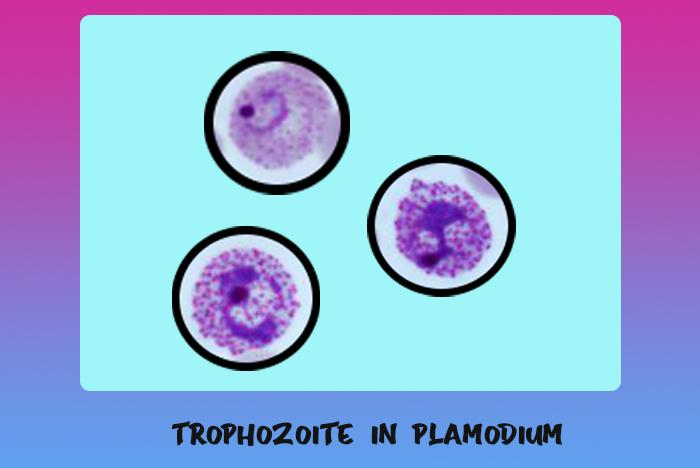
- Upon release, the merozoites invade the RBCs where they undergo another asexual cycle called the erythrocytic cycle. Here, the merozoites form immature trophozoites which progress to mature trophozoites or trophoblasts.
- The trophozoites cannot digest the haem so they convert it in hemozoin and digest the globin that is used as a source of amino acids for their reproduction.
Additional Information:
- In the P. vivax and P. ovale species a dormant stage, hypnozoites, can persist in the liver (if untreated) that causes relapses by invading the bloodstream weeks, or even years later.
- Hemozoin is also known as malarial pigment.
- The first two stages, the infection with sporozoites and asexual reproduction, take place exclusively into the human body, while the third one, sexual reproduction, starts in the human body and is completed in the mosquito vector.
So, the correct answer is ‘Globin part of haemoglobin’.
Note:
- The erythrocytic cycle is also known as the Golgi cycle.
- Less common routes of transmission of malaria are via infected blood transfusion, transplantation, infected needles, and from a mother to her fetus during pregnancy.
- Erythrocytic schizogony gives birth to new merozoites that continue to infect other RBCs and cause their rupture. Each new release of merozoites leads to febrile waves i.e. fever and fluctuations in body temperature.
Complete answer:
- Malaria is a parasitic infection caused by the protozoan parasites Plasmodium falciparum, P. vivax, P. malariae, or P. ovale. The female Anopheles mosquito is a host as well as a vector of the parasite.
- The life cycle of Plasmodium is divided into two distinct phases: the asexual cycle that occurs in humans and the sexual cycle that occurs in mosquitoes.
- In the beginning, an infected mosquito injects the sporozoites into the human being’s body through the blood meal. They travel from the bloodstream into the liver rapidly. This is the beginning of the exo-erythrocytic stage during which asexual multiplication occurs. Within the liver cells, the sporozoites undergo many nuclear divisions to become schizonts, which after 6-15 days burst and release thousands of merozoites that get circulated. This marks the end of the exo-erythrocytic cycle.
- Upon release, the merozoites invade the RBCs where they undergo another asexual cycle called the erythrocytic cycle. Here, the merozoites form immature trophozoites which progress to mature trophozoites or trophoblasts.
- The trophozoites cannot digest the haem so they convert it in hemozoin and digest the globin that is used as a source of amino acids for their reproduction.
Additional Information:
- In the P. vivax and P. ovale species a dormant stage, hypnozoites, can persist in the liver (if untreated) that causes relapses by invading the bloodstream weeks, or even years later.
- Hemozoin is also known as malarial pigment.
- The first two stages, the infection with sporozoites and asexual reproduction, take place exclusively into the human body, while the third one, sexual reproduction, starts in the human body and is completed in the mosquito vector.
So, the correct answer is ‘Globin part of haemoglobin’.
Note:
- The erythrocytic cycle is also known as the Golgi cycle.
- Less common routes of transmission of malaria are via infected blood transfusion, transplantation, infected needles, and from a mother to her fetus during pregnancy.
- Erythrocytic schizogony gives birth to new merozoites that continue to infect other RBCs and cause their rupture. Each new release of merozoites leads to febrile waves i.e. fever and fluctuations in body temperature.
Recently Updated Pages
Master Class 11 Computer Science: Engaging Questions & Answers for Success

Master Class 11 Business Studies: Engaging Questions & Answers for Success
Master Class 11 Economics: Engaging Questions & Answers for Success
Master Class 11 English: Engaging Questions & Answers for Success
Master Class 11 Maths: Engaging Questions & Answers for Success
Master Class 11 Biology: Engaging Questions & Answers for Success
Trending doubts
One Metric ton is equal to kg A 10000 B 1000 C 100 class 11 physics CBSE
There are 720 permutations of the digits 1 2 3 4 5 class 11 maths CBSE
Discuss the various forms of bacteria class 11 biology CBSE
Draw a diagram of a plant cell and label at least eight class 11 biology CBSE
State the laws of reflection of light
Explain zero factorial class 11 maths CBSE