




Triangle ABC has \[AC = 8x - 3,{\text{ }}BC = 4x - 1,\] angle \[ABC = 120\] and angle \[ACB = 15.\] Show that the exact value of $x\;{\text{is}}\;\left( {9 + sqrt6} \right)$ divided by 20.
Answer
 Verified
552.3k+ views
Hint:First either find the equation of the third side AC, or the angle BAC, and then use sine rule for triangles that can be understood as the ratio of length of side to sine of its opposite angle is equal to the ratio of length of other sides to their respective sine of opposite angles.
Complete step by step solution:
We can prove the given question with the help of sine rule for triangles.
Let us understand what sine rule for triangle says,
In a $\Delta ABC,$
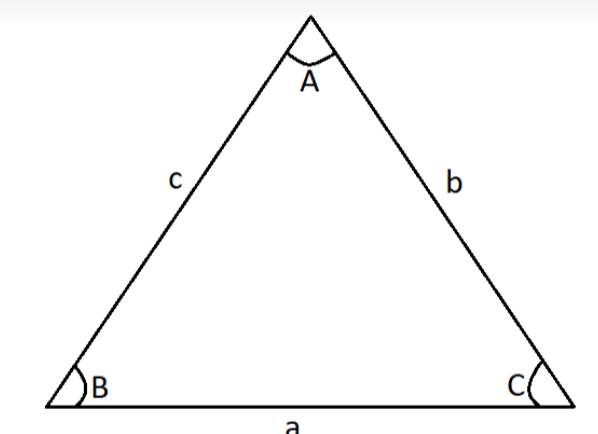
Where ${\text{a,}}\;{\text{b}}\;{\text{and}}\;{\text{c}}$ are its sides and
${\text{A,}}\,{\text{B}}\;{\text{and}}\;{\text{C}}$ are its angles, sine rule is given as
$\dfrac{{\text{a}}}{{{\text{sinA}}}} = \dfrac{{\text{b}}}{{{\text{sinB}}}} =
\dfrac{{\text{c}}}{{{\text{sinC}}}}$
In order to apply this rule we should have at least two pairs of angles and their respective sides, but here in the question we have one pair only, that is $AC = 8x - 3\;and\;\angle ABC = {120^0}$
We have to find angle BAC, in order to have the another pair
We will use property of triangles to find it, that sum of all interior angle of a triangle is equal to ${180^0}$
$
\Rightarrow \angle ABC + \angle ACB + \angle BAC = {180^0} \\
\Rightarrow {120^0} + {15^0} + \angle BAC = {180^0} \\
\Rightarrow \angle BAC = {180^0} - {120^0} - {15^0} \\
\Rightarrow \angle BAC = {45^0} \\
$
Now applying sine rule,
$
\dfrac{{AC}}{{\sin \angle ABC}} = \dfrac{{BC}}{{\sin \angle BAC}} \\
\Rightarrow \dfrac{{8x - 3}}{{\sin {{120}^0}}} = \dfrac{{4x - 1}}{{\sin {{45}^0}}} \\
\Rightarrow \dfrac{{8x - 3}}{{\dfrac{{\sqrt 3 }}{2}}} = \dfrac{{4x - 1}}{{\dfrac{1}{{\sqrt 2 }}}} \\
\Rightarrow \dfrac{{(8x - 3)2}}{{\sqrt 3 }} = \dfrac{{(4x - 1)\sqrt 2 }}{1} \\
\Rightarrow 16x - 6 = (4x - 1)\sqrt 6 \\
\Rightarrow 16x - 4\sqrt 6 x = - \sqrt 6 + 6 \\
\Rightarrow 4x\left( {4 - \sqrt 6 } \right) = 6 - \sqrt 6 \\
\Rightarrow x = \dfrac{{6 - \sqrt 6 }}{{4\left( {4 - \sqrt 6 } \right)}} \\
$
Rationalizing the it by multiplying and dividing with $\left( {4 + \sqrt 6 } \right)$
$
\Rightarrow x = \dfrac{{6 - \sqrt 6 }}{{4\left( {4 - \sqrt 6 } \right)}} \times \dfrac{{\left( {4 + \sqrt 6 } \right)}}{{\left( {4 + \sqrt 6 } \right)}} \\
\Rightarrow x = \dfrac{{\left( {6 - \sqrt 6 } \right)\left( {4 + \sqrt 6 } \right)}}{{4\left( {{4^2} - {{\left({\sqrt 6 } \right)}^2}} \right)}} \\
$
Simplifying it further, we will get
$
\Rightarrow x = \dfrac{{\left( {24 - 4\sqrt 6 + 6\sqrt 6 - 6} \right)}}{{4\left( {16 - 6} \right)}} \\
\Rightarrow x = \dfrac{{\left( {18 + 2\sqrt 6 } \right)}}{{4\left( {10} \right)}} \\
\Rightarrow x = \dfrac{{2\left( {9 + \sqrt 6 } \right)}}{{4\left( {10} \right)}} \\
\Rightarrow x = \dfrac{{9 + \sqrt 6 }}{{20}} \\
$
So we have proved the value of $x = \dfrac{{9 + \sqrt 6 }}{{20}}$
Note: We have calculated the angle instead of the side of the triangle for second pair of angle and side, because according to this question we have to find the equation of the third side with help of the first two which is much more complex than finding the third angle of a triangle when two of it are given.
Complete step by step solution:
We can prove the given question with the help of sine rule for triangles.
Let us understand what sine rule for triangle says,
In a $\Delta ABC,$
Where ${\text{a,}}\;{\text{b}}\;{\text{and}}\;{\text{c}}$ are its sides and
${\text{A,}}\,{\text{B}}\;{\text{and}}\;{\text{C}}$ are its angles, sine rule is given as
$\dfrac{{\text{a}}}{{{\text{sinA}}}} = \dfrac{{\text{b}}}{{{\text{sinB}}}} =
\dfrac{{\text{c}}}{{{\text{sinC}}}}$
In order to apply this rule we should have at least two pairs of angles and their respective sides, but here in the question we have one pair only, that is $AC = 8x - 3\;and\;\angle ABC = {120^0}$
We have to find angle BAC, in order to have the another pair
We will use property of triangles to find it, that sum of all interior angle of a triangle is equal to ${180^0}$
$
\Rightarrow \angle ABC + \angle ACB + \angle BAC = {180^0} \\
\Rightarrow {120^0} + {15^0} + \angle BAC = {180^0} \\
\Rightarrow \angle BAC = {180^0} - {120^0} - {15^0} \\
\Rightarrow \angle BAC = {45^0} \\
$
Now applying sine rule,
$
\dfrac{{AC}}{{\sin \angle ABC}} = \dfrac{{BC}}{{\sin \angle BAC}} \\
\Rightarrow \dfrac{{8x - 3}}{{\sin {{120}^0}}} = \dfrac{{4x - 1}}{{\sin {{45}^0}}} \\
\Rightarrow \dfrac{{8x - 3}}{{\dfrac{{\sqrt 3 }}{2}}} = \dfrac{{4x - 1}}{{\dfrac{1}{{\sqrt 2 }}}} \\
\Rightarrow \dfrac{{(8x - 3)2}}{{\sqrt 3 }} = \dfrac{{(4x - 1)\sqrt 2 }}{1} \\
\Rightarrow 16x - 6 = (4x - 1)\sqrt 6 \\
\Rightarrow 16x - 4\sqrt 6 x = - \sqrt 6 + 6 \\
\Rightarrow 4x\left( {4 - \sqrt 6 } \right) = 6 - \sqrt 6 \\
\Rightarrow x = \dfrac{{6 - \sqrt 6 }}{{4\left( {4 - \sqrt 6 } \right)}} \\
$
Rationalizing the it by multiplying and dividing with $\left( {4 + \sqrt 6 } \right)$
$
\Rightarrow x = \dfrac{{6 - \sqrt 6 }}{{4\left( {4 - \sqrt 6 } \right)}} \times \dfrac{{\left( {4 + \sqrt 6 } \right)}}{{\left( {4 + \sqrt 6 } \right)}} \\
\Rightarrow x = \dfrac{{\left( {6 - \sqrt 6 } \right)\left( {4 + \sqrt 6 } \right)}}{{4\left( {{4^2} - {{\left({\sqrt 6 } \right)}^2}} \right)}} \\
$
Simplifying it further, we will get
$
\Rightarrow x = \dfrac{{\left( {24 - 4\sqrt 6 + 6\sqrt 6 - 6} \right)}}{{4\left( {16 - 6} \right)}} \\
\Rightarrow x = \dfrac{{\left( {18 + 2\sqrt 6 } \right)}}{{4\left( {10} \right)}} \\
\Rightarrow x = \dfrac{{2\left( {9 + \sqrt 6 } \right)}}{{4\left( {10} \right)}} \\
\Rightarrow x = \dfrac{{9 + \sqrt 6 }}{{20}} \\
$
So we have proved the value of $x = \dfrac{{9 + \sqrt 6 }}{{20}}$
Note: We have calculated the angle instead of the side of the triangle for second pair of angle and side, because according to this question we have to find the equation of the third side with help of the first two which is much more complex than finding the third angle of a triangle when two of it are given.
Recently Updated Pages
Master Class 11 Computer Science: Engaging Questions & Answers for Success

Master Class 11 Business Studies: Engaging Questions & Answers for Success
Master Class 11 Economics: Engaging Questions & Answers for Success
Master Class 11 English: Engaging Questions & Answers for Success
Master Class 11 Maths: Engaging Questions & Answers for Success
Master Class 11 Biology: Engaging Questions & Answers for Success
Trending doubts
One Metric ton is equal to kg A 10000 B 1000 C 100 class 11 physics CBSE
There are 720 permutations of the digits 1 2 3 4 5 class 11 maths CBSE
Discuss the various forms of bacteria class 11 biology CBSE
Draw a diagram of a plant cell and label at least eight class 11 biology CBSE
State the laws of reflection of light
Explain zero factorial class 11 maths CBSE