




Triangle ABC and DEF are similar
(1) if area \[\left( \Delta ABC \right)=16c{{m}^{2}}\], area \[\left( \Delta DEF \right)=25c{{m}^{2}}\], and BC = 2.34 cm. Find EF.
(2) if area \[\left( \Delta ABC \right)=9c{{m}^{2}}\], area \[\left( \Delta DEF \right)=64c{{m}^{2}}\] , and DE = 5.1 cm. Find AB.
(3) if AC = 19 cm and DF = 8 cm, the ratio of the area of the two triangles.
(4) if area \[\left( \Delta ABC \right)=36c{{m}^{2}}\], area \[\left( \Delta DEF \right)=64c{{m}^{2}}\] , and DE = 6.2 cm. Find AB.
(5) if AB = 1.2 cm and DE = 1.4, find the ratio of the areas of the triangle ABC and DEF.
Answer
 Verified
641.7k+ views
Hint: Here, use the property of the similar triangles that is when two triangles are similar, the ratio of their corresponding sides are equal and the area of the triangle is equal to the square of the ratio of the corresponding sides. That is in \[\Delta ABC\] and \[\Delta DEF\],
\[\dfrac{\text{Area of }\Delta ABC}{\text{Area of }\Delta DEF}={{\left( \dfrac{AB}{DE} \right)}^{2}}={{\left( \dfrac{AC}{DF} \right)}^{2}}={{\left( \dfrac{BC}{EF} \right)}^{2}}\]
Complete step-by-step solution:
Before proceeding with the question, let us first see what similar triangles are. Two triangles are similar if their corresponding angles are equal and corresponding sides are in proportion. In other words, similar triangles are of the same shape, but not necessarily the same size. The sides of the two similar triangles are proportional. That is if \[\Delta UVW\] is similar to \[\Delta XYZ\], then,
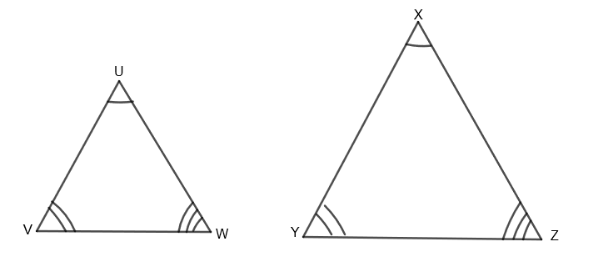
\[\dfrac{UV}{XY}=\dfrac{UW}{XZ}=\dfrac{VW}{YZ}\]
Also, in similar triangles, the ratio of the areas of the triangles is equal to the square of the ratio of the corresponding sides. That is in \[\Delta UVW\] and \[\Delta XYZ\],
\[\dfrac{\text{Area of }\Delta UVW}{\text{Area of }\Delta XYZ}={{\left( \dfrac{UV}{XY} \right)}^{2}}={{\left( \dfrac{UW}{XZ} \right)}^{2}}={{\left( \dfrac{VW}{YZ} \right)}^{2}}\]
Now, let us consider our question. It is given that the triangles ABC and DEF are similar,
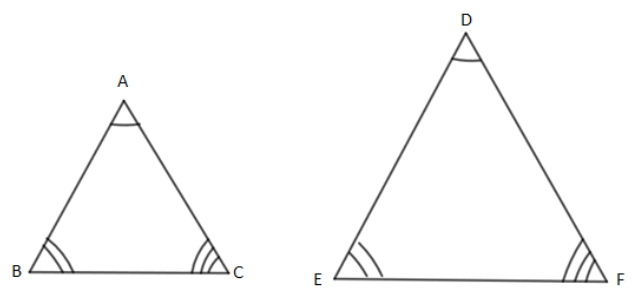
Therefore, according to the property of similar triangles, the ratio of areas of the two triangles would be equal to the square of the ratio of their corresponding sides. So, we get,
\[\dfrac{\text{Area of }\Delta ABC}{\text{Area of }\Delta DEF}={{\left( \dfrac{AB}{DE} \right)}^{2}}={{\left( \dfrac{AC}{DF} \right)}^{2}}={{\left( \dfrac{BC}{EF} \right)}^{2}}.....\left( i \right)\]
(1) Here, we are given that the area \[\left( \Delta ABC \right)=16c{{m}^{2}}\], area \[\left( \Delta DEF \right)=25c{{m}^{2}}\] , and BC = 2.34 cm we have to find EF.
From equation (i), we get,
\[\dfrac{\text{Area of }\Delta ABC}{\text{Area of }\Delta DEF}={{\left( \dfrac{BC}{EF} \right)}^{2}}\]
By substituting the values of the areas of \[\Delta ABC\] and \[\Delta DEF\] and length of BC, we get,
\[\dfrac{16}{25}={{\left( \dfrac{2.34}{EF} \right)}^{2}}\]
By taking the square root on both the sides, we get,
\[\Rightarrow \sqrt{\dfrac{16}{25}}=\sqrt{{{\left( \dfrac{2.34}{EF} \right)}^{2}}}\]
\[\Rightarrow \dfrac{4}{5}=\dfrac{2.34}{EF}\]
By cross multiplying the above equation, we get,
\[4.\left( EF \right)=5\times 2.34\]
\[EF=\dfrac{5\times 2.34}{4}=\dfrac{11.7}{4}=2.925cm\]
(2) Here, we are given that area \[\left( \Delta ABC \right)=9c{{m}^{2}}\], area \[\left( \Delta DEF \right)=64c{{m}^{2}}\] , and DE = 5.1 cm, we have to find AB.
From equation (i), we get,
\[\dfrac{\text{Area of }\Delta ABC}{\text{Area of }\Delta DEF}={{\left( \dfrac{AB}{DE} \right)}^{2}}\]
By substituting the values of the areas of \[\Delta ABC\] and \[\Delta DEF\] and length of DE, we get,
\[\dfrac{9}{64}={{\left( \dfrac{AB}{5.1} \right)}^{2}}\]
By taking the square root on both the sides, we get,
\[\Rightarrow \sqrt{\dfrac{9}{64}}=\sqrt{{{\left( \dfrac{AB}{5.1} \right)}^{2}}}\]
\[\Rightarrow \dfrac{3}{8}=\dfrac{AB}{5.1}\]
By cross multiplying the above equation, we get,
\[3.\left( 5.1 \right)=8.\left( AB \right)\]
\[AB=\dfrac{3\times 5.1}{8}=\dfrac{15.3}{8}=1.9125cm\]
So, we get AB = 1.9125 cm.
(3) Here we are given that AC = 19 cm and DF = 8 cm, we have to find the ratio of the area of the two triangles.
From equation (i), we get,
\[\dfrac{\text{Area of }\Delta ABC}{\text{Area of }\Delta DEF}={{\left( \dfrac{AC}{DF} \right)}^{2}}\]
By substituting the values of AC = 19 cm and DF = 8 cm, we get,
\[\dfrac{\text{Area of }\Delta ABC}{\text{Area of }\Delta DEF}={{\left( \dfrac{19}{8} \right)}^{2}}=\dfrac{361}{64}\approx 5.64\]
So, we get the ratio of the area of the triangles \[\simeq 5.64\].
(4) Here, we are given that area \[\left( \Delta ABC \right)=36c{{m}^{2}}\], area \[\left( \Delta DEF \right)=64c{{m}^{2}}\] , and DE = 6.2 cm, we have to find AB.
From equation (i), we get,
\[\dfrac{\text{Area of }\Delta ABC}{\text{Area of }\Delta DEF}={{\left( \dfrac{AB}{DE} \right)}^{2}}\]
By substituting the values of the areas of \[\Delta ABC\] and \[\Delta DEF\] and length of DE, we get,
\[\dfrac{36}{64}={{\left( \dfrac{AB}{6.2} \right)}^{2}}\]
By taking the square root on both the sides, we get,
\[\Rightarrow \sqrt{\dfrac{36}{64}}=\sqrt{{{\left( \dfrac{AB}{6.2} \right)}^{2}}}\]
\[\Rightarrow \dfrac{6}{8}=\dfrac{AB}{6.2}\]
By cross multiplying the above equation, we get,
\[6.\left( 6.2 \right)=8.\left( AB \right)\]
\[AB=\dfrac{6\times 6.2}{8}=\dfrac{37.2}{8}=4.65cm\]
So, we get AB = 4.65 cm.
(5) Here, we are given that AB = 1.2 cm and DE = 1.4 cm, we have to find the ratio of the area of the two triangles.
From equation (i), we get,
\[\dfrac{\text{Area of }\Delta ABC}{\text{Area of }\Delta DEF}={{\left( \dfrac{AB}{DE} \right)}^{2}}\]
By substituting the values of AB = 1.2 cm and DE = 1.4 cm, we get,
\[\dfrac{\text{Area of }\Delta ABC}{\text{Area of }\Delta DEF}={{\left( \dfrac{1.2}{1.4} \right)}^{2}}=\dfrac{1.44}{1.96}\approx 0.735\]
So, we get the ratio of the areas of the triangles \[\simeq 0.735\].
Note: In the questions involving similar triangles, students often make mistakes in writing the corresponding sides, that is, in our question, some students may take BC corresponding to DF which is wrong. Here, sides AC is corresponding to sides DF, side BC to side EF, and side AB to side DE. Also, students must remember that in similar triangles, the ratio of the sides are equal, not the sides itself like in congruent triangles.
\[\dfrac{\text{Area of }\Delta ABC}{\text{Area of }\Delta DEF}={{\left( \dfrac{AB}{DE} \right)}^{2}}={{\left( \dfrac{AC}{DF} \right)}^{2}}={{\left( \dfrac{BC}{EF} \right)}^{2}}\]
Complete step-by-step solution:
Before proceeding with the question, let us first see what similar triangles are. Two triangles are similar if their corresponding angles are equal and corresponding sides are in proportion. In other words, similar triangles are of the same shape, but not necessarily the same size. The sides of the two similar triangles are proportional. That is if \[\Delta UVW\] is similar to \[\Delta XYZ\], then,
\[\dfrac{UV}{XY}=\dfrac{UW}{XZ}=\dfrac{VW}{YZ}\]
Also, in similar triangles, the ratio of the areas of the triangles is equal to the square of the ratio of the corresponding sides. That is in \[\Delta UVW\] and \[\Delta XYZ\],
\[\dfrac{\text{Area of }\Delta UVW}{\text{Area of }\Delta XYZ}={{\left( \dfrac{UV}{XY} \right)}^{2}}={{\left( \dfrac{UW}{XZ} \right)}^{2}}={{\left( \dfrac{VW}{YZ} \right)}^{2}}\]
Now, let us consider our question. It is given that the triangles ABC and DEF are similar,
Therefore, according to the property of similar triangles, the ratio of areas of the two triangles would be equal to the square of the ratio of their corresponding sides. So, we get,
\[\dfrac{\text{Area of }\Delta ABC}{\text{Area of }\Delta DEF}={{\left( \dfrac{AB}{DE} \right)}^{2}}={{\left( \dfrac{AC}{DF} \right)}^{2}}={{\left( \dfrac{BC}{EF} \right)}^{2}}.....\left( i \right)\]
(1) Here, we are given that the area \[\left( \Delta ABC \right)=16c{{m}^{2}}\], area \[\left( \Delta DEF \right)=25c{{m}^{2}}\] , and BC = 2.34 cm we have to find EF.
From equation (i), we get,
\[\dfrac{\text{Area of }\Delta ABC}{\text{Area of }\Delta DEF}={{\left( \dfrac{BC}{EF} \right)}^{2}}\]
By substituting the values of the areas of \[\Delta ABC\] and \[\Delta DEF\] and length of BC, we get,
\[\dfrac{16}{25}={{\left( \dfrac{2.34}{EF} \right)}^{2}}\]
By taking the square root on both the sides, we get,
\[\Rightarrow \sqrt{\dfrac{16}{25}}=\sqrt{{{\left( \dfrac{2.34}{EF} \right)}^{2}}}\]
\[\Rightarrow \dfrac{4}{5}=\dfrac{2.34}{EF}\]
By cross multiplying the above equation, we get,
\[4.\left( EF \right)=5\times 2.34\]
\[EF=\dfrac{5\times 2.34}{4}=\dfrac{11.7}{4}=2.925cm\]
(2) Here, we are given that area \[\left( \Delta ABC \right)=9c{{m}^{2}}\], area \[\left( \Delta DEF \right)=64c{{m}^{2}}\] , and DE = 5.1 cm, we have to find AB.
From equation (i), we get,
\[\dfrac{\text{Area of }\Delta ABC}{\text{Area of }\Delta DEF}={{\left( \dfrac{AB}{DE} \right)}^{2}}\]
By substituting the values of the areas of \[\Delta ABC\] and \[\Delta DEF\] and length of DE, we get,
\[\dfrac{9}{64}={{\left( \dfrac{AB}{5.1} \right)}^{2}}\]
By taking the square root on both the sides, we get,
\[\Rightarrow \sqrt{\dfrac{9}{64}}=\sqrt{{{\left( \dfrac{AB}{5.1} \right)}^{2}}}\]
\[\Rightarrow \dfrac{3}{8}=\dfrac{AB}{5.1}\]
By cross multiplying the above equation, we get,
\[3.\left( 5.1 \right)=8.\left( AB \right)\]
\[AB=\dfrac{3\times 5.1}{8}=\dfrac{15.3}{8}=1.9125cm\]
So, we get AB = 1.9125 cm.
(3) Here we are given that AC = 19 cm and DF = 8 cm, we have to find the ratio of the area of the two triangles.
From equation (i), we get,
\[\dfrac{\text{Area of }\Delta ABC}{\text{Area of }\Delta DEF}={{\left( \dfrac{AC}{DF} \right)}^{2}}\]
By substituting the values of AC = 19 cm and DF = 8 cm, we get,
\[\dfrac{\text{Area of }\Delta ABC}{\text{Area of }\Delta DEF}={{\left( \dfrac{19}{8} \right)}^{2}}=\dfrac{361}{64}\approx 5.64\]
So, we get the ratio of the area of the triangles \[\simeq 5.64\].
(4) Here, we are given that area \[\left( \Delta ABC \right)=36c{{m}^{2}}\], area \[\left( \Delta DEF \right)=64c{{m}^{2}}\] , and DE = 6.2 cm, we have to find AB.
From equation (i), we get,
\[\dfrac{\text{Area of }\Delta ABC}{\text{Area of }\Delta DEF}={{\left( \dfrac{AB}{DE} \right)}^{2}}\]
By substituting the values of the areas of \[\Delta ABC\] and \[\Delta DEF\] and length of DE, we get,
\[\dfrac{36}{64}={{\left( \dfrac{AB}{6.2} \right)}^{2}}\]
By taking the square root on both the sides, we get,
\[\Rightarrow \sqrt{\dfrac{36}{64}}=\sqrt{{{\left( \dfrac{AB}{6.2} \right)}^{2}}}\]
\[\Rightarrow \dfrac{6}{8}=\dfrac{AB}{6.2}\]
By cross multiplying the above equation, we get,
\[6.\left( 6.2 \right)=8.\left( AB \right)\]
\[AB=\dfrac{6\times 6.2}{8}=\dfrac{37.2}{8}=4.65cm\]
So, we get AB = 4.65 cm.
(5) Here, we are given that AB = 1.2 cm and DE = 1.4 cm, we have to find the ratio of the area of the two triangles.
From equation (i), we get,
\[\dfrac{\text{Area of }\Delta ABC}{\text{Area of }\Delta DEF}={{\left( \dfrac{AB}{DE} \right)}^{2}}\]
By substituting the values of AB = 1.2 cm and DE = 1.4 cm, we get,
\[\dfrac{\text{Area of }\Delta ABC}{\text{Area of }\Delta DEF}={{\left( \dfrac{1.2}{1.4} \right)}^{2}}=\dfrac{1.44}{1.96}\approx 0.735\]
So, we get the ratio of the areas of the triangles \[\simeq 0.735\].
Note: In the questions involving similar triangles, students often make mistakes in writing the corresponding sides, that is, in our question, some students may take BC corresponding to DF which is wrong. Here, sides AC is corresponding to sides DF, side BC to side EF, and side AB to side DE. Also, students must remember that in similar triangles, the ratio of the sides are equal, not the sides itself like in congruent triangles.
Recently Updated Pages
Master Class 11 English: Engaging Questions & Answers for Success

Master Class 11 Maths: Engaging Questions & Answers for Success
Class 11 Question and Answer - Your Ultimate Solutions Guide
Master Class 11 Biology: Engaging Questions & Answers for Success
Master Class 11 Physics: Engaging Questions & Answers for Success
Master Class 11 Accountancy: Engaging Questions & Answers for Success
Trending doubts
Explain the Treaty of Vienna of 1815 class 10 social science CBSE
Who Won 36 Oscar Awards? Record Holder Revealed
What is the median of the first 10 natural numbers class 10 maths CBSE
Why is it 530 pm in india when it is 1200 afternoon class 10 social science CBSE
Why is there a time difference of about 5 hours between class 10 social science CBSE
What is the full form of POSCO class 10 social science CBSE