




Trace the following central conics.
$4{{x}^{2}}+27xy+35{{y}^{2}}-14x-31y-6=0$.
Answer
 Verified
586.2k+ views
Hint: We will compare the given equation to the general equation of second degree. The general equation of second degree is as follows, $a{{x}^{2}}+2hxy+b{{y}^{2}}+2gx+2fy+c=0$. Then we will look at the equation $\Delta =abc+2fgh-a{{f}^{2}}-b{{g}^{2}}-c{{h}^{2}}$. We will also check the relation between ${{h}^{2}}$ and $ab$. With the help of these three equations, and their relations, we will be able to determine the conics section represented by the given equation.
Complete step by step answer:
The given equation is $4{{x}^{2}}+27xy+35{{y}^{2}}-14x-31y-6=0$. The general equation of second degree is $a{{x}^{2}}+2hxy+b{{y}^{2}}+2gx+2fy+c=0$. Comparing these two equations, we get the following values, $a=4$, $b=35$, $c=-6$, $h=\dfrac{27}{2}$, $f=\dfrac{-31}{2}$ and $g=-7$.
We have $\Delta =abc+2fgh-a{{f}^{2}}-b{{g}^{2}}-c{{h}^{2}}$. Now, we will substitute the values we have in $\Delta $. We get the following equation,
$\Delta =(4\times 35\times -6)+2\left( \dfrac{-31}{2}\times -7\times \dfrac{27}{2} \right)-4\times {{\left( \dfrac{-31}{2} \right)}^{2}}-35\times {{\left( -7 \right)}^{2}}+6\times {{\left( \dfrac{27}{2} \right)}^{2}}$
Simplifying this equation, we get
$\begin{align}
& \Delta =-840+2929.5-961-1715+1093.5 \\
& =507
\end{align}$
Next, we calculate ${{h}^{2}}$ and $ab$. So we have, ${{h}^{2}}={{\left( \dfrac{27}{2} \right)}^{2}}=\dfrac{729}{4}=182.25$ and $ab=4\times 35=140$.
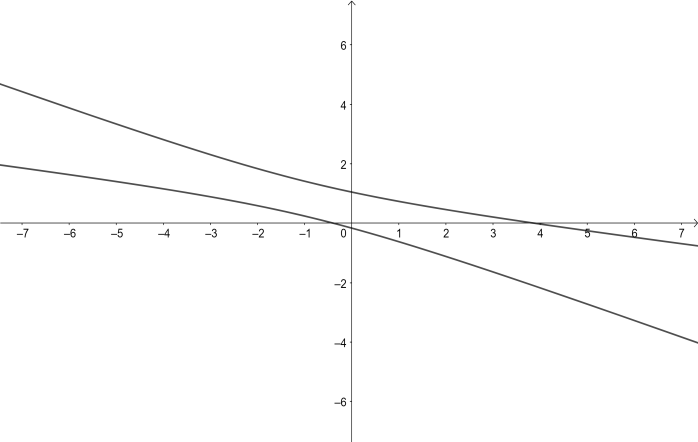
Now, as $\Delta \ne 0$ and ${{h}^{2}}>ab$, we conclude that the given equation is a hyperbola. The coordinates of the centre of the hyperbola are $(0,0)$. The coordinates of the vertices are $(a,0)$ and $(-a,0)$, that is, $(4,0)$ and $(-4,0)$. The eccentricity is given by the following formula, $e=\sqrt{\dfrac{{{a}^{2}}+{{b}^{2}}}{{{a}^{2}}}}$ . Substituting the values of $a$ and $b$, we get the following,
$e=\sqrt{\dfrac{{{(4)}^{2}}+{{(35)}^{2}}}{{{(4)}^{2}}}}=\sqrt{\dfrac{16+1225}{16}}=\sqrt{\dfrac{1241}{16}}=\sqrt{77.5625}=8.807$.
The coordinates of the foci are $(\pm ae,0)$, that is $(\pm 35.228,0)$. The graph that we get by plotting the given equation is as follows,
Note:
The values of $\Delta $, ${{h}^{2}}$ and $ab$ help us in determining which conics section is being represented by the given equation. If $\Delta =0$, they are a pair of straight lines. If $\Delta \ne 0,a=b$ and $h=0$, then it is a circle. If $\Delta \ne 0$ and ${{h}^{2}}=ab$, then it is a parabola. If $\Delta \ne 0$ and ${{h}^{2}}ab$, then it is a hyperbola.
Complete step by step answer:
The given equation is $4{{x}^{2}}+27xy+35{{y}^{2}}-14x-31y-6=0$. The general equation of second degree is $a{{x}^{2}}+2hxy+b{{y}^{2}}+2gx+2fy+c=0$. Comparing these two equations, we get the following values, $a=4$, $b=35$, $c=-6$, $h=\dfrac{27}{2}$, $f=\dfrac{-31}{2}$ and $g=-7$.
We have $\Delta =abc+2fgh-a{{f}^{2}}-b{{g}^{2}}-c{{h}^{2}}$. Now, we will substitute the values we have in $\Delta $. We get the following equation,
$\Delta =(4\times 35\times -6)+2\left( \dfrac{-31}{2}\times -7\times \dfrac{27}{2} \right)-4\times {{\left( \dfrac{-31}{2} \right)}^{2}}-35\times {{\left( -7 \right)}^{2}}+6\times {{\left( \dfrac{27}{2} \right)}^{2}}$
Simplifying this equation, we get
$\begin{align}
& \Delta =-840+2929.5-961-1715+1093.5 \\
& =507
\end{align}$
Next, we calculate ${{h}^{2}}$ and $ab$. So we have, ${{h}^{2}}={{\left( \dfrac{27}{2} \right)}^{2}}=\dfrac{729}{4}=182.25$ and $ab=4\times 35=140$.
Now, as $\Delta \ne 0$ and ${{h}^{2}}>ab$, we conclude that the given equation is a hyperbola. The coordinates of the centre of the hyperbola are $(0,0)$. The coordinates of the vertices are $(a,0)$ and $(-a,0)$, that is, $(4,0)$ and $(-4,0)$. The eccentricity is given by the following formula, $e=\sqrt{\dfrac{{{a}^{2}}+{{b}^{2}}}{{{a}^{2}}}}$ . Substituting the values of $a$ and $b$, we get the following,
$e=\sqrt{\dfrac{{{(4)}^{2}}+{{(35)}^{2}}}{{{(4)}^{2}}}}=\sqrt{\dfrac{16+1225}{16}}=\sqrt{\dfrac{1241}{16}}=\sqrt{77.5625}=8.807$.
The coordinates of the foci are $(\pm ae,0)$, that is $(\pm 35.228,0)$. The graph that we get by plotting the given equation is as follows,
Note:
The values of $\Delta $, ${{h}^{2}}$ and $ab$ help us in determining which conics section is being represented by the given equation. If $\Delta =0$, they are a pair of straight lines. If $\Delta \ne 0,a=b$ and $h=0$, then it is a circle. If $\Delta \ne 0$ and ${{h}^{2}}=ab$, then it is a parabola. If $\Delta \ne 0$ and ${{h}^{2}}
Recently Updated Pages
Master Class 11 Business Studies: Engaging Questions & Answers for Success

Master Class 11 Economics: Engaging Questions & Answers for Success
Master Class 11 Computer Science: Engaging Questions & Answers for Success
Master Class 11 English: Engaging Questions & Answers for Success
Master Class 11 Maths: Engaging Questions & Answers for Success
Master Class 11 Biology: Engaging Questions & Answers for Success
Trending doubts
One Metric ton is equal to kg A 10000 B 1000 C 100 class 11 physics CBSE
Discuss the various forms of bacteria class 11 biology CBSE
Draw a diagram of a plant cell and label at least eight class 11 biology CBSE
State the laws of reflection of light
Explain zero factorial class 11 maths CBSE
10 examples of friction in our daily life