




TP and TQ are tangents to the parabola and the normals at P and Q meet at a point R on the curve ; prove that the centre of the circle circumscribing the triangle TPQ lies on the parabola $2{{y}^{2}}=a\left( x-a \right)$\[\]
Answer
 Verified
584.4k+ views
Hint: We know that the parametric form of any point of the general parabola ${{y}^{2}}=4ax$ is $\left( a{{t}^{2}},2at \right)$. We assume $P\left( {{x}_{1}},{{y}_{1}} \right)$ and $Q\left( {{x}_{2}},{{y}_{2}} \right)$ ad find $T\left( {{x}_{3}},{{y}_{3}} \right)$ in a parametric form and find the equation of the chord using two-point form $ax+by+c=0$. We use the equation of circle $\left( x-{{x}_{1}} \right)\left( x-{{x}_{1}} \right)+\left( y-{{y}_{1}} \right)\left( y-{{y}_{2}} \right)+m\left( ax+by+c \right)=0$ and compare the center of the circle to the center $\left( h,k \right)$. We establish a relation between $h,k$ to find the locus. \[\]
Complete step by step answer:
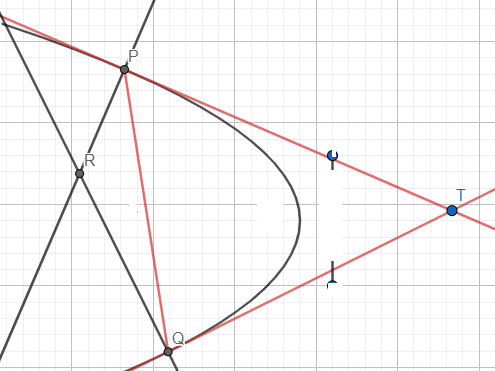
We are given in the question that TP and TQ are tangents to the parabola and the normals at P and Q meet at a point R on the curve. We are asked to prove that the center of the circle circumscribing the triangle TPQ lies on the parabola$2{{y}^{2}}=a\left( x-a \right)$.
We know the parametric form of any point of the general parabola ${{y}^{2}}=4ax$ is $\left( a{{t}^{2}},2at \right)$ ad where $t$ is the varying parameter .
We assign the co-ordinates of the point of contact P and Q as $P\left( a{{t}_{1}}^{2},2a{{t}_{1}} \right)$ and $Q\left( a{{t}_{2}}^{2},2a{{t}_{2}} \right)$ . We know that the point of intersection of tangents drawn at $P\left( a{{t}_{1}}^{2},2a{{t}_{1}} \right)$ and $Q\left( a{{t}_{2}}^{2},2a{{t}_{2}} \right)$ is $\left( a{{t}_{1}}{{t}_{2}},a\left( {{t}_{1}}+{{t}_{2}} \right) \right)$which is the co-ordinates of T. Let us denote the centre of the circle as $\left( h,k \right)$ and we have find its locus. \[\]
We use two-point form and find the equation of the chord PQ as
\[\begin{align}
& y-2a{{t}_{2}}=\dfrac{2a\left( {{t}_{2}}-{{t}_{1}} \right)}{{{t}_{2}}^{2}-{{t}_{1}}^{2}} \\
& \Rightarrow \left( {{t}_{1}}+{{t}_{2}} \right)\left( y-2a{{t}_{1}} \right)=2a\left( x-a{{t}_{1}}^{2} \right) \\
& \Rightarrow 2x-\left( {{t}_{1}}+{{t}_{2}} \right)y+2a{{t}_{1}}{{t}_{2}}=0 \\
\end{align}\]
We know that the equation of circle though parametric points $P\left( a{{t}_{1}}^{2},2a{{t}_{1}} \right)$ ,$Q\left( a{{t}_{2}}^{2},2a{{t}_{2}} \right)$ and the chord $2x-\left( {{t}_{1}}+{{t}_{2}} \right)y+2a{{t}_{1}}{{t}_{2}}=0$ is given by
\[\left( x-a{{t}_{1}}^{2} \right)\left( x-a{{t}_{2}}^{2} \right)+\left( y-2a{{t}_{1}} \right)\left( y-2a{{t}_{2}} \right)+m\left( 2x-\left( {{t}_{1}}+{{t}_{2}} \right)y+2a{{t}_{1}}{{t}_{2}} \right)=0...(1)\]
where $m$ is ay constant. We know that $T\left( a{{t}_{1}}{{t}_{2}},a\left( {{t}_{1}}+{{t}_{2}} \right) \right)$ lies in the above circle and so we put T in above equation and get
$m=-a\left( {{t}_{1}}{{t}_{2}}+1 \right)$
We simplify equation(1) and get ,
\[{{x}^{2}}+{{y}^{2}}-x\left( a{{t}_{1}}^{2}+a{{t}_{2}}^{2}-2m \right)-y\left( 2a{{t}_{1}}+2a{{t}_{2}}+\left( {{t}_{1}}+{{t}_{2}} \right)m \right)+{{a}^{2}}{{t}_{1}}^{2}{{t}_{2}}^{2}+4{{a}^{2}}{{t}_{1}}{{t}_{2}}+2a{{t}_{1}}{{t}_{2}}k=0\]
We compare the above equation with general equation of circle ${{x}^{2}}+{{y}^{2}}+2gx+2fy+c=0$ and compare the centre as $\left( -g,-f \right)$ with denoted centre $\left( h,k \right)$. We use the value of $m=-a\left( {{t}_{1}}{{t}_{2}}+1 \right)$ and compare the abscissas to have
\[\begin{align}
& 2h=a{{t}_{1}}^{2}+a{{t}_{2}}^{2}-2m \\
& \Rightarrow 2h=a{{t}_{1}}^{2}+a{{t}_{2}}^{2}-2\left( -a\left( {{t}_{1}}{{t}_{2}}+1 \right) \right) \\
& \Rightarrow 2h=a{{\left( {{t}_{1}}+{{t}_{2}} \right)}^{2}}+2a...(2) \\
\end{align}\]
Similarly we compare the ordinates to have,
\[\begin{align}
& 2k=2a{{t}_{1}}+2a{{t}_{2}}+\left( {{t}_{1}}+{{t}_{2}} \right)m \\
& \Rightarrow 2k=2a{{t}_{1}}+2a{{t}_{2}}+\left( {{t}_{1}}+{{t}_{2}} \right)\left( -a\left( {{t}_{1}}{{t}_{2}}+1 \right) \right) \\
& \Rightarrow 2k=a\left( 2\left( {{t}_{1}}+{{t}_{2}} \right)-3\left( {{t}_{1}}+{{t}_{2}} \right) \right) \\
& \Rightarrow 2k=-a\left( {{t}_{1}}+{{t}_{2}} \right) \\
& \Rightarrow {{t}_{1}}+{{t}_{2}}=\dfrac{-2k}{a} \\
\end{align}\]
We put the above value in equation (2) to get,
\[\begin{align}
& 2h=a{{\left( \dfrac{-2k}{a} \right)}^{2}}+2a \\
& \Rightarrow 2ah=4{{k}^{2}}+2{{a}^{2}} \\
& \Rightarrow 2{{k}^{2}}=a\left( h-a \right) \\
\end{align}\]
So the locus of $\left( h,k \right)$ is
$2{{y}^{2}}=a\left( x-a \right)$\[\]
Note:
The general equation of any parabola is ${{y}^{2}}=4ax$ and the equation of tangent at any point on the parabola is given by $y=mx+\dfrac{a}{m}$. The equation of tangent at any point $\left( {{x}_{1}},{{y}_{1}} \right)$ is $y{{y}_{1}}=2a\left( x+{{x}_{1}} \right)$
Complete step by step answer:
We are given in the question that TP and TQ are tangents to the parabola and the normals at P and Q meet at a point R on the curve. We are asked to prove that the center of the circle circumscribing the triangle TPQ lies on the parabola$2{{y}^{2}}=a\left( x-a \right)$.
We know the parametric form of any point of the general parabola ${{y}^{2}}=4ax$ is $\left( a{{t}^{2}},2at \right)$ ad where $t$ is the varying parameter .
We assign the co-ordinates of the point of contact P and Q as $P\left( a{{t}_{1}}^{2},2a{{t}_{1}} \right)$ and $Q\left( a{{t}_{2}}^{2},2a{{t}_{2}} \right)$ . We know that the point of intersection of tangents drawn at $P\left( a{{t}_{1}}^{2},2a{{t}_{1}} \right)$ and $Q\left( a{{t}_{2}}^{2},2a{{t}_{2}} \right)$ is $\left( a{{t}_{1}}{{t}_{2}},a\left( {{t}_{1}}+{{t}_{2}} \right) \right)$which is the co-ordinates of T. Let us denote the centre of the circle as $\left( h,k \right)$ and we have find its locus. \[\]
We use two-point form and find the equation of the chord PQ as
\[\begin{align}
& y-2a{{t}_{2}}=\dfrac{2a\left( {{t}_{2}}-{{t}_{1}} \right)}{{{t}_{2}}^{2}-{{t}_{1}}^{2}} \\
& \Rightarrow \left( {{t}_{1}}+{{t}_{2}} \right)\left( y-2a{{t}_{1}} \right)=2a\left( x-a{{t}_{1}}^{2} \right) \\
& \Rightarrow 2x-\left( {{t}_{1}}+{{t}_{2}} \right)y+2a{{t}_{1}}{{t}_{2}}=0 \\
\end{align}\]
We know that the equation of circle though parametric points $P\left( a{{t}_{1}}^{2},2a{{t}_{1}} \right)$ ,$Q\left( a{{t}_{2}}^{2},2a{{t}_{2}} \right)$ and the chord $2x-\left( {{t}_{1}}+{{t}_{2}} \right)y+2a{{t}_{1}}{{t}_{2}}=0$ is given by
\[\left( x-a{{t}_{1}}^{2} \right)\left( x-a{{t}_{2}}^{2} \right)+\left( y-2a{{t}_{1}} \right)\left( y-2a{{t}_{2}} \right)+m\left( 2x-\left( {{t}_{1}}+{{t}_{2}} \right)y+2a{{t}_{1}}{{t}_{2}} \right)=0...(1)\]
where $m$ is ay constant. We know that $T\left( a{{t}_{1}}{{t}_{2}},a\left( {{t}_{1}}+{{t}_{2}} \right) \right)$ lies in the above circle and so we put T in above equation and get
$m=-a\left( {{t}_{1}}{{t}_{2}}+1 \right)$
We simplify equation(1) and get ,
\[{{x}^{2}}+{{y}^{2}}-x\left( a{{t}_{1}}^{2}+a{{t}_{2}}^{2}-2m \right)-y\left( 2a{{t}_{1}}+2a{{t}_{2}}+\left( {{t}_{1}}+{{t}_{2}} \right)m \right)+{{a}^{2}}{{t}_{1}}^{2}{{t}_{2}}^{2}+4{{a}^{2}}{{t}_{1}}{{t}_{2}}+2a{{t}_{1}}{{t}_{2}}k=0\]
We compare the above equation with general equation of circle ${{x}^{2}}+{{y}^{2}}+2gx+2fy+c=0$ and compare the centre as $\left( -g,-f \right)$ with denoted centre $\left( h,k \right)$. We use the value of $m=-a\left( {{t}_{1}}{{t}_{2}}+1 \right)$ and compare the abscissas to have
\[\begin{align}
& 2h=a{{t}_{1}}^{2}+a{{t}_{2}}^{2}-2m \\
& \Rightarrow 2h=a{{t}_{1}}^{2}+a{{t}_{2}}^{2}-2\left( -a\left( {{t}_{1}}{{t}_{2}}+1 \right) \right) \\
& \Rightarrow 2h=a{{\left( {{t}_{1}}+{{t}_{2}} \right)}^{2}}+2a...(2) \\
\end{align}\]
Similarly we compare the ordinates to have,
\[\begin{align}
& 2k=2a{{t}_{1}}+2a{{t}_{2}}+\left( {{t}_{1}}+{{t}_{2}} \right)m \\
& \Rightarrow 2k=2a{{t}_{1}}+2a{{t}_{2}}+\left( {{t}_{1}}+{{t}_{2}} \right)\left( -a\left( {{t}_{1}}{{t}_{2}}+1 \right) \right) \\
& \Rightarrow 2k=a\left( 2\left( {{t}_{1}}+{{t}_{2}} \right)-3\left( {{t}_{1}}+{{t}_{2}} \right) \right) \\
& \Rightarrow 2k=-a\left( {{t}_{1}}+{{t}_{2}} \right) \\
& \Rightarrow {{t}_{1}}+{{t}_{2}}=\dfrac{-2k}{a} \\
\end{align}\]
We put the above value in equation (2) to get,
\[\begin{align}
& 2h=a{{\left( \dfrac{-2k}{a} \right)}^{2}}+2a \\
& \Rightarrow 2ah=4{{k}^{2}}+2{{a}^{2}} \\
& \Rightarrow 2{{k}^{2}}=a\left( h-a \right) \\
\end{align}\]
So the locus of $\left( h,k \right)$ is
$2{{y}^{2}}=a\left( x-a \right)$\[\]
Note:
The general equation of any parabola is ${{y}^{2}}=4ax$ and the equation of tangent at any point on the parabola is given by $y=mx+\dfrac{a}{m}$. The equation of tangent at any point $\left( {{x}_{1}},{{y}_{1}} \right)$ is $y{{y}_{1}}=2a\left( x+{{x}_{1}} \right)$
Recently Updated Pages
Master Class 10 Computer Science: Engaging Questions & Answers for Success

Master Class 10 General Knowledge: Engaging Questions & Answers for Success
Master Class 10 English: Engaging Questions & Answers for Success
Master Class 10 Social Science: Engaging Questions & Answers for Success
Master Class 10 Maths: Engaging Questions & Answers for Success
Master Class 10 Science: Engaging Questions & Answers for Success
Trending doubts
What is the median of the first 10 natural numbers class 10 maths CBSE
Which women's tennis player has 24 Grand Slam singles titles?
Who is the Brand Ambassador of Incredible India?
Why is there a time difference of about 5 hours between class 10 social science CBSE
Write a letter to the principal requesting him to grant class 10 english CBSE
A moving boat is observed from the top of a 150 m high class 10 maths CBSE