



TP and TQ are any two tangents to a parabola and the tangent at a third point R cuts them in P’ and Q’; Prove that:
$\dfrac{TP'}{TP}+\dfrac{TQ'}{TQ}=1$
Answer
 Verified
621.3k+ views
Hint: Use parametric form of representation for representing the coordinates of a point on the parabola, ${{y}^{2}}=4ax$ (Standard equation of a parabola). Write the coordinates of P, Q and R in parametric form, since according to question P, Q and R lies on the parabola.
Now, use the section formula to get the ratios $\dfrac{TP'}{TP}and\dfrac{TQ'}{TQ}$ and then add them to get the result.
Complete step-by-step answer:
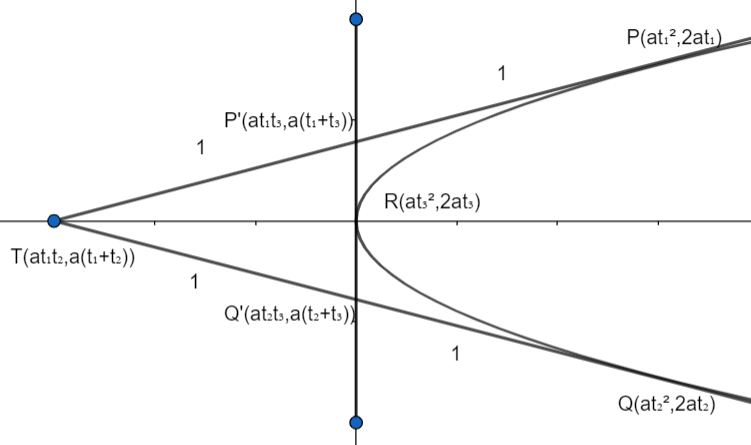
The parametric representation of the coordinates of a point on the parabola${{y}^{2}}=4ax$ is $\left( a{{t}^{2}},2at \right)$.
According to the question, point P, Q and R lies on the parabola.
TP is the tangent at point P.
TQ is the tangent at point Q.
P’Q’ is the tangent at point R.
We know that if tangent to the parabola ${{y}^{2}}=4ax$ cuts at point $\left( a{{t}^{2}},2at \right)$, then equation tangent is given by $ty=x+a{{t}^{2}}$
Let, coordinates of P be $\left( a{{t}_{1}}^{2},2a{{t}_{1}} \right)$
So, equation of tangent on parabola at point P will be ${{t}_{1}}y=x+a{{t}_{1}}^{2}$
Coordinates of Q be $\left( a{{t}_{2}}^{2},2a{{t}_{2}} \right)$
So, equation of tangent on parabola at point Q will be ${{t}_{2}}y=x+a{{t}_{2}}^{2}$
Coordinates of R be $\left( a{{t}_{3}}^{2},2a{{t}_{3}} \right)$
So, equation of tangent on parabola at point R will be ${{t}_{3}}y=x+a{{t}_{3}}^{2}$
Since, point of intersection of the tangents at the point ${{t}_{1}}\ and\ {{t}_{2}}\ is\text{ }T\ \left[ a{{t}_{1}}{{t}_{2}},a\left( {{t}_{1}}+{{t}_{2}} \right) \right]$.
Similarly, point of intersection of the tangents at the point ${{t}_{2}}\ and\ {{t}_{3}}\ isQ'\ \left[ a{{t}_{2}}{{t}_{3}},a\left( {{t}_{2}}+{{t}_{3}} \right) \right]$.
Similarly, point of intersection of the tangents at the point ${{t}_{1}}\ and\ {{t}_{3}}\ isP'\ \left[ a{{t}_{1}}{{t}_{3}},a\left( {{t}_{1}}+{{t}_{3}} \right) \right]$.
Hence, coordinates of $T=\left[ a{{t}_{1}}{{t}_{2}},a\left( {{t}_{1}}+{{t}_{2}} \right) \right]$
Coordinates of $P'=\left[ a{{t}_{3}}{{t}_{1}},a\left( {{t}_{3}}+{{t}_{1}} \right) \right]$
Coordinates of $Q'=\left[ a{{t}_{3}}{{t}_{2}},a\left( {{t}_{3}}+{{t}_{2}} \right) \right]$
Section formula: The coordinates of a point dividing a line joining the points $A\left( {{x}_{1}},{{y}_{1}} \right)\ and\ B\left( {{x}_{2}},{{y}_{2}} \right)$ in the ratio m:n is given by,
$\left( \dfrac{m{{x}_{2}}+n{{x}_{1}}}{m+n},\dfrac{m{{y}_{2}}+n{{y}_{1}}}{m+n} \right)$
Let, the ratio constant be $\lambda $ ,
i.e.
$\begin{align}
& \dfrac{TP'}{TP}=\dfrac{\lambda }{1}............\left( 1 \right)=\dfrac{TQ'}{TQ} \\
& Now,\ \lambda =\dfrac{{{t}_{3}}-{{t}_{2}}}{{{t}_{1}}-{{t}_{2}}}=\dfrac{TP'}{TP}.......\left( 1 \right) \\
\end{align}$
(Using section formula, as $TP':TP=\lambda :1$ )
Hence,
$\begin{align}
& P'\left\{ a{{t}_{1}}{{t}_{3}},a\left( {{t}_{1}}+{{t}_{3}} \right) \right\}=\dfrac{\lambda \left( P \right)+1\left( T \right)}{\lambda +1} \\
& Similarly, \\
& \dfrac{TQ'}{TQ}=\dfrac{{{t}_{1}}-{{t}_{3}}}{{{t}_{1}}-{{t}_{2}}}.............\left( 2 \right)\left\{ \begin{matrix}
\text{since},TQ':TQ=\lambda :1 \\
Q'a{{t}_{3}}{{t}_{2}},a\left( {{t}_{2}}+{{t}_{3}} \right) \\
=\dfrac{\lambda \left( Q \right)+1\left( T \right)}{\lambda +1} \\
\end{matrix} \right. \\
\end{align}$
Now, Adding equation (1) and (2), we get,
\[\begin{align}
& \dfrac{TP'}{TP}+\dfrac{TQ'}{TQ}=\dfrac{{{t}_{3}}-{{t}_{2}}}{{{t}_{1}}-{{t}_{2}}}+\dfrac{{{t}_{1}}-{{t}_{3}}}{{{t}_{1}}-{{t}_{2}}} \\
& \dfrac{TP'}{TP}+\dfrac{TQ'}{TQ}=\dfrac{{{t}_{3}}-{{t}_{2}}+{{t}_{1}}-{{t}_{3}}}{{{t}_{1}}-{{t}_{2}}} \\
& \dfrac{TP'}{TP}+\dfrac{TQ'}{TQ}=\dfrac{{{t}_{1}}-{{t}_{2}}}{{{t}_{1}}-{{t}_{2}}} \\
& \dfrac{TP'}{TP}+\dfrac{TQ'}{TQ}=1 \\
\end{align}\]
Note: Students can make mistakes here by finding the distance TP, TP’, TQ and TQ’ using distance formula after writing coordinates of points P, Q, P’, Q’ and T using parametric form. But students need to find the ratio $\dfrac{TP'}{TP}and\dfrac{TQ'}{TQ}$. Hence, they need to find this ratio using the section formula, by taking the (assuming) ratio constant $\lambda $.
Now, use the section formula to get the ratios $\dfrac{TP'}{TP}and\dfrac{TQ'}{TQ}$ and then add them to get the result.
Complete step-by-step answer:
The parametric representation of the coordinates of a point on the parabola${{y}^{2}}=4ax$ is $\left( a{{t}^{2}},2at \right)$.
According to the question, point P, Q and R lies on the parabola.
TP is the tangent at point P.
TQ is the tangent at point Q.
P’Q’ is the tangent at point R.
We know that if tangent to the parabola ${{y}^{2}}=4ax$ cuts at point $\left( a{{t}^{2}},2at \right)$, then equation tangent is given by $ty=x+a{{t}^{2}}$
Let, coordinates of P be $\left( a{{t}_{1}}^{2},2a{{t}_{1}} \right)$
So, equation of tangent on parabola at point P will be ${{t}_{1}}y=x+a{{t}_{1}}^{2}$
Coordinates of Q be $\left( a{{t}_{2}}^{2},2a{{t}_{2}} \right)$
So, equation of tangent on parabola at point Q will be ${{t}_{2}}y=x+a{{t}_{2}}^{2}$
Coordinates of R be $\left( a{{t}_{3}}^{2},2a{{t}_{3}} \right)$
So, equation of tangent on parabola at point R will be ${{t}_{3}}y=x+a{{t}_{3}}^{2}$
Since, point of intersection of the tangents at the point ${{t}_{1}}\ and\ {{t}_{2}}\ is\text{ }T\ \left[ a{{t}_{1}}{{t}_{2}},a\left( {{t}_{1}}+{{t}_{2}} \right) \right]$.
Similarly, point of intersection of the tangents at the point ${{t}_{2}}\ and\ {{t}_{3}}\ isQ'\ \left[ a{{t}_{2}}{{t}_{3}},a\left( {{t}_{2}}+{{t}_{3}} \right) \right]$.
Similarly, point of intersection of the tangents at the point ${{t}_{1}}\ and\ {{t}_{3}}\ isP'\ \left[ a{{t}_{1}}{{t}_{3}},a\left( {{t}_{1}}+{{t}_{3}} \right) \right]$.
Hence, coordinates of $T=\left[ a{{t}_{1}}{{t}_{2}},a\left( {{t}_{1}}+{{t}_{2}} \right) \right]$
Coordinates of $P'=\left[ a{{t}_{3}}{{t}_{1}},a\left( {{t}_{3}}+{{t}_{1}} \right) \right]$
Coordinates of $Q'=\left[ a{{t}_{3}}{{t}_{2}},a\left( {{t}_{3}}+{{t}_{2}} \right) \right]$
Section formula: The coordinates of a point dividing a line joining the points $A\left( {{x}_{1}},{{y}_{1}} \right)\ and\ B\left( {{x}_{2}},{{y}_{2}} \right)$ in the ratio m:n is given by,
$\left( \dfrac{m{{x}_{2}}+n{{x}_{1}}}{m+n},\dfrac{m{{y}_{2}}+n{{y}_{1}}}{m+n} \right)$
Let, the ratio constant be $\lambda $ ,
i.e.
$\begin{align}
& \dfrac{TP'}{TP}=\dfrac{\lambda }{1}............\left( 1 \right)=\dfrac{TQ'}{TQ} \\
& Now,\ \lambda =\dfrac{{{t}_{3}}-{{t}_{2}}}{{{t}_{1}}-{{t}_{2}}}=\dfrac{TP'}{TP}.......\left( 1 \right) \\
\end{align}$
(Using section formula, as $TP':TP=\lambda :1$ )
Hence,
$\begin{align}
& P'\left\{ a{{t}_{1}}{{t}_{3}},a\left( {{t}_{1}}+{{t}_{3}} \right) \right\}=\dfrac{\lambda \left( P \right)+1\left( T \right)}{\lambda +1} \\
& Similarly, \\
& \dfrac{TQ'}{TQ}=\dfrac{{{t}_{1}}-{{t}_{3}}}{{{t}_{1}}-{{t}_{2}}}.............\left( 2 \right)\left\{ \begin{matrix}
\text{since},TQ':TQ=\lambda :1 \\
Q'a{{t}_{3}}{{t}_{2}},a\left( {{t}_{2}}+{{t}_{3}} \right) \\
=\dfrac{\lambda \left( Q \right)+1\left( T \right)}{\lambda +1} \\
\end{matrix} \right. \\
\end{align}$
Now, Adding equation (1) and (2), we get,
\[\begin{align}
& \dfrac{TP'}{TP}+\dfrac{TQ'}{TQ}=\dfrac{{{t}_{3}}-{{t}_{2}}}{{{t}_{1}}-{{t}_{2}}}+\dfrac{{{t}_{1}}-{{t}_{3}}}{{{t}_{1}}-{{t}_{2}}} \\
& \dfrac{TP'}{TP}+\dfrac{TQ'}{TQ}=\dfrac{{{t}_{3}}-{{t}_{2}}+{{t}_{1}}-{{t}_{3}}}{{{t}_{1}}-{{t}_{2}}} \\
& \dfrac{TP'}{TP}+\dfrac{TQ'}{TQ}=\dfrac{{{t}_{1}}-{{t}_{2}}}{{{t}_{1}}-{{t}_{2}}} \\
& \dfrac{TP'}{TP}+\dfrac{TQ'}{TQ}=1 \\
\end{align}\]
Note: Students can make mistakes here by finding the distance TP, TP’, TQ and TQ’ using distance formula after writing coordinates of points P, Q, P’, Q’ and T using parametric form. But students need to find the ratio $\dfrac{TP'}{TP}and\dfrac{TQ'}{TQ}$. Hence, they need to find this ratio using the section formula, by taking the (assuming) ratio constant $\lambda $.
Recently Updated Pages
Master Class 11 English: Engaging Questions & Answers for Success

Master Class 11 Social Science: Engaging Questions & Answers for Success
Master Class 11 Maths: Engaging Questions & Answers for Success
Master Class 11 Chemistry: Engaging Questions & Answers for Success
Master Class 11 Biology: Engaging Questions & Answers for Success
Master Class 11 Physics: Engaging Questions & Answers for Success
Trending doubts
One Metric ton is equal to kg A 10000 B 1000 C 100 class 11 physics CBSE
Difference Between Prokaryotic Cells and Eukaryotic Cells
Find the value of the expression given below sin 30circ class 11 maths CBSE
1 ton equals to A 100 kg B 1000 kg C 10 kg D 10000 class 11 physics CBSE
Two of the body parts which do not appear in MRI are class 11 biology CBSE
Draw a diagram of nephron and explain its structur class 11 biology CBSE