




Total number of lone pair of electrons in ${\text{XeO}}{{\text{F}}_{\text{4}}}$ is:
(A)- 0
(B)- 1
(C)- 2
(D)- 3
Answer
 Verified
582.3k+ views
Hint: For calculating the number of lone pairs of electrons in any compound, first we have to know about the atomic number and electronic configuration of all the atoms present in that compound so that we will ensure the bonding between them.
Complete answer:
In the above given compound ${\text{XeO}}{{\text{F}}_{\text{4}}}$, xenon is the central atom as it is electropositive or less electronegative among oxygen and fluorine. For the calculation of lone pair of electron in ${\text{XeO}}{{\text{F}}_{\text{4}}}$ we will follow the following points:
-Atomic number of oxygen is 8 & its electronic configuration is written as ${\text{1}}{{\text{s}}^{\text{2}}}{\text{,2}}{{\text{s}}^{\text{2}}}{\text{2}}{{\text{p}}^{\text{4}}}$ and from this it is clear that oxygen has total 6 valence electrons.
-Atomic number of fluorine is 9 & its electronic configuration is written as ${\text{1}}{{\text{s}}^{\text{2}}}{\text{,2}}{{\text{s}}^{\text{2}}}{\text{2}}{{\text{p}}^5}$ and from this it is clear that oxygen has total 7 valence electrons.
-Atomic number of xenon is 54 & its electronic configuration is written as $\left[ {{\text{Kr}}} \right]{\text{4}}{{\text{d}}^{{\text{10}}}}{\text{5}}{{\text{s}}^{\text{2}}}{\text{5}}{{\text{p}}^{\text{6}}}$ and from this it is clear that xenon has total 8 valence electrons. Among these 8 electrons 6 are used by the xenon for binding with fluorine and oxygen atoms in the following manner and remaining two electrons are present in the form of lone pair.
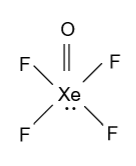
So in ${\text{XeO}}{{\text{F}}_{\text{4}}}$ one lone pair of electrons is present.
Hence, option (B) is correct.
Note:
Here some of you may do wrong if you count all the lone pairs of electrons of each atom present in the compound, because in this type of compound only lone pairs of central atoms are important, not of all atoms.
Complete answer:
In the above given compound ${\text{XeO}}{{\text{F}}_{\text{4}}}$, xenon is the central atom as it is electropositive or less electronegative among oxygen and fluorine. For the calculation of lone pair of electron in ${\text{XeO}}{{\text{F}}_{\text{4}}}$ we will follow the following points:
-Atomic number of oxygen is 8 & its electronic configuration is written as ${\text{1}}{{\text{s}}^{\text{2}}}{\text{,2}}{{\text{s}}^{\text{2}}}{\text{2}}{{\text{p}}^{\text{4}}}$ and from this it is clear that oxygen has total 6 valence electrons.
-Atomic number of fluorine is 9 & its electronic configuration is written as ${\text{1}}{{\text{s}}^{\text{2}}}{\text{,2}}{{\text{s}}^{\text{2}}}{\text{2}}{{\text{p}}^5}$ and from this it is clear that oxygen has total 7 valence electrons.
-Atomic number of xenon is 54 & its electronic configuration is written as $\left[ {{\text{Kr}}} \right]{\text{4}}{{\text{d}}^{{\text{10}}}}{\text{5}}{{\text{s}}^{\text{2}}}{\text{5}}{{\text{p}}^{\text{6}}}$ and from this it is clear that xenon has total 8 valence electrons. Among these 8 electrons 6 are used by the xenon for binding with fluorine and oxygen atoms in the following manner and remaining two electrons are present in the form of lone pair.
So in ${\text{XeO}}{{\text{F}}_{\text{4}}}$ one lone pair of electrons is present.
Hence, option (B) is correct.
Note:
Here some of you may do wrong if you count all the lone pairs of electrons of each atom present in the compound, because in this type of compound only lone pairs of central atoms are important, not of all atoms.
Recently Updated Pages
Master Class 12 Economics: Engaging Questions & Answers for Success

Master Class 12 English: Engaging Questions & Answers for Success
Master Class 12 Social Science: Engaging Questions & Answers for Success
Master Class 12 Maths: Engaging Questions & Answers for Success
Master Class 12 Physics: Engaging Questions & Answers for Success
Master Class 9 General Knowledge: Engaging Questions & Answers for Success
Trending doubts
One Metric ton is equal to kg A 10000 B 1000 C 100 class 11 physics CBSE
Difference Between Prokaryotic Cells and Eukaryotic Cells
Two of the body parts which do not appear in MRI are class 11 biology CBSE
1 ton equals to A 100 kg B 1000 kg C 10 kg D 10000 class 11 physics CBSE
10 examples of friction in our daily life
DNA is not present in A Nucleus B Mitochondria C Chloroplast class 11 biology CBSE