




Torsion and detorsion are exceptional to which of the following phylum?
A. Mollusca
B. Echinodermata
C. Annelida
D. All of the above
Answer
 Verified
633.3k+ views
Hint: Torsion and detorsion are the features of the second-largest phylum of invertebrates having a peculiar shell enclosed body that occurs during the developmental stages of the members belonging to this phylum.
Complete answer:
Tension is the twisted rotation of the organs of mollusks in an anticlockwise direction through a 180° angle during the development of larva. The exact opposite of this phenomenon is called detorsion.
Additional Information:
-The process of torsion occurs in gastropods (mollusks) where the symmetric larva is converted into an asymmetrical adult.
-The body of mollusks is divided into three parts: visceral mass, mantle, and shell.
-All three parts of the body are rotated at 180 degrees according to the head and foot.
-The rotation will result in the arrangement of mantle and anus in the anterior position which is above the head.
-Torsion will result in asymmetrical growth as one side will be larger while others will be smaller.
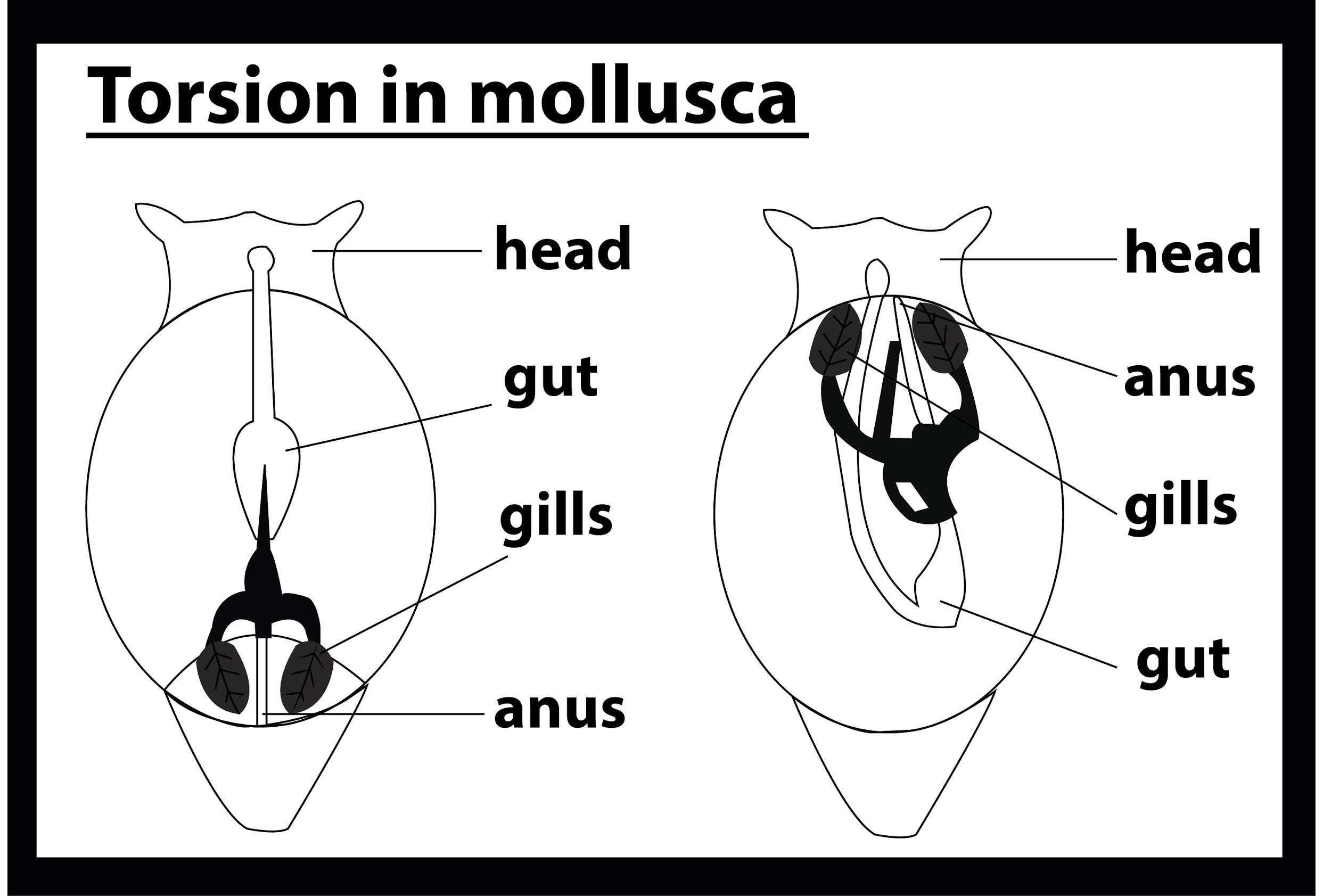
-This process hells in the protection and growth of the organisms.
-The distortion resumes the symmetrical growth in some of the mollusks.
-Distortion occurs when the shell is lost completely or is reduced much.
So, the correct answer is ‘Mollusca'.
Note: Mollusca is the largest phylum comprising marine animals. The word mollusk is derived from the French word mollusque and the Latin word mollis meaning ‘soft’. Echinoderms are marine animals including seas urchins, starfish, etc. The word Echinodermata is derived from the Greek word echinos meaning ‘hedgehog' and derma meaning ‘skin’. Annelida is a phylum of a ring or segmented worms. The word Annelida is derived from the Latin word annellus meaning ‘little ring’.
Complete answer:
Tension is the twisted rotation of the organs of mollusks in an anticlockwise direction through a 180° angle during the development of larva. The exact opposite of this phenomenon is called detorsion.
Additional Information:
-The process of torsion occurs in gastropods (mollusks) where the symmetric larva is converted into an asymmetrical adult.
-The body of mollusks is divided into three parts: visceral mass, mantle, and shell.
-All three parts of the body are rotated at 180 degrees according to the head and foot.
-The rotation will result in the arrangement of mantle and anus in the anterior position which is above the head.
-Torsion will result in asymmetrical growth as one side will be larger while others will be smaller.
-This process hells in the protection and growth of the organisms.
-The distortion resumes the symmetrical growth in some of the mollusks.
-Distortion occurs when the shell is lost completely or is reduced much.
So, the correct answer is ‘Mollusca'.
Note: Mollusca is the largest phylum comprising marine animals. The word mollusk is derived from the French word mollusque and the Latin word mollis meaning ‘soft’. Echinoderms are marine animals including seas urchins, starfish, etc. The word Echinodermata is derived from the Greek word echinos meaning ‘hedgehog' and derma meaning ‘skin’. Annelida is a phylum of a ring or segmented worms. The word Annelida is derived from the Latin word annellus meaning ‘little ring’.
Recently Updated Pages
Master Class 11 English: Engaging Questions & Answers for Success

Master Class 11 Social Science: Engaging Questions & Answers for Success
Master Class 11 Maths: Engaging Questions & Answers for Success
Master Class 11 Biology: Engaging Questions & Answers for Success
Master Class 11 Physics: Engaging Questions & Answers for Success
Master Class 11 Chemistry: Engaging Questions & Answers for Success
Trending doubts
One Metric ton is equal to kg A 10000 B 1000 C 100 class 11 physics CBSE
Difference Between Prokaryotic Cells and Eukaryotic Cells
Two of the body parts which do not appear in MRI are class 11 biology CBSE
Find the value of the expression given below sin 30circ class 11 maths CBSE
Draw a diagram of a plant cell and label at least eight class 11 biology CBSE
10 examples of friction in our daily life