



What is tonoplast?
(a) Outer membrane of mitochondria
(b) Inner membrane of the chloroplast
(c) Membrane boundary of the vacuole of plant cells
(d) Cell membrane of a plant cell
Answer
 Verified
637.8k+ views
Complete answer:
The tonoplast is a single membrane that connects and separates the vacuoles from the cytoplasm. Tonoplasts promote the uphill movement of many ions and other materials in plants, allowing their vacuole concentration higher than the cytoplasm. The membrane-bound space located in the cytoplasm is the vacuole.
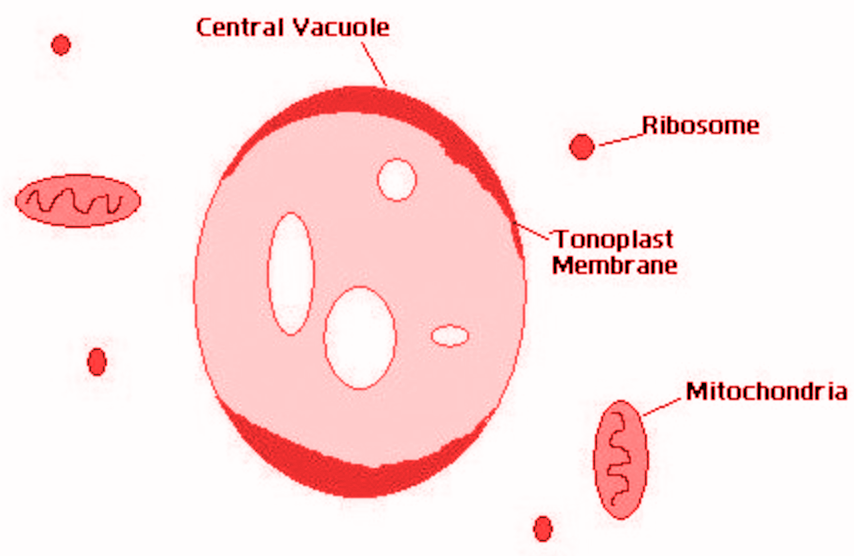
We get the name from the Greek word 'tonoplast,' which means 'tension, stretching, and molded.' On the vacuole, the tonoplast retains tension. This helps to give some sort of structure to the vacuole. It also helps to maintain proper nutrient and ion balance within and outside the vacuole, thereby maintaining proper turgor pressure in the cell of the plant.
The 'vacuolar membrane' is also known as Tonoplast.
So, the correct answer is, ‘Membrane boundary of the vacuole of plant cells’.
Additional information:
Mitochondria's outer membrane consists of porin proteins and the stroma is the chloroplast's inner membrane. A tonoplast is not the cell membrane of a plant cell. It is a basic biological / unit membrane present in any cellular organism.
All plant and fungal cells contain vacuoles whereas the vacuoles of animal cells are smaller in size. Most bacteria cells have vacuoles.
The vacuole is often considered as the largest organelle in the cell. A smaller version of a membrane-bound vacuole, many of which can converge to make a vacuole is called a vesicle.
Note: As animal cells have no central vacuole, the tonoplast is unique to plant cells. A tonoplast is a bilayer of lipids, representative of other cell membranes. The tonoplast is also semi-permeable. This implies that it can move through some molecules and substrates, but others cannot. This allows a balance of ions inside and outside the central vacuole to be preserved by the tonoplast.
Recently Updated Pages
Master Class 11 Maths: Engaging Questions & Answers for Success

Master Class 11 Economics: Engaging Questions & Answers for Success
Master Class 11 Biology: Engaging Questions & Answers for Success
Class 11 Question and Answer - Your Ultimate Solutions Guide
Master Class 11 English: Engaging Questions & Answers for Success
Master Class 11 Social Science: Engaging Questions & Answers for Success
Trending doubts
Difference Between Prokaryotic Cells and Eukaryotic Cells
Find the value of the expression given below sin 30circ class 11 maths CBSE
One Metric ton is equal to kg A 10000 B 1000 C 100 class 11 physics CBSE
Two of the body parts which do not appear in MRI are class 11 biology CBSE
10 examples of friction in our daily life
Draw a diagram of nephron and explain its structur class 11 biology CBSE