



To which phylum do sponges belong?
Answer
 Verified
646.2k+ views
Hint: Sponges defined as sessile metazoans. The organisms of this phylum have channels and pores in their body that allows water to circulate through them.
Complete answer:
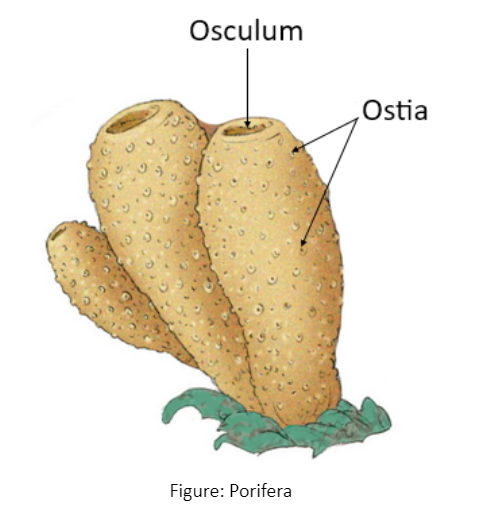
Sponges belong to phylum Porifera. Below are given a few characteristics of Phylum Porifera:
- They are asymmetrical, meaning any plane that passes through their surface does not divide them into half.
- Primitive multicellular organisms, with the cellular level of organization, cells are arranged as loose cell aggregates.
- Sponges can remould their bodies. Most of the cells of sponges can move within their bodies and few can change from one type to another.
- Canal system is present, through which water and food are transferred and waste is removed. Water enters through small pores called Ostia, reaches the central cavity called spongocoel and leaves through the osculum.
- They are hermaphrodites, that is sexes are not separated.
- Reproduce asexually by fragmentation and sexually through gamete formation.
- They are known as non-chordates due to the absence of a notochord.
- The body of sponges consists of a non-living jelly-like mass that sandwiched between two main layers of cells.
- Archaeocytes are totipotent in nature they can be transformed from one cell to another type of cell. These cells are also known as amoebocytes.
Examples of Sponges are - Sycon, Spongilla, Euspongia.
Note:
-Choanocytes are collar cells that align the spongocoel.
-The Skeleton of Porifera is made up of spicules or spongin fiber.
-They undergo internal fertilization and a larva stage is achieved, which is very distinct from the adult.
Complete answer:
Sponges belong to phylum Porifera. Below are given a few characteristics of Phylum Porifera:
- They are asymmetrical, meaning any plane that passes through their surface does not divide them into half.
- Primitive multicellular organisms, with the cellular level of organization, cells are arranged as loose cell aggregates.
- Sponges can remould their bodies. Most of the cells of sponges can move within their bodies and few can change from one type to another.
- Canal system is present, through which water and food are transferred and waste is removed. Water enters through small pores called Ostia, reaches the central cavity called spongocoel and leaves through the osculum.
- They are hermaphrodites, that is sexes are not separated.
- Reproduce asexually by fragmentation and sexually through gamete formation.
- They are known as non-chordates due to the absence of a notochord.
- The body of sponges consists of a non-living jelly-like mass that sandwiched between two main layers of cells.
- Archaeocytes are totipotent in nature they can be transformed from one cell to another type of cell. These cells are also known as amoebocytes.
Examples of Sponges are - Sycon, Spongilla, Euspongia.
Note:
-Choanocytes are collar cells that align the spongocoel.
-The Skeleton of Porifera is made up of spicules or spongin fiber.
-They undergo internal fertilization and a larva stage is achieved, which is very distinct from the adult.
Recently Updated Pages
Basicity of sulphurous acid and sulphuric acid are

Master Class 12 Economics: Engaging Questions & Answers for Success
Master Class 12 Biology: Engaging Questions & Answers for Success
Master Class 11 English: Engaging Questions & Answers for Success
Master Class 11 Physics: Engaging Questions & Answers for Success
Master Class 11 Computer Science: Engaging Questions & Answers for Success
Trending doubts
Difference Between Plant Cell and Animal Cell
Fill the blanks with the suitable prepositions 1 The class 9 english CBSE
What is pollution? How many types of pollution? Define it
What is the full form of pH?
What is the Full Form of ICSE, CBSE and SSC
Name 10 Living and Non living things class 9 biology CBSE