




To what height should a cylindrical vessel be filled with a homogenous liquid to make the force with which the liquid pressure on the sides of the vessel equal to the force exerted by liquid on the bottom of the vessel?
[A] Equal to the radius
[B] Less than radius
[C] More than radius
[D] Four times of radius
Answer
 Verified
575.1k+ views
Hint: In order to solve this question we need to understand buoyancy force and the pressure exerted by liquid. Whenever any object is pressed inside water then it replaces liquid around it, so water exerts an upward force on the object, this force is known as buoyant force. Pressure exerted by liquid is mathematically defined as the product of density of liquid, acceleration due to gravity and height of the water column above it.
Complete answer:
Let the radius of cylindrical vessel be, $ r $ and height of liquid to be filled is $ h $
Also let the density of water be $ \rho $
So. The mass of water is defined as, $ M = \rho V $
Here, V is volume of water
We know volume of water in form of cylindrical vessel is, $ V = \pi {r^2}h $
So the mass is, $ M = \pi \rho {r^2}h $
So the force exerted on bottom of vessel is, $ W = Mg $
Putting values we get, $ W = \pi \rho {r^2}gh \to (i) $
Let $ dx $ be elemental length of water at distance of $ x $ from above, as shown in figure
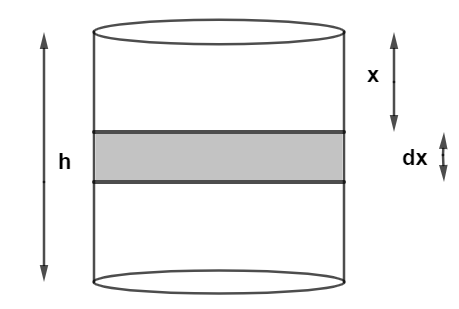
So the pressure exerted by liquid on side of vessel would be, $ P = \rho gx $
Let the elemental area be $ dA $ and it is equal to, $ dA = 2\pi rdx $
So, elemental force exerted by water on side of vessel is, $ dF = PdA $
Putting values we get, $ dF = (\rho gx)(2\pi rdx) $
$ dF = 2\pi \rho rgxdx $
Integrating we get, $ F = 2\pi \rho rg{\int_0^h {xdx} ^2} $
$ F = 2\pi \rho rg{\left[ {\dfrac{{{x^2}}}{2}} \right]^h}_0 $
$ F = \pi \rho rgh $
So now we equate both the force on sides of vessel and due to liquid column on bottom of vessel, $ W = F $
Putting values we get, $ \pi \rho {r^2}hg = \pi \rho r{h^2}g $
$ h = r $
So the correct option is, [A] Equal to the radius.
Note:
It should be remembered that, here we assumed that the liquid is of uniform density. Also the limit on “x” is from $ 0 $ to h. Also here we have used the elemental concept because we need to find what is the force exerted by whole water at the side of a vessel, so we calculated the elemental force due to one column and then later integrated it for the whole water vessel.
Complete answer:
Let the radius of cylindrical vessel be, $ r $ and height of liquid to be filled is $ h $
Also let the density of water be $ \rho $
So. The mass of water is defined as, $ M = \rho V $
Here, V is volume of water
We know volume of water in form of cylindrical vessel is, $ V = \pi {r^2}h $
So the mass is, $ M = \pi \rho {r^2}h $
So the force exerted on bottom of vessel is, $ W = Mg $
Putting values we get, $ W = \pi \rho {r^2}gh \to (i) $
Let $ dx $ be elemental length of water at distance of $ x $ from above, as shown in figure
So the pressure exerted by liquid on side of vessel would be, $ P = \rho gx $
Let the elemental area be $ dA $ and it is equal to, $ dA = 2\pi rdx $
So, elemental force exerted by water on side of vessel is, $ dF = PdA $
Putting values we get, $ dF = (\rho gx)(2\pi rdx) $
$ dF = 2\pi \rho rgxdx $
Integrating we get, $ F = 2\pi \rho rg{\int_0^h {xdx} ^2} $
$ F = 2\pi \rho rg{\left[ {\dfrac{{{x^2}}}{2}} \right]^h}_0 $
$ F = \pi \rho rgh $
So now we equate both the force on sides of vessel and due to liquid column on bottom of vessel, $ W = F $
Putting values we get, $ \pi \rho {r^2}hg = \pi \rho r{h^2}g $
$ h = r $
So the correct option is, [A] Equal to the radius.
Note:
It should be remembered that, here we assumed that the liquid is of uniform density. Also the limit on “x” is from $ 0 $ to h. Also here we have used the elemental concept because we need to find what is the force exerted by whole water at the side of a vessel, so we calculated the elemental force due to one column and then later integrated it for the whole water vessel.
Recently Updated Pages
Which will be the least stable resonating structure class 11 chemistry CBSE

How many 5 digit telephone numbers can be construc-class-11-maths-CBSE
How do you find the angle of the resultant vector class 11 physics CBSE
Draw labelled diagram of the following i Gram seed class 11 biology CBSE
1 Quintal is equal to a 110 kg b 10 kg c 100kg d 1000 class 11 physics CBSE
What is the need and importance of classification class 11 biology CBSE
Trending doubts
Find the value of the expression given below sin 30circ class 11 maths CBSE
One Metric ton is equal to kg A 10000 B 1000 C 100 class 11 physics CBSE
10 examples of friction in our daily life
Draw a diagram of a plant cell and label at least eight class 11 biology CBSE
Difference between physical and chemical change class 11 chemistry CBSE
Proton was discovered by A Thomson B Rutherford C Chadwick class 11 chemistry CBSE