




To make the following reduction process spontaneous, temperature should be:
$ ZnO\, + \,C\,\xrightarrow{\Delta }\,Zn\, + \,CO $
(A) $ < 1000{\,^ \circ }\,C $
(B) $ > 1000{\,^ \circ }\,C $
(C) $ < 500{\,^ \circ }\,C $
(D) $ > 500{\,^ \circ }C\,but\, < \,{1000^ \circ }C $
Answer
 Verified
607.2k+ views
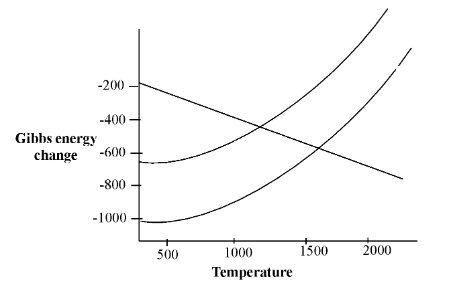
Hint :This is Ellingham diagram in which spontaneity of any reaction is predicted using graph lines and temperature conditions. So, here see which graph lines are above and then place perpendicular lines along x and y axis by which we get to know the temperature conditions. As it was asked for a zinc reaction with oxygen see its graph line.
Complete Step By Step Answer:
Here, as you see that the graph lines are given for a particular reaction. There are three types of reactions in the graph, first is the reaction of carbon with oxygen which will form the carbon monoxide having negative slope. In the second reaction, zinc is reacting with oxygen to give zinc oxide and the third one is the reaction of magnesium with oxygen giving magnesium oxide.
In Ellingham diagram questions you have to see the positive slope of the zinc reaction and thus as it is cutting carbon monoxide graph lines thus we should be able to make a feasible process above $ > 1000{\,^ \circ }\,C $ .
For spontaneous reactions which are feasible must have their Gibbs energy sign as negative, so for the conversion of zinc into zinc oxide is feasible spontaneous process when the reaction gets temperature above $ > 1000{\,^ \circ }\,C $ this kind of high temperature is provided by blast furnace.
Note :
We are seeing conversion of magnesium into magnesium oxide line also have positive graph slope hence if we try to find its temperature by where it becomes a spontaneous process, the temperature should be greater than $ 1500{\,^ \circ }\,C $ according to the Ellingham diagram, you will find it when you see that it is intercepting by line of carbon monoxide.
Complete Step By Step Answer:
Here, as you see that the graph lines are given for a particular reaction. There are three types of reactions in the graph, first is the reaction of carbon with oxygen which will form the carbon monoxide having negative slope. In the second reaction, zinc is reacting with oxygen to give zinc oxide and the third one is the reaction of magnesium with oxygen giving magnesium oxide.
In Ellingham diagram questions you have to see the positive slope of the zinc reaction and thus as it is cutting carbon monoxide graph lines thus we should be able to make a feasible process above $ > 1000{\,^ \circ }\,C $ .
For spontaneous reactions which are feasible must have their Gibbs energy sign as negative, so for the conversion of zinc into zinc oxide is feasible spontaneous process when the reaction gets temperature above $ > 1000{\,^ \circ }\,C $ this kind of high temperature is provided by blast furnace.
Note :
We are seeing conversion of magnesium into magnesium oxide line also have positive graph slope hence if we try to find its temperature by where it becomes a spontaneous process, the temperature should be greater than $ 1500{\,^ \circ }\,C $ according to the Ellingham diagram, you will find it when you see that it is intercepting by line of carbon monoxide.
Recently Updated Pages
If x a + bt + ct2 where x is in meters and t is in class 11 physics CBSE

A car covers the first half distance between two places class 11 physics CBSE
The resultant of two vectors overrightarrow P and overrightarrow class 11 physics CBSE
Find the value of cos 135 class 11 maths CBSE
A mass M is held in place by an applied force F and class 11 physics CBSE
A solution of glucose in water is labelled as 10 dfracwv class 11 chemistry CBSE
Trending doubts
One Metric ton is equal to kg A 10000 B 1000 C 100 class 11 physics CBSE
Find the value of the expression given below sin 30circ class 11 maths CBSE
Draw a diagram of nephron and explain its structur class 11 biology CBSE
10 examples of friction in our daily life
Proton was discovered by A Thomson B Rutherford C Chadwick class 11 chemistry CBSE
Bond order ofO2 O2+ O2 and O22 is in order A O2 langle class 11 chemistry CBSE