




To get from one office to another, one travels as follows (with all angles measured clockwise from the west) $2m$ at $180{}^\circ $, $0.5m$ at $150{}^\circ $, and $1m$ at $30{}^\circ $. How far will a person be from his starting point? (in m)
$\begin{align}
& A)1.5m \\
& B)1.74m \\
& C)1m \\
& D)1.96m \\
\end{align}$
Answer
 Verified
576.3k+ views
Hint: For finding the distance of the person from the starting point, we have to take distances travelled in each direction by the person in vector form. Then we will draw a diagram by taking x-axis as east-west and y-axis as North West. After finding the final point of the person, we will take the difference in distance from his starting point which will give us the answer.
Complete answer:
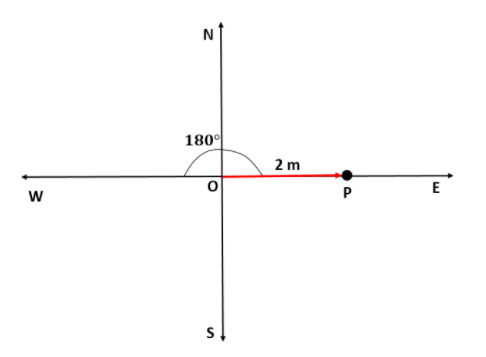
Initially, let us draw a diagram by taking x-axis as east-west and y-axis as North West. Here, +x- axis is taken as east, -x-axis is taken as west, +y-axis is taken as north and –y-axis is taken as south.
Now, let us assume that the person's starting point is O, which is the origin and he was moving $2m$ at $180{}^\circ $ from west. That is, he will be moving in the east direction. Let that point be P.
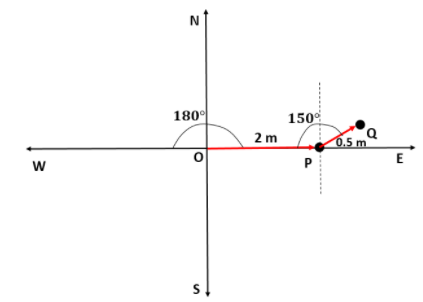
Now, the person is at P and moves $0.5m$ at $150{}^\circ $ from his west. So, he will be moving in the north-east direction. Let that point be Q.
Now, the person is at Q and moves $1m$ at $30{}^\circ $ from his west. So, he will be moving in the north-west direction. Let that point be R.
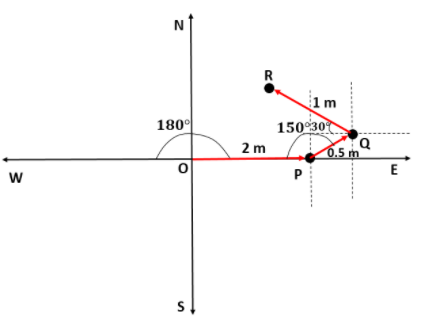
Now, we will find the coordinates of R.
Distance travelled in +x direction = $2\widehat{i}$
Distance moved in north-east direction = $0.5\cos \left( 30{}^\circ \right)\widehat{i}+0.5\sin \left( 30{}^\circ \right)\widehat{j}$
Since, $180{}^\circ -150{}^\circ =30{}^\circ $
Distance moved in north-west direction = $1\sin \left( 60{}^\circ \right)\widehat{i}+1\cos \left( 60{}^\circ \right)\widehat{j}$
Since, the person is moving towards –x direction and +y direction and we are taking the angle in clockwise direction.
Now, the coordinates of final position (R) of the person will be,
\[\begin{align}
& R\left( x,y \right)=\left( 2+0.5\cos \left( 30 \right)-1sin\left( 60 \right) \right)\widehat{i}+\left( 0.5\sin \left( 30 \right)+1\cos \left( 60 \right) \right)\widehat{j} \\
& \Rightarrow R\left( x,y \right)=\left( 2+\dfrac{\sqrt{3}}{4}-\dfrac{\sqrt{3}}{2} \right)\widehat{i}+\left( \dfrac{1}{4}+\dfrac{1}{2} \right)\widehat{j} \\
& \Rightarrow R\left( x,y \right)=\left( 2-\dfrac{\sqrt{3}}{4} \right)\widehat{i}+\left( \dfrac{3}{4} \right)\widehat{j} \\
& \Rightarrow R\left( x,y \right)=\left( \dfrac{8-1.732}{4} \right)\widehat{i}+\left( \dfrac{3}{4} \right)\widehat{j}\text{ }\left( \because \sqrt{3}=1.7320 \right) \\
& \therefore R\left( x,y \right)=\left( 1.567 \right)\widehat{i}+\left( 0.75 \right)\widehat{j} \\
\end{align}\]
Now, the distance of the person from his starting position will be the hypotenuse of the triangle.
That is,
$\begin{align}
& O{{R}^{2}}={{x}^{2}}+{{y}^{2}} \\
& \Rightarrow O{{R}^{2}}={{\left( 1.567 \right)}^{2}}+{{\left( 0.75 \right)}^{2}} \\
& \Rightarrow O{{R}^{2}}=2.455489+0.5625 \\
& \Rightarrow O{{R}^{2}}\approx 3.016 \\
& \Rightarrow OR=\sqrt{3.016} \\
& \therefore OR=1.74m \\
\end{align}$
So, the person is $1.74m$ far from his starting point.
Therefore, option B is correct.
Note:
For solving this type of question, drawing a diagram is a must. Also, try to measure the angle in only one direction throughout the solution. Be precise with calculations. While taking components of a vector, take the adjacent component to the angle as cos and the other as sine.
Complete answer:
Initially, let us draw a diagram by taking x-axis as east-west and y-axis as North West. Here, +x- axis is taken as east, -x-axis is taken as west, +y-axis is taken as north and –y-axis is taken as south.
Now, let us assume that the person's starting point is O, which is the origin and he was moving $2m$ at $180{}^\circ $ from west. That is, he will be moving in the east direction. Let that point be P.
Now, the person is at P and moves $0.5m$ at $150{}^\circ $ from his west. So, he will be moving in the north-east direction. Let that point be Q.
Now, the person is at Q and moves $1m$ at $30{}^\circ $ from his west. So, he will be moving in the north-west direction. Let that point be R.
Now, we will find the coordinates of R.
Distance travelled in +x direction = $2\widehat{i}$
Distance moved in north-east direction = $0.5\cos \left( 30{}^\circ \right)\widehat{i}+0.5\sin \left( 30{}^\circ \right)\widehat{j}$
Since, $180{}^\circ -150{}^\circ =30{}^\circ $
Distance moved in north-west direction = $1\sin \left( 60{}^\circ \right)\widehat{i}+1\cos \left( 60{}^\circ \right)\widehat{j}$
Since, the person is moving towards –x direction and +y direction and we are taking the angle in clockwise direction.
Now, the coordinates of final position (R) of the person will be,
\[\begin{align}
& R\left( x,y \right)=\left( 2+0.5\cos \left( 30 \right)-1sin\left( 60 \right) \right)\widehat{i}+\left( 0.5\sin \left( 30 \right)+1\cos \left( 60 \right) \right)\widehat{j} \\
& \Rightarrow R\left( x,y \right)=\left( 2+\dfrac{\sqrt{3}}{4}-\dfrac{\sqrt{3}}{2} \right)\widehat{i}+\left( \dfrac{1}{4}+\dfrac{1}{2} \right)\widehat{j} \\
& \Rightarrow R\left( x,y \right)=\left( 2-\dfrac{\sqrt{3}}{4} \right)\widehat{i}+\left( \dfrac{3}{4} \right)\widehat{j} \\
& \Rightarrow R\left( x,y \right)=\left( \dfrac{8-1.732}{4} \right)\widehat{i}+\left( \dfrac{3}{4} \right)\widehat{j}\text{ }\left( \because \sqrt{3}=1.7320 \right) \\
& \therefore R\left( x,y \right)=\left( 1.567 \right)\widehat{i}+\left( 0.75 \right)\widehat{j} \\
\end{align}\]
Now, the distance of the person from his starting position will be the hypotenuse of the triangle.
That is,
$\begin{align}
& O{{R}^{2}}={{x}^{2}}+{{y}^{2}} \\
& \Rightarrow O{{R}^{2}}={{\left( 1.567 \right)}^{2}}+{{\left( 0.75 \right)}^{2}} \\
& \Rightarrow O{{R}^{2}}=2.455489+0.5625 \\
& \Rightarrow O{{R}^{2}}\approx 3.016 \\
& \Rightarrow OR=\sqrt{3.016} \\
& \therefore OR=1.74m \\
\end{align}$
So, the person is $1.74m$ far from his starting point.
Therefore, option B is correct.
Note:
For solving this type of question, drawing a diagram is a must. Also, try to measure the angle in only one direction throughout the solution. Be precise with calculations. While taking components of a vector, take the adjacent component to the angle as cos and the other as sine.
Recently Updated Pages
Master Class 11 Computer Science: Engaging Questions & Answers for Success

Master Class 11 Business Studies: Engaging Questions & Answers for Success
Master Class 11 Economics: Engaging Questions & Answers for Success
Master Class 11 English: Engaging Questions & Answers for Success
Master Class 11 Maths: Engaging Questions & Answers for Success
Master Class 11 Biology: Engaging Questions & Answers for Success
Trending doubts
One Metric ton is equal to kg A 10000 B 1000 C 100 class 11 physics CBSE
There are 720 permutations of the digits 1 2 3 4 5 class 11 maths CBSE
Discuss the various forms of bacteria class 11 biology CBSE
Draw a diagram of a plant cell and label at least eight class 11 biology CBSE
State the laws of reflection of light
Explain zero factorial class 11 maths CBSE