




How many tiles, each of area \[400{\text{ c}}{{\text{m}}^2}\], will be needed to pave a footpath which is \[2{\text{ m}}\] wide and surrounds a grass plot \[25{\text{ m}}\] long and \[13{\text{ m}}\] wide?
A. 4400
B. 3200
C. 4200
D. 4300
Answer
 Verified
594.9k+ views
Hint: First, find the area of the rectangular plot, then find the length and breadth of the outside rectangle using that find the area of the outside rectangle. Area of the footpath is equal to the difference of the area of the outside rectangle and the area of the rectangular plot, and to find the number of tiles we will divide the area of the footpath by the area of each tile.
Complete step by step answer:
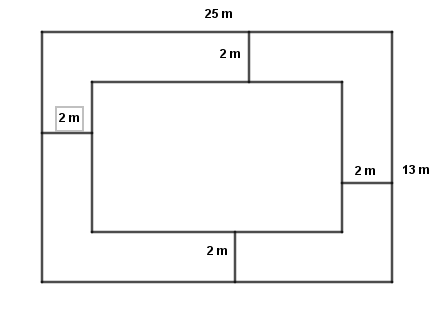
Given,
Length of the plot, L \[ = 25{\text{ m}}\]
Breadth of the plot, B \[ = 13{\text{ m}}\]
Area of the rectangular plot = L × B \[ = 25{\text{ m}} \times 13{\text{ m}} = 325{\text{ }}{{\text{m}}^2}\]
[Area of rectangle: Area of rectangle = Length × Breadth]
It is given that the path is 2 m wide; therefore, both the length and breadth of the outside rectangle will be increased by 4 m.
Length of outside rectangle, l\[ = 25 + 2 + 2 = 29{\text{ m}}\]
Breadth of outside rectangle, b \[ = 13 + 2 + 2 = 17{\text{ m}}\]
⇒ Area of outside rectangle = l × b \[ = 29{\text{ m}} \times 17{\text{ m}} = 493{\text{ }}{{\text{m}}^2}\]
[Area of rectangle: Area of rectangle = Length × Breadth]
Area of footpath = Area of outer rectangle – Area of inner rectangle
⇒ Area of foot path = 493 m2 – 325 m2 = 168 m2
We have, $1m^2 = 10000 cm^2$
Converting \[168{\text{ }}{{\text{m}}^2}\] to \[{\text{c}}{{\text{m}}^2}\]
We get, $168 m^2 = 1680000cm^2$
Area of one square tile \[ = 400{\text{ c}}{{\text{m}}^2}\]
Let n be the number of tiles, needed to pave the footpath.
Then, n × Area of one square tile = Area of footpath
Number of tiles, n\[ = \dfrac{{1680000}}{{400}} = 4200\]
Therefore, the number of tiles, each of area \[400{\text{ c}}{{\text{m}}^2}\], that will be needed to pave a footpath which is \[2{\text{ m}}\] wide and surrounds a grass plot \[25{\text{ m}}\] long and \[13{\text{ m}}\] wide is \[4200\].
So, the correct option is (C).
Note:
In these types of questions, first draw the figure to understand the problems geometrically. Also remember that conversion of units is an important part, and to find the number of tiles we will divide the area of the footpath by the area of each tile.
Complete step by step answer:
Given,
Length of the plot, L \[ = 25{\text{ m}}\]
Breadth of the plot, B \[ = 13{\text{ m}}\]
Area of the rectangular plot = L × B \[ = 25{\text{ m}} \times 13{\text{ m}} = 325{\text{ }}{{\text{m}}^2}\]
[Area of rectangle: Area of rectangle = Length × Breadth]
It is given that the path is 2 m wide; therefore, both the length and breadth of the outside rectangle will be increased by 4 m.
Length of outside rectangle, l\[ = 25 + 2 + 2 = 29{\text{ m}}\]
Breadth of outside rectangle, b \[ = 13 + 2 + 2 = 17{\text{ m}}\]
⇒ Area of outside rectangle = l × b \[ = 29{\text{ m}} \times 17{\text{ m}} = 493{\text{ }}{{\text{m}}^2}\]
[Area of rectangle: Area of rectangle = Length × Breadth]
Area of footpath = Area of outer rectangle – Area of inner rectangle
⇒ Area of foot path = 493 m2 – 325 m2 = 168 m2
We have, $1m^2 = 10000 cm^2$
Converting \[168{\text{ }}{{\text{m}}^2}\] to \[{\text{c}}{{\text{m}}^2}\]
We get, $168 m^2 = 1680000cm^2$
Area of one square tile \[ = 400{\text{ c}}{{\text{m}}^2}\]
Let n be the number of tiles, needed to pave the footpath.
Then, n × Area of one square tile = Area of footpath
Number of tiles, n\[ = \dfrac{{1680000}}{{400}} = 4200\]
Therefore, the number of tiles, each of area \[400{\text{ c}}{{\text{m}}^2}\], that will be needed to pave a footpath which is \[2{\text{ m}}\] wide and surrounds a grass plot \[25{\text{ m}}\] long and \[13{\text{ m}}\] wide is \[4200\].
So, the correct option is (C).
Note:
In these types of questions, first draw the figure to understand the problems geometrically. Also remember that conversion of units is an important part, and to find the number of tiles we will divide the area of the footpath by the area of each tile.
Recently Updated Pages
Master Class 10 Computer Science: Engaging Questions & Answers for Success

Master Class 10 General Knowledge: Engaging Questions & Answers for Success
Master Class 10 English: Engaging Questions & Answers for Success
Master Class 10 Social Science: Engaging Questions & Answers for Success
Master Class 10 Maths: Engaging Questions & Answers for Success
Master Class 10 Science: Engaging Questions & Answers for Success
Trending doubts
What is the median of the first 10 natural numbers class 10 maths CBSE
Which women's tennis player has 24 Grand Slam singles titles?
Who is the Brand Ambassador of Incredible India?
Why is there a time difference of about 5 hours between class 10 social science CBSE
Write a letter to the principal requesting him to grant class 10 english CBSE
A moving boat is observed from the top of a 150 m high class 10 maths CBSE