




Three vertices of a rhombus taken in order are \[\left( {2, - 1} \right),\left( {3,4} \right)\] and \[\left( { - 2,3} \right)\]. Find the fourth vertex.
Answer
 Verified
538.2k+ views
Hint: Here, in the given question, the three vertices of a rhombus are given and we are asked to find the fourth one. As we know that, rhombus has a special property that the diagonals of rhombus bisect each other. We will use this property and midpoint formula to get the required vertex of a rhombus.
Formula used:
Midpoint formula: If \[\left( {{x_1},{y_1}} \right)\] and \[\left( {{x_2},{y_2}} \right)\] are the two points joining a line segment, then the midpoint, say \[\left( {x,y} \right)\], of this line segment can be calculated by \[\left( {x,y} \right) = \left( {\dfrac{{{x_1} + {x_2}}}{2},\dfrac{{{y_1} + {y_2}}}{2}} \right)\].
Complete step-by-step solution:
Given, three vertices of rhombus \[A\left( {2, - 1} \right)\], \[B\left( {3,4} \right)\] and \[C\left( { - 2,3} \right)\].
Let the fourth vertex be \[D\left( {x,y} \right)\]
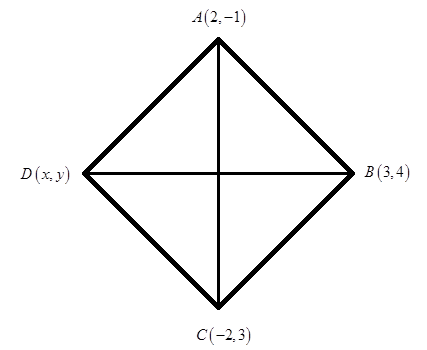
Now, we have, \[ABCD\] is a rhombus, where \[AB = BC = CD = AD\].
We know that the rhombus has a property that the diagonals of rhombus bisect each other perpendicularly. In the given rhombus,\[AC\] and \[BD\] are the diagonals.
If diagonal bisects each other, then the midpoint of the diagonals should be the same.
Using Midpoint formula,
Coordinates of midpoint of \[AC\]=\[\left( {\dfrac{{2 + \left( { - 2} \right)}}{2},\dfrac{{ - 1 + 3}}{2}} \right)\].
=\[\left( {0,1} \right)\]
Coordinates of midpoint of \[BD\]=\[\left( {\dfrac{{3 + x}}{2},\dfrac{{4 + y}}{2}} \right)\].
Since, midpoint of \[AC\] and \[BD\] is same, we conclude,
\[\left( {\dfrac{{3 + x}}{2},\dfrac{{4 + y}}{2}} \right) = \left( {0,1} \right)\]
\[ \Rightarrow \dfrac{{3 + x}}{2} = 0\]and\[\dfrac{{4 + y}}{2} = 1\]
\[ \Rightarrow x = - 3\] and \[y = - 2\]
Hence, the fourth vertex of the given rhombus is \[D\left( { - 3, - 2} \right)\].
Note: Alternatively, this question can also be solved using distance formula between two points.
Some properties of rhombus are:
> All the four sides of a rhombus are equal to one another.
> Opposite sides of a rhombus are parallel to each other.
> Opposite angles of rhombus are equal.
> Diagonals of a rhombus bisect each other perpendicularly.
> The adjacent angles of rhombus are supplementary.
using this property we can solve the problem easily.
Formula used:
Midpoint formula: If \[\left( {{x_1},{y_1}} \right)\] and \[\left( {{x_2},{y_2}} \right)\] are the two points joining a line segment, then the midpoint, say \[\left( {x,y} \right)\], of this line segment can be calculated by \[\left( {x,y} \right) = \left( {\dfrac{{{x_1} + {x_2}}}{2},\dfrac{{{y_1} + {y_2}}}{2}} \right)\].
Complete step-by-step solution:
Given, three vertices of rhombus \[A\left( {2, - 1} \right)\], \[B\left( {3,4} \right)\] and \[C\left( { - 2,3} \right)\].
Let the fourth vertex be \[D\left( {x,y} \right)\]
Now, we have, \[ABCD\] is a rhombus, where \[AB = BC = CD = AD\].
We know that the rhombus has a property that the diagonals of rhombus bisect each other perpendicularly. In the given rhombus,\[AC\] and \[BD\] are the diagonals.
If diagonal bisects each other, then the midpoint of the diagonals should be the same.
Using Midpoint formula,
Coordinates of midpoint of \[AC\]=\[\left( {\dfrac{{2 + \left( { - 2} \right)}}{2},\dfrac{{ - 1 + 3}}{2}} \right)\].
=\[\left( {0,1} \right)\]
Coordinates of midpoint of \[BD\]=\[\left( {\dfrac{{3 + x}}{2},\dfrac{{4 + y}}{2}} \right)\].
Since, midpoint of \[AC\] and \[BD\] is same, we conclude,
\[\left( {\dfrac{{3 + x}}{2},\dfrac{{4 + y}}{2}} \right) = \left( {0,1} \right)\]
\[ \Rightarrow \dfrac{{3 + x}}{2} = 0\]and\[\dfrac{{4 + y}}{2} = 1\]
\[ \Rightarrow x = - 3\] and \[y = - 2\]
Hence, the fourth vertex of the given rhombus is \[D\left( { - 3, - 2} \right)\].
Note: Alternatively, this question can also be solved using distance formula between two points.
Some properties of rhombus are:
> All the four sides of a rhombus are equal to one another.
> Opposite sides of a rhombus are parallel to each other.
> Opposite angles of rhombus are equal.
> Diagonals of a rhombus bisect each other perpendicularly.
> The adjacent angles of rhombus are supplementary.
using this property we can solve the problem easily.
Recently Updated Pages
Master Class 10 Social Science: Engaging Questions & Answers for Success

Master Class 10 Science: Engaging Questions & Answers for Success
Master Class 10 Maths: Engaging Questions & Answers for Success
Master Class 10 General Knowledge: Engaging Questions & Answers for Success
Master Class 10 Computer Science: Engaging Questions & Answers for Success
Class 10 Question and Answer - Your Ultimate Solutions Guide
Trending doubts
What is the full form of PNG A Petrol Natural Gas B class 10 chemistry CBSE
The power of the lens is 2D What is its focal length class 10 physics CBSE
Distinguish between the reserved forests and protected class 10 biology CBSE
Metals which do not react with dilute acids beginarray20l class 10 chemistry CBSE
If a trait A exists in 10 of a population of an asexually class 10 biology CBSE
Find the value of log sqrt 2 64 class 10 maths CBSE