




Three vectors $\vec{A},\,\vec{B}\,\text{and}\,\vec{C}$ satisfy the relation $\vec{A}.\vec{B}=0$ and $\vec{A}.\vec{C}=0$. To which of the following vectors, vector A is parallel to?
A. $\vec{B}.\vec{C}$
B. $\vec{B}$
C. $\vec{C}$
D. $\vec{B}\times \vec{C}$
Answer
 Verified
585.6k+ views
Hint: When two vectors are parallel to each other, their dot product is zero.
The resultant vector obtained by cross product of two vectors is perpendicular to both of the vectors.
Use these properties of dot product and cross product of vectors to obtain the result.
Complete step by step answer:
Dot product of two vectors is product of their magnitudes and cosine of angle between them. The resultant dot product is scalar. Therefore, it is also known as a scalar product. Mathematically, we can write scalar product of two vectors $\vec{a}$ and $\vec{b}$ as
$\vec{a}.\vec{b}=\,\left| {\vec{a}} \right|\left| {\vec{b}} \right|\cos \theta $
Where $\left| {\vec{a}} \right|$ and $\left| {\vec{b}} \right|$ is the magnitude of $\vec{a}$ and $\vec{b}$ respectively and $\theta $ is the angle between them.
If the dot product of any two vectors is zero, then either one of the vectors is zero or both vectors are perpendicular to each other.
According to the question, $\vec{A}.\vec{B}=0$ and $\vec{A}.\vec{C}=0$
Therefore, we can conclude that $\vec{A}$ is perpendicular to $\vec{B}$ and $\vec{A}$ is also perpendicular to $\vec{C}$. Mathematically,
$\vec{A}\bot \vec{B}$
$\vec{A}\bot \vec{C}$
The cross product of two vectors gives resultant vectors perpendicular to both the vectors.
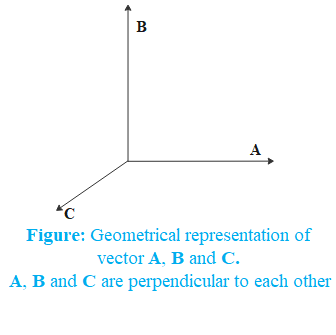
Therefore, resultant vector of cross product of vector B and vector C will be perpendicular to both vectors, B and C. Since vector A is also perpendicular to both the vectors B and C, it will lie in the same plane as the cross product $\vec{B}\times \vec{C}$.
From the above statement, we can conclude that $\vec{A}$ is parallel to $\vec{B}\times C$.
So, the correct answer is “Option D”.
Note: Dot product of two vectors is commutative i.e. $\vec{a}.\vec{b}=\vec{b}.\vec{a}=ab\cos \theta $.
Since any vector is parallel to itself, the dot product of a vector to itself is the magnitude squared of the vector i.e. ${{(\vec{a})}^{2}}=\vec{a}.\vec{a}=a.a.\cos (0)={{a}^{2}}$
The dot product also follows distributive law i.e. $\vec{a}.(\vec{b}+\vec{c})=\vec{a}.\vec{b}+\vec{a}.\vec{c}$
The resultant vector obtained by cross product of two vectors is perpendicular to both of the vectors.
Use these properties of dot product and cross product of vectors to obtain the result.
Complete step by step answer:
Dot product of two vectors is product of their magnitudes and cosine of angle between them. The resultant dot product is scalar. Therefore, it is also known as a scalar product. Mathematically, we can write scalar product of two vectors $\vec{a}$ and $\vec{b}$ as
$\vec{a}.\vec{b}=\,\left| {\vec{a}} \right|\left| {\vec{b}} \right|\cos \theta $
Where $\left| {\vec{a}} \right|$ and $\left| {\vec{b}} \right|$ is the magnitude of $\vec{a}$ and $\vec{b}$ respectively and $\theta $ is the angle between them.
If the dot product of any two vectors is zero, then either one of the vectors is zero or both vectors are perpendicular to each other.
According to the question, $\vec{A}.\vec{B}=0$ and $\vec{A}.\vec{C}=0$
Therefore, we can conclude that $\vec{A}$ is perpendicular to $\vec{B}$ and $\vec{A}$ is also perpendicular to $\vec{C}$. Mathematically,
$\vec{A}\bot \vec{B}$
$\vec{A}\bot \vec{C}$
The cross product of two vectors gives resultant vectors perpendicular to both the vectors.
Therefore, resultant vector of cross product of vector B and vector C will be perpendicular to both vectors, B and C. Since vector A is also perpendicular to both the vectors B and C, it will lie in the same plane as the cross product $\vec{B}\times \vec{C}$.
From the above statement, we can conclude that $\vec{A}$ is parallel to $\vec{B}\times C$.
So, the correct answer is “Option D”.
Note: Dot product of two vectors is commutative i.e. $\vec{a}.\vec{b}=\vec{b}.\vec{a}=ab\cos \theta $.
Since any vector is parallel to itself, the dot product of a vector to itself is the magnitude squared of the vector i.e. ${{(\vec{a})}^{2}}=\vec{a}.\vec{a}=a.a.\cos (0)={{a}^{2}}$
The dot product also follows distributive law i.e. $\vec{a}.(\vec{b}+\vec{c})=\vec{a}.\vec{b}+\vec{a}.\vec{c}$
Recently Updated Pages
Master Class 11 Computer Science: Engaging Questions & Answers for Success

Master Class 11 Business Studies: Engaging Questions & Answers for Success
Master Class 11 Economics: Engaging Questions & Answers for Success
Master Class 11 English: Engaging Questions & Answers for Success
Master Class 11 Maths: Engaging Questions & Answers for Success
Master Class 11 Biology: Engaging Questions & Answers for Success
Trending doubts
One Metric ton is equal to kg A 10000 B 1000 C 100 class 11 physics CBSE
There are 720 permutations of the digits 1 2 3 4 5 class 11 maths CBSE
Discuss the various forms of bacteria class 11 biology CBSE
Draw a diagram of a plant cell and label at least eight class 11 biology CBSE
State the laws of reflection of light
Explain zero factorial class 11 maths CBSE